
Suspicion of Suspension of $14 Billion Arms Sale to Taiwan: PLA's 16 Flights Around Taiwan Expose Attrition Warfare Window
 Li Minghui
Cloud of Uncertainty Over $14 Billion Arms Sale to Taiwan: PLA's 16 Flights Around Taiwan Expose Attrition Warfare Window
On May 22, this news may not seem significant, but it is easily underestimated. The Associated Press reported that Taiwan has stated it has not yet received notification from the United States regarding the suspension of a $14 billion arms sale; the same report also mentioned that the acting U.S. Secretary of the Navy said at a congressional hearing that some foreign arms sales are being paused to prioritize U.S. military ammunition needs in the Iran conflict. For Taipei, this is a diplomatic reassurance; for Beijing, it feels more like a result of a supply chain stress test.
What concerns me more is another number that occurred simultaneously: Taiwan's defense department announced on May 23 that from 6 AM to 6 AM the next day, the PLA conducted 16 military aircraft flights and 8 naval vessel activities around the Taiwan Strait, with 13 flights crossing the median line of the Strait and entering Taiwan's northern, central, southwestern, and eastern airspace. The previous day's data showed 6 military aircraft and 10 naval vessels. This is not a "single-day peak," but it indicates that the PLA is still applying pressure on Taiwan's air defense and maritime surveillance systems at a medium intensity and sustainable pace.
Military Implications of the Arms Sale Suspension
This $14 billion arms sale has not yet entered the actual delivery phase, and the $11 billion equipment package authorized by the Trump administration last December has also not progressed. In other words, Taiwan is not facing "a shortage of missiles today," but rather the pace of replenishment over the next 3 to 5 years may be extended. Many of Taiwan's anti-ship missiles, air defense munitions, shore-based mobile launchers, and unmanned reconnaissance systems are consumable-intensive equipment; during peacetime, one looks at parameters, but during wartime, one looks at inventory.
In simple terms, the military balance in the Taiwan Strait is shifting from "which platform is more advanced" to "who can sustain ammunition and maintenance chains better." If the PLA maintains daily flights of several to dozens of aircraft and several to over a dozen vessels operating in the offshore waters, Taiwan must scramble fighter jets, deploy vessels, activate radars, and keep shore-based missile systems on standby. These actions themselves do not initiate war, but they continuously consume flight hours, fuel, spare parts, and personnel energy.
The PLA's Advantage is Not Just Individual Equipment
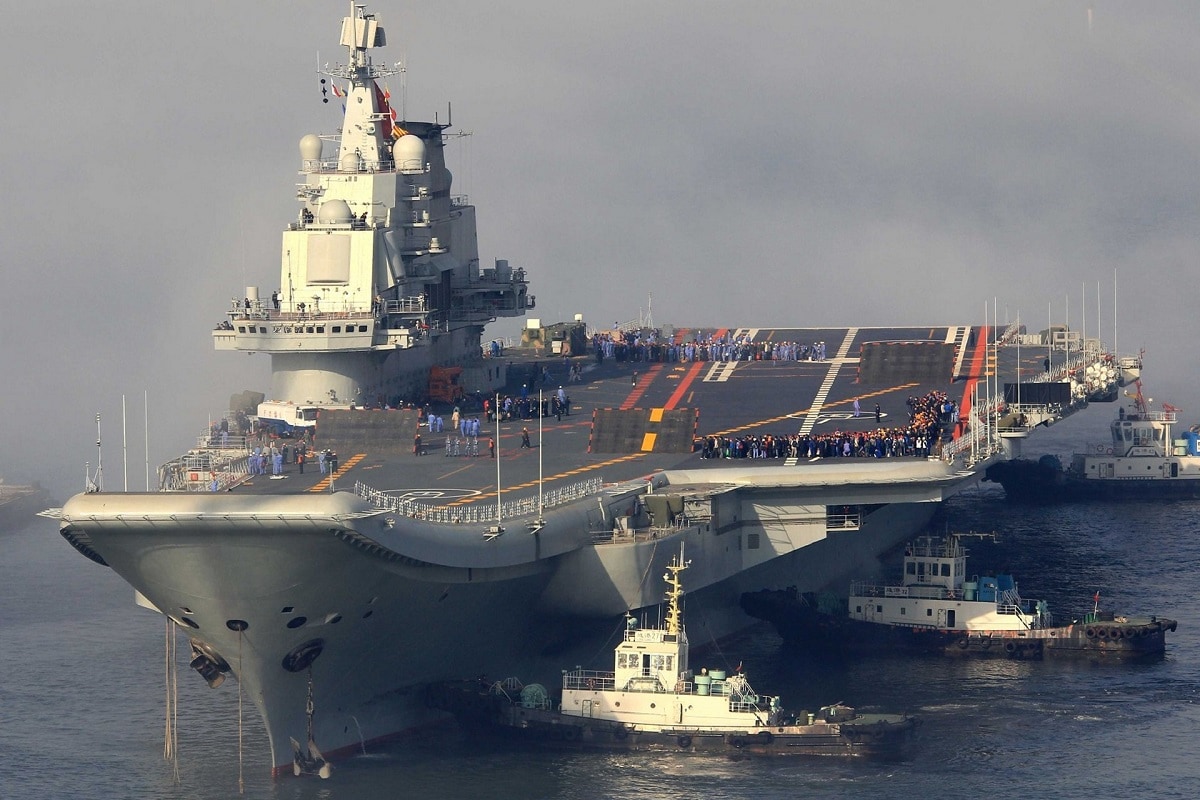
On May 19, the PLA Navy's Liaoning aircraft carrier group conducted training in the Western Pacific, with official statements including long-range tactical flights, live-fire exercises, support cover, and comprehensive rescue. In late April, the 076-class amphibious assault ship Sichuan also went to the South China Sea for cross-regional test training, testing multiple onboard systems and platform performance. When viewed alongside the daily activities around the Taiwan Strait, the PLA is not just showcasing a single aircraft carrier or a "drone carrier," but rather integrating large platforms, shore-based air forces, unmanned systems, and maritime police forces into the same timeline.
There is an easily overlooked detail: the routes announced by Taiwan on May 23 covered northern, central, southwestern, and eastern airspace. This multi-directional entry does not necessarily indicate complex tactical maneuvers, but it forces Taiwan's air defense command system to handle multiple sectors simultaneously. For the PLA, deploying 16 flights is not heavy; for Taiwan, each time it must assess whether these aircraft are routine patrols, electronic reconnaissance, anti-submarine coordination, or familiarizing themselves with routes for larger-scale operations.
Shortcomings are Also Being Exposed
However, this should not be interpreted as the PLA having completely resolved the issue of system warfare. The South China Morning Post cited an article from the PLA Daily on May 19, stating that some units still have deficiencies in human-machine integration, professional talent training, and human-machine collaboration, especially after the introduction of unmanned and intelligent equipment. If the technical capabilities of operators do not keep pace, the advantages of the equipment will be diminished. This reminder is very real. Domestic drones, robotic dogs, unmanned boats, and new types of onboard platforms are accelerating their entry into the military, and the challenge has shifted from "whether there are" to "whether they can collaborate in complex electromagnetic environments."
- Routine flights of aircraft and vessels around Taiwan test the consumption of Taiwan's military vigilance.
- The Liaoning's long-range training tests the sustained deployment and support capabilities of the carrier group.
- The Sichuan's cross-regional tests assess the integration of unmanned aerial platforms and amphibious platforms.
- The uncertainty of U.S. arms sales tests Taiwan's ammunition stockpiles and political patience.
My judgment is that Beijing does not need to wait for a specific batch of U.S. arms sales to be officially stalled before adjusting the pressure rhythm in the Taiwan Strait. It is more likely to take advantage of the window where U.S. ammunition is constrained by the Middle East to maintain activities around the Taiwan Strait in a range of "not reaching crisis, but consuming daily." This range is beneficial for PLA training and also helps to discover Taiwan's air defense response patterns.
The Real Issue Lies Beyond 2026
In the short term, whether the $14 billion arms sale is suspended still has political maneuvering room; in the long term, the issue lies in whether the U.S. industrial system can simultaneously meet ammunition demands in Europe, the Middle East, and the Indo-Pacific. How much equipment Taiwan can purchase ultimately depends on how much the U.S. can produce, who it is willing to prioritize, and whether it can deliver on time. This logic also applies to the PLA: while equipment displays are increasing, training, maintenance, ammunition, and personnel quality ultimately determine real combat effectiveness.
Therefore, what is most worth monitoring in the coming days is not whether there are 16 or 24 aircraft on a given day, but two more mundane numbers: how long Taiwan's interception and standby consumption can last, and how long the PLA can maintain the rhythm of joint operations across multiple services. The truly unanswered question is whether, if the pace of U.S. arms sales continues to be slowed by other battlefields, this attrition test in the Taiwan Strait will shift from a gray area to a more proactive military agenda in Beijing's hands.
Main sources: AP News, Taiwan's Defense Department May 23 PLA Dynamics, Taiwan's Defense Department May 22 PLA Dynamics, Xinhua News on Liaoning Carrier Group's Western Pacific Training, South China Morning Post report on PLA training shortcomings.
On May 22-23, 2023, the People's Liberation Army (PLA) conducted operations around Taiwan, involving 16 aircraft and 8 naval vessels, with 13 aircraft crossing the median line of the Taiwan Strait. This activity reflects ongoing military pressure on Taiwan amid uncertainties regarding a $14 billion U.S. arms sale. The PLA's operations are designed to test Taiwan's defense readiness and logistics capabilities.
- The U.S. has not officially notified Taiwan of a pause in a $14 billion arms sale.
- On May 23, the PLA conducted 16 aircraft and 8 naval vessel operations around Taiwan.
- 13 aircraft crossed the median line of the Taiwan Strait, indicating sustained military pressure on Taiwan.
- The PLA's operations are aimed at testing Taiwan's defense capabilities and logistics.
- The military balance in the Taiwan Strait is shifting towards ammunition and maintenance capabilities rather than advanced platforms.