
Sweden's 36 Gripen for Ukraine Highlight Europe's Capability Gap 2026
 Dr. Klaus Weber
Sweden's 36 Gripen for Ukraine Highlight Europe's Capability Gap 2026
Sixteen used Gripen C/D from Swedish stocks and twenty new Gripen E/F starting in 2030: This is no longer a symbolic air force aid, but the first attempt to institutionalize the Ukrainian combat aircraft fleet in a European context. The Swedish government confirmed on May 28, 2026, that Kyiv initially wants to procure 20 Gripen E/F and that Stockholm will deliver up to 16 JAS 39 Gripen C/D with advanced armament, provided a purchase contract is concluded. Saab articulated the same step in a more industrially sober manner: Ukraine and Sweden moved from a letter of intent to a concrete procurement line.
It is precisely this sobriety that makes the decision important. Europe has been talking about strategic autonomy for years. Sweden is now selling and donating a complete combat aircraft ecosystem designed for short runways, decentralized operations, and quick maintenance. But is that enough? The answer is uncomfortable: militarily, the step makes sense, but institutionally it remains fragile.
A European Combat Aircraft Instead of an American Standard Solution
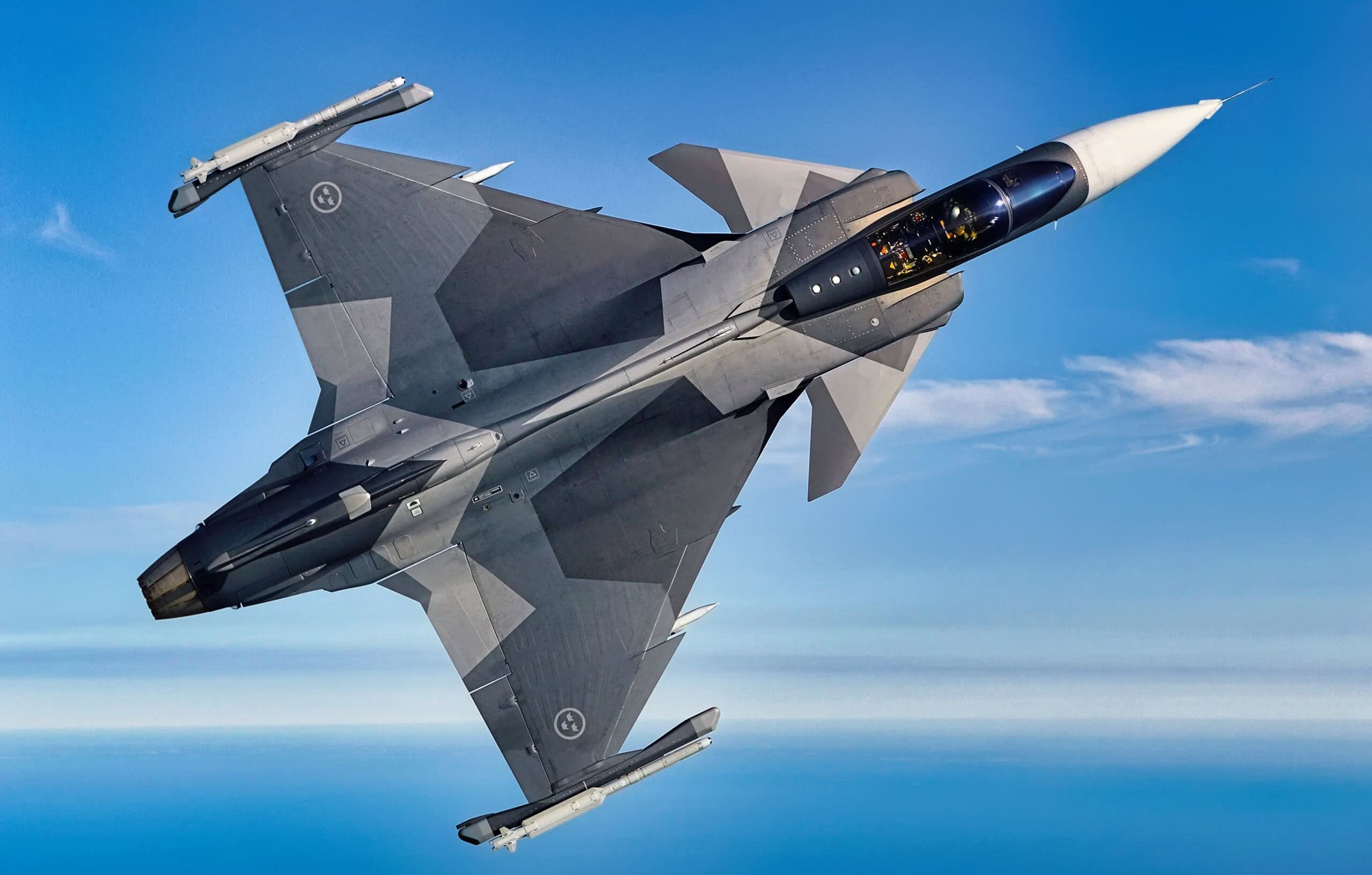
The Gripen is not a simple replacement for the F-16. The Swedish design follows a different military logic. The aircraft was developed for operation from makeshift road bases, small ground teams, and short rearmament times. For a country whose airfields are regularly threatened by Russian missiles and drones, this feature is politically less glamorous but operationally crucial.
The C/D version is older but available. The E/F version is more modern, has greater range, better sensors, an AESA radar, more powerful electronic warfare capabilities, and a larger payload. This is precisely the Swedish construction of the package: C/D is intended to reduce the short-term capability gap, while E/F is meant to create a long-term Ukrainian air force architecture. This is smarter than the European habitual model, where each country contributes individual systems and then hopes that NATO logistics will somehow sort out the rest.
Nevertheless, a problem remains that does not disappear in Stockholm. A combat aircraft is not a single device but a system of pilots, technicians, spare parts, weapons integration, data links, ground infrastructure, and tactical doctrine. The number 36 sounds politically impressive. In military practice, it only means air power if it results in a sustainably maintainable fleet.
Financing Makes the Deal European
The timing is no coincidence. On the same day, Reuters reported that the Ukrainian parliament ratified the EU loan of 90 billion euros. The Council had already agreed on April 23 to a Ukraine Support Loan of 90 billion euros for 2026 and 2027. According to the Council, an indicative 60 billion euros are to flow into the defense industry and procurement. The Commission had previously proposed a tranche of 45 billion euros for 2026, including 28.3 billion euros for Ukrainian and European defense capabilities.
This makes the Gripen deal more than just a bilateral Swedish decision. It is a test case for whether European credit instruments can generate real military capacity. So far, Brussels has often mobilized money without having institutional control over the outcome. SAFE, EDIP, and the Ukraine Support Loan create financing pathways. However, they do not build squadrons, train pilots, or resolve certification of guided missiles.
The Swedish package is therefore politically cleaner than many previous European commitments: a concrete weapon system, a concrete manufacturer, a concrete user, and a financing framework coincide. This is how European defense cooperation should look more often. However, Sweden is not the result of EU planning here, but a national state with a functioning industry that acts faster than European institutions.
Why Gripen Does Not Replace the Patriot Gap
In parallel to the Gripen news, President Volodymyr Zelensky again requested additional Patriot PAC-3 missiles. Associated Press reported on May 28 that Zelensky stated in Sweden that Washington must act faster; deliveries remain dangerously scarce while the Iran war further binds American stocks. This connection is crucial. The Gripen can strengthen Ukrainian air defense, but it does not replace a ballistic missile defense.
Russian Iskander, Kinzhal, or Oreshnik attacks require interception systems with different physical and sensory characteristics than a multirole combat aircraft. Gripen can engage cruise missiles, drones, aircraft, and certain aerial targets, provided that armament, early warning, and data link function properly. Against ballistic threats, Patriot with PAC-3-MSE or comparable capability remains central. Europe's structural weakness lies precisely there: it can deliver a very good Swedish combat aircraft, but it does not produce ballistic missile defense in sufficient numbers.
The European anti-ballistic coalition launched in May with 13 states shows that the problem has been recognized. Euromaidan Press reported that the initiative aims to advance European production of systems that Europe has not built in sufficient quantities so far. However, the production numbers remain brutal: Russia can deploy dozens of ballistic missiles monthly, while Western interceptors compete globally for Ukraine, US forces, Israel, Gulf states, and Taiwan. A coalition without production targets is not yet a capacity.
Sweden's Model and Germany's Problem
For Germany, the Gripen deal is uncomfortably instructive. Berlin finances a lot, delivers important air defense, and has a real Ukrainian success to show with IRIS-T. However, in the area of combat aircraft, Germany has no comparable national course of action. The Eurofighter is politically European, industrially complex, and hardly suitable for quick third-party transfers. FCAS is mired in governance conflicts. The F-35 procurement strengthens nuclear participation but not European industrial autonomy.
In contrast, Sweden demonstrates a rare institutional coherence: national industry, national air force, exportable system, and political will fit together. This is not the romance of small states. It is the result of decades of security planning under the assumption that, in a crisis, one must remain capable of acting alone with limited resources. Many larger European states lack this discipline.
Ukraine will benefit from this, but not immediately and fully. Training, spare parts, weapons integration, and maintenance cycles will determine whether the first C/D machines in 2027 are indeed more than a political signal. The E/F deliveries starting in 2030 already belong to the post-war or long-war architecture. This temporal division makes the deal strategically interesting: it is both immediate aid and the building of a future Ukrainian air force.
The Strategic Balance
Sweden's decision is the clearest European step so far to not only supply Ukraine with stocks but to integrate it into a European defense and capability architecture. It shows what is possible when financing, industry, and political will coincide. However, it also shows what Europe still lacks: joint planning, sufficient ammunition production, and a credible solution for ballistic missile defense.
The Gripen deal is therefore neither a wonder weapon nor a PR gesture. It is a useful, concrete, and institutionally incomplete step. Europe can provide Ukraine with a combat aircraft that fits the war. But as long as Zelensky continues to request Patriot missiles in Washington on the same day, European autonomy remains a partial capability. More European aircraft are necessary. Without European interceptors, the sky over Ukraine remains American licensed.
Sources
- Swedish government, press release from May 28, 2026, on the sale of 20 Gripen E/F and the planned delivery of up to 16 Gripen C/D.
- Saab, statement from May 28, 2026, on the Ukrainian Gripen procurement.
- Council of the European Union, Ukraine Support Loan and military support for Ukraine, as of May 2026.
- European Commission, preparatory steps for the 90 billion euro loan and 28.3 billion euros for defense capabilities.
- Associated Press, May 28, 2026, Zelensky's demand for additional Patriot missiles during the visit to Sweden.
- Euromaidan Press, May 13, 2026, European anti-ballistic coalition and production bottlenecks.
Sweden confirmed the sale of 20 new Gripen E/F and 16 used Gripen C/D aircraft to Ukraine on May 28, 2026, as part of efforts to strengthen its air force capabilities. This deal is significant for European military cooperation and is linked to a broader EU support loan for Ukraine's defense. President Zelenskyy also reiterated the need for additional Patriot missiles during this time.
- Sweden will provide 20 new Gripen E/F and 16 used Gripen C/D to Ukraine.
- The deal is part of a broader European effort to enhance Ukraine's military capabilities.
- The Gripen aircraft are designed for short runways and rapid maintenance, suitable for Ukraine's operational needs.
- The deal is linked to a larger EU loan to support Ukraine's defense industry.
- President Zelenskyy requested additional Patriot missiles during the same period.