
Sweden's 4 Luleå Frigate with FDI and Aster 30 Strengthen Europe's Baltic Air Defense
 Dr. Klaus Weber
Sweden's 4 Luleå Frigates with FDI and Aster 30 Strengthen Europe's Baltic Air Defense
40 billion Swedish kronor is not the decisive point. What matters is that Sweden intends to procure four frigates equipped with Aster 30 and CAMM-ER after more than four decades without serious sea-based air defense. The government in Stockholm instructed the procurement authority FMV on May 19 to negotiate with France regarding Naval Group's FDI design for the future Luleå class. Thus, Sweden is not just buying a ship. It is purchasing an institutional shortcut to a capability that is no longer optional in the Baltic Sea region.
The Decision is Less French than European
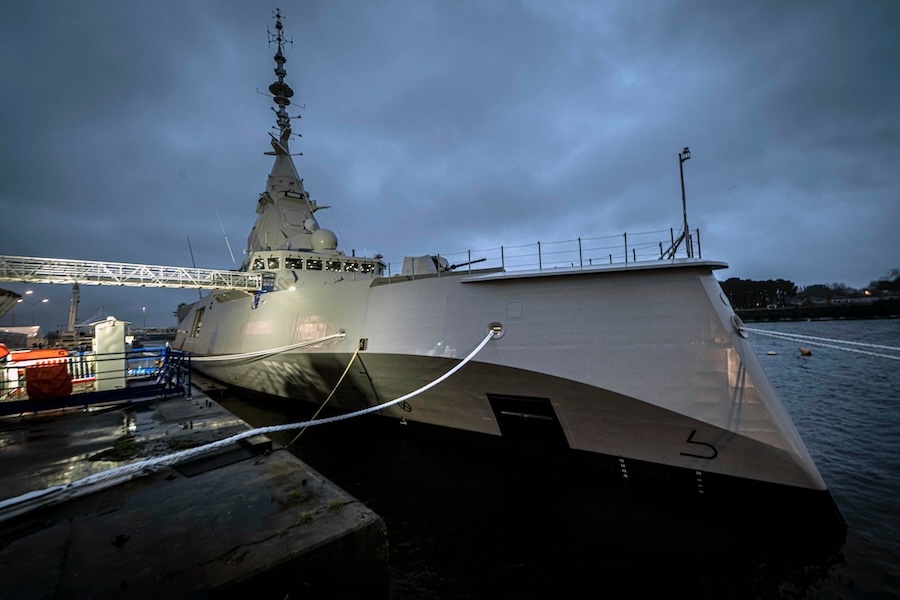
According to available information, Naval Group prevailed over Babcock's Arrowhead 120 and Navantia's ALFA 4000. The reasoning is revealing: maturity of the design, delivery schedule, and shared costs with existing operators like France and Greece. The first fully equipped ship could be delivered as early as 2030, with another to follow each year thereafter. For a country that has so far focused its navy heavily on corvettes, submarines, and coastal defense, this is a remarkable leap.
The FDI is not a Swedish flagship project. It is an already ongoing French program, being built in Lorient and also ordered by Greece. Precisely for this reason, it is politically attractive for Sweden. Stockholm does not need to prove a national design identity but rather close a capability gap. This is the sober core of the decision. European defense cooperation usually does not work when it is carried as a flag. It works when a state accepts that time, risk, and industrial learning curves are more important than national vanity.
Four Ships Do Not Replace a Fleet, but They Change the Architecture
The planned Luleå frigates are expected to displace around 4,000 tons and be about 120 meters long. They are intended to combine air defense, anti-submarine warfare, surface combat, and broader maritime domain control. This is important because the Baltic Sea has not automatically become a secure internal area of the alliance following Sweden's NATO accession. It is a logistical corridor for Sweden, Finland, and the Baltic states, and at the same time, an operational area where Russian missiles, submarines, drones, and electronic reconnaissance cannot be considered separately.
- Program scope: four future Luleå-class frigates.
- Estimated value: about 40 billion SEK, approximately 4.25 billion USD.
- Design basis: Naval Group FDI, already under construction or ordered for France and Greece.
- Delivery target: first fully equipped ship from 2030, then one ship per year.
- Armament according to reports: Aster 30 for wide-area air defense and CAMM-ER for medium defense layers.
The new element is maritime air defense. Sweden has not operated a real sea-based air defense missile system since the retirement of Seacat in the early 1980s. This was explainable during the Cold War, but in 2026, it is hardly tenable. A NATO navy that must protect supply routes in the Baltic Sea cannot think of air defense only on land. Ports, ferry routes, amphibious movements, mine countermeasures, and reinforcement transports require mobile protective spaces.
Aster 30 is the Political Message in the Engine Room
Naval Group describes the FDI as a multipurpose frigate with 32 Sylver vertical launch cells for Aster 15 and Aster 30, AESA multifunction radar with four fixed panels, SETIS command and weapon control system, anti-submarine sonar, torpedo defense, and electronic warfare capabilities. MBDA describes the Aster family as a two-stage system with an active seeker and special maneuverability against challenging targets, including tactical ballistic missiles. CAMM-ER complements this layer with a 160-kilogram, 4.2-meter missile, soft vertical launch technology, and a two-way data link.
But the real question is not whether these technical specifications are impressive. They are. The question is whether Sweden is procuring a frigate or an integrated air defense function. A frigate with Aster 30 is only strategically valuable if it is integrated into NATO air situational awareness, Swedish sensors, Finnish coastal defense, Baltic logistics, and allied reinforcement chains. Otherwise, it becomes a very expensive standalone system. This is where Europe's old problem lies: platforms are bought faster than doctrine, data connections, and ammunition reserves are organized.
The Swedish Mix Remains National, the Hull Will Be European
The planned integration of Swedish systems is not insignificant. Reports mention Saab RBS 15 anti-ship missiles, Torped 47, Giraffe 1X radar, Trackfire weapon stations, as well as Bofors 57mm and 40mm guns. This is not a pure import. It is a hybrid solution: French hull and combat system architecture, Swedish effectors and sensor components, European missile families. For the European defense industry, this is more interesting than the usual debate about strategic autonomy.
Autonomy does not mean that every country designs every system itself. That would be mere industrial folklore. Autonomy means that Europe within the alliance has enough of its own production lines, integration expertise, and spare parts chains to maintain political agency. If Sweden chooses the FDI because an existing European design is deliverable faster than a newly emerging national design, then that is not a loss of sovereignty. It is a more realistic form of it.
The Luleå decision reveals a paradox: Sweden gains national maritime operational capability precisely by relying on a non-Swedish frigate architecture.
The Difficult Part Begins After Selection
The negotiations with France will show how much industrial work remains in Sweden, how deeply Saab systems are integrated, how ammunition stockpiling is managed, and who receives priority in spare parts and missile supply chains in times of crisis. These questions are less visible than a contract value but are militarily more important. Greece, France, and soon Sweden could share costs and exchange experiences. However, they could also compete for scarce components if Aster production, VLS capacities, or shipyard windows do not grow quickly enough.
For Germany, this decision carries an uncomfortable lesson. Berlin talks a lot about a turning point and European defense capability, but its maritime air defense and Baltic priorities often lag behind the rhetoric. Sweden acts here like a NATO frontline state: it identifies a concrete capability gap, accepts a foreign mature design, and integrates its own industry where it makes operational sense. This is less elegant than a grand European strategy, but likely more effective.
Why the Baltic Sea Has Become a Frigate Question
Since Finland and Sweden joined NATO, the alliance has gained more geographical depth in the north. At the same time, the responsibility for maritime supply lines has grown. The defense of the Baltic states does not only depend on brigades, tanks, and aircraft. It depends on whether ports, ships, tankers, ferry lines, mine countermeasure units, and air defense zones can operate under pressure. Four frigates do not solve this task alone. But without such ships, Baltic defense remains too land-centered.
This makes the Luleå class a test case for European defense policy. If the ships really arrive in 2030 equipped with Aster 30, CAMM-ER, Swedish effectors, and NATO-compatible command architecture, it would be a practical gain. If integration is delayed, if ammunition remains scarce, or if national division of labor becomes more important than readiness, it would be another example of Europe's ability to devalue correct procurement decisions through poor program discipline.
More money is necessary. Mature designs are necessary. European industrial cooperation is necessary. But none of these alone is sufficient. Sweden's decision is therefore neither a triumph of French industrial policy nor a complete breakthrough in European defense integration. It is something rarer: a concrete, verifiable procurement decision, from which we will see in four years whether Europe has learned from its own delays.
Source Situation
The analysis is based on Defence Industry Europe regarding the Swedish selection decision of May 19, 2026, on Naval Group regarding the FDI configuration and NATO interoperability, as well as on MBDA information regarding Aster and CAMM-ER. The specific Swedish final configuration remains to be confirmed until the conclusion of negotiations.
Sweden plans to procure four Luleå-class frigates equipped with Aster 30 and CAMM-ER missile systems to enhance its air defense capabilities in the Baltic Sea. The first fully equipped ship is expected to be delivered by 2030, with one ship delivered annually thereafter. This decision marks a significant shift in Sweden's naval strategy, addressing a critical capability gap following its NATO membership.
- Sweden plans to procure four Luleå-class frigates for air defense.
- The frigates will be equipped with Aster 30 and CAMM-ER missile systems.
- The first ship is expected to be delivered by 2030, with subsequent deliveries annually.
- This procurement marks a significant shift in Sweden's naval capabilities after decades without serious sea-based air defense.
- The decision reflects a broader European defense cooperation strategy.