
T-72B3A with Arena-M failed its first battle near Mayak in 2026
 Dmitri Volkov
T-72B3A with Arena-M failed its first battle near Mayak in 2026
The most important aspect of the video footage from the Mayak area is not that a Ukrainian FPV drone hit the rear of the Russian T-72B3A. There have been thousands of such incidents in this war already. What matters more is that the strike targeted a vehicle that Moscow was trying to present as a response to this thousand-incident statistic. The tank was equipped with the active protection system "Arena-M," upgraded to combat FPV drones, but the system did not prevent the defeat (Militarnyi, July 23-24, 2026; Defence Blog, July 24, 2026).
One tank and ten vehicles in the column
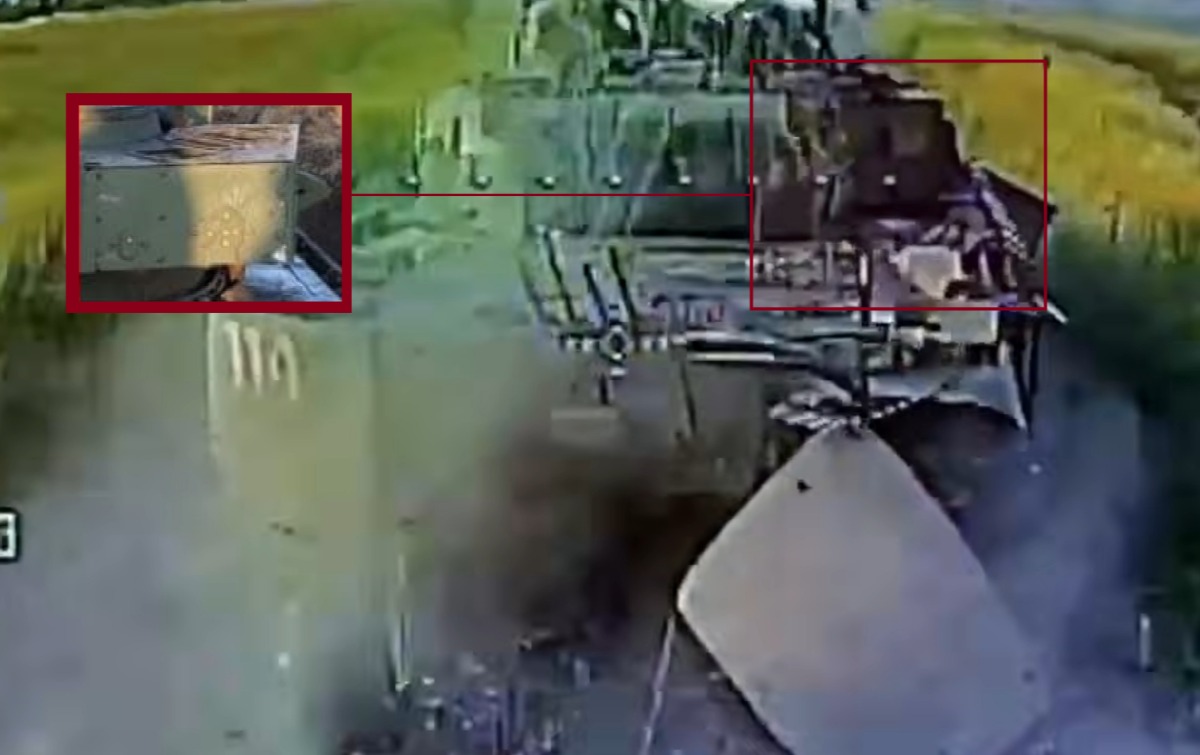
According to Militarnyi, the footage was published by the Special Operations Center "Omega" of the National Guard of Ukraine. It concerns an attack on a column of ten Russian tanks in the vicinity of the settlement of Mayak in the Donetsk region. One of the T-72B3A tanks showed signs of the "Arena-M" installation: a characteristic module on the turret and an additional anti-drone grid. It is still unknown how many vehicles in the column actually had such a set. This is an important caveat because the Russian army often showcases a prototype as a serial solution and then sends one or two units into battle to maintain the appearance of an industrial response.
The strike came from the rear, which is where the Soviet and Russian tank design schools traditionally left less protection. "Arena-M" was created as a hard-kill system: the radar detects an approaching projectile, calculates its trajectory, and fires a countermeasure. In theory, this should work against anti-tank missiles and grenades. In 2026, Russian engineers announced a software upgrade for FPV drones, but the physics of the target changed more than the language of press releases. A slow, small, maneuverable device made of plastic, wires, and a metal warhead with an unpredictable angle of attack does not resemble a classic ATGM with beautiful ballistics for a training range.
Why this is not just an unfortunate interception
There are three possible explanations, and each is unpleasant for the Russian armored school. First: the system is technically incapable of reliably intercepting FPV drones, despite claims of modernization. Second: the system was turned off because the crews feared false alarms, risks to their own infantry, or rapid depletion of munitions. Third: countermeasures had already been expended earlier in the battle. Any of these versions points not to randomness but to a problem in the combat cycle. Active protection is only useful when it works at the right moment, from the right direction, and with a sufficient reserve of munitions. Otherwise, it is an expensive architectural element on the turret, almost like antennas on a command vehicle from the 1990s that looked good in parades but did not always catch a signal.
Militarnyi reminds us that back in November 2025, there were reports of Russia's inability to reconfigure "Arena-M" for FPV interception due to limitations in radar technology. The problem is not necessarily in the "stealthiness" of the drone per se: Ukrainian and Russian FPVs carry metal warheads, batteries, and wiring. A more serious issue is the filtering of interference at ground level, classifying small targets at short distances, and prioritizing in a situation where shrapnel, smoke, dust, friendly drones, and enemy drones are all flying around the tank simultaneously. The Soviet designer liked to divide the battlefield into standard threats; the current battlefield responds with chaos, and it is cheap and serial.
Delayed modernization of a Soviet idea
"Arena" is not a new idea. Its roots go back to the late Soviet attempt to protect tanks from anti-tank weapons in frontal and side projections. Russian designers have been showcasing the integration of "Arena-M" on T-72B3 and T-90M since at least 2019; live-fire tests on the T-72B3 were demonstrated on Russian television as early as 2021. In 2024, individual T-72B3 and T-90M tanks with these systems appeared in photographs, but there was no mass deployment in combat units. This is a typical trajectory for the Russian defense industry: experimental design work lasts a long time, the exhibition model looks convincing, but serial implementation is hindered by cost, electronics, crew training, and industrial discipline.
After the start of the full-scale war, this delay became particularly costly. Russian tanks first received makeshift "barbecues," then factory grids, then electronic warfare sets, and finally attempts to combine all this with active protection. But each new addition increases weight, complicates maintenance, and does not solve the main issue: the tank no longer operates in a relatively predictable duel of armor against missile. It is in a transparent observation zone, where a drone costing a few hundred dollars can wait for hours for a crew error, and the operator chooses not a beautiful frontal attack but the rear, the roof of the engine compartment, or the moment of turning.
Price for Russian tactics
From a military perspective, the loss of one T-72B3A does not change the front line. But it changes the value of promises. The Russian command in 2025-2026 is trying to restore the role of armored vehicles as a breakthrough tool, especially in the Donetsk direction, where infantry assaults yield slow progress at a high cost. For this, at least a minimal protective bubble around the tank group is needed: electronic warfare against control channels, grids against top hits, active protection against the most dangerous approaches, artillery suppression of operators and reconnaissance drones. If one element is declared as a technological solution and then publicly fails, crews quickly draw conclusions. In the Russian army, soldier empiricism often outweighs the general's report.
The production side is no less important. Uralvagonzavod and Rostec can install "Arena-M" on a limited number of T-90M and T-72B3A, but mass equipping requires not only hardware but also a stable supply of radars, processors, sensors, countermeasures, and training kits. Sanction pressure did not destroy the Russian defense industry; that would be too simple a Western fairy tale. It did something else: it raised the price of each complex electronic subsystem and forced a choice between the number of platforms and the quality of protection. When a tank factory must deliver vehicles to the front now, active protection becomes not a standard but a premium option for individual batches.
Forecast
Russia will not abandon "Arena-M" after this episode. On the contrary, new statements about algorithm improvements, expansion of coverage sectors, and integration with onboard electronic warfare systems can be expected. However, the coming year will likely not show a mass revolution in tank protection but a mosaic adaptation: some vehicles will receive active protection, some will get coarser grids and electronic warfare, and a large portion will continue to operate under the old logic of armor, which the war has already outpaced. "Arena-M" may become a useful system against some threats if it reaches a stable serial level. But as a universal answer to FPV drones, it currently appears not as a shield but as a late commentary on a war that has changed faster than Russian industry.
Sources: Militarnyi, Special Operations Center "Omega" of the National Guard of Ukraine, Defence Blog, open materials on the "Arena-M" program and its installation on T-72B3/T-90M.
A Ukrainian FPV drone struck a Russian T-72B3A tank equipped with the Arena-M active protection system near Mayak on July 23-24, 2026. The system failed to prevent the strike, raising concerns about its effectiveness against modern drone threats. This incident occurred within a column of ten Russian tanks, indicating potential vulnerabilities in Russian armored units.
- A Ukrainian FPV drone struck a Russian T-72B3A tank equipped with Arena-M.
- The attack occurred in a column of ten Russian tanks near Mayak.
- The Arena-M system failed to intercept the drone despite claims of upgrades.
- The incident raises concerns about the effectiveness of Russian tank defenses against modern threats.
- The Russian military's reliance on outdated technology is highlighted by this failure.