
Taiwan Tests MQ-9B Drones and Extends Its Maritime Kill Chain
 S.W
S.WTaiwan Tests MQ-9B Drones and Extends Its Maritime Kill Chain
Two Aircraft Are Now Flying
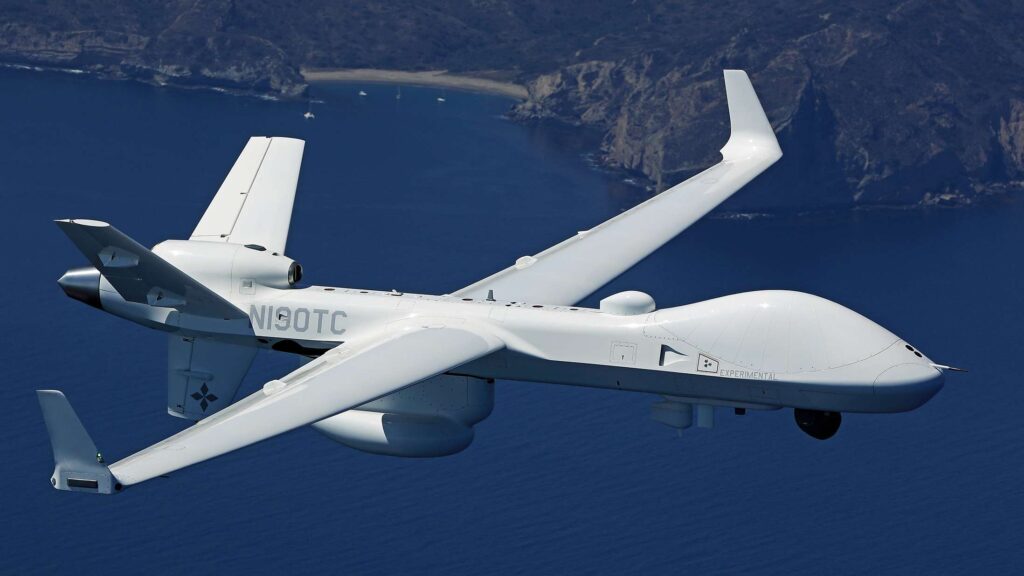
Taiwan has moved its MQ-9B program from procurement into operations. The first two of four MQ-9B SkyGuardian remotely piloted aircraft conducted initial flight tests at Hualien Air Base on September 14, according to Focus Taiwan. The aircraft were delivered earlier this year and assembled after a March handover ceremony in the United States. The remaining two are scheduled for delivery in 2027.
That sounds like a modest milestone. It is not. Taiwan has spent years improving its ability to detect Chinese aircraft and ships around the island, but a persistent, long-range unmanned aircraft changes the arithmetic of surveillance. The question is not whether four drones can defeat the People’s Liberation Army Navy. They cannot. The question is whether they can keep enough Chinese ships under observation long enough for Taiwan, the United States, and other partners to act on the information. That is a much more useful capability.
What Taiwan Bought
The MQ-9B is the maritime-capable evolution of the Reaper family, designed around endurance rather than speed. General Atomics lists more than 40 hours of flight time, a 79-foot wingspan, automatic takeoff and landing, a Lynx multi-mode radar, and electro-optical/infrared sensors. Its open architecture supports nine hardpoints and an external payload capacity of up to 4,750 pounds, although Taiwan’s initial value is surveillance, not air attack.
The United States Defense Security Cooperation Agency described the Taiwanese system as providing intelligence, surveillance and reconnaissance, target acquisition, and potential counter-land, counter-sea, and anti-submarine capabilities. Those mission labels should not be confused with an immediate strike fleet. A four-aircraft buy has limited availability once training, maintenance, weather, and equipment inspections are counted. Even with 40-hour endurance, a small fleet cannot maintain continuous coverage over every approach to Taiwan.
The useful comparison is not with a fighter squadron. It is with Taiwan’s existing sensor network. A SkyGuardian can remain on station for many hours, carry radar and imaging sensors, and relay data beyond the line of sight through satellite communications. That makes it a mobile collection node that can investigate contacts rather than simply report that a contact exists.
Hualien Changes the Geometry
Stationing the aircraft at Hualien matters. The base sits on Taiwan’s mountainous east coast, away from the island’s most exposed western approaches. Hualien is not invulnerable, and no fixed airfield should be treated as a sanctuary in a missile war. But eastern basing complicates the PLA’s targeting problem and gives Taiwan a better launch point for monitoring activity that moves around the island’s eastern flank.
That flank is the operational hinge of a blockade scenario. Chinese naval forces operating east of Taiwan would try to bypass the island’s dense western defenses, threaten ports and sea lines, and complicate American reinforcement from the Philippine Sea. A drone that can observe those movements without risking a manned fighter for every sortie gives Taiwan more time to classify a contact, build a track, and pass targeting-quality information to shore-based anti-ship missile units.
There is a catch. The MQ-9B is a large, slow aircraft. Its radar and datalink make it valuable, but they also make its emissions and flight patterns worth hunting. Chinese fighters, long-range surface-to-air missiles, electronic warfare systems, and cyber operations would all be relevant threats. The platform can contribute to a kill chain only if Taiwan can protect the ground stations, rotate aircraft intelligently, and preserve alternative communications when satellites or data links are contested.
The Real Value Is the Network
Researchers at Taiwan’s Institute for National Defense and Security Research have emphasized that the MQ-9B’s primary role is battlefield reconnaissance rather than independent offensive action. That is the correct starting point. The aircraft is most valuable when its sensor picture is fused with Taiwan’s coastal radars, naval patrols, unmanned systems, and mobile missile batteries.
For the United States, the potential payoff is even larger. A shared satellite communications architecture could allow Taiwanese and American forces to exchange maritime intelligence rapidly, as General Atomics describes the aircraft’s beyond-line-of-sight design. In a crisis, that could shorten the time between detection and a decision to reposition forces or cue a weapon. But data sharing is not the same as alliance integration. It requires compatible terminals, agreed rules for classification, resilient links, and commanders who trust the feed under fire.
The four-aircraft fleet will therefore be a test of Taiwan’s command-and-control architecture as much as of the airframe. If the drones merely generate video for separate Taiwanese offices, their contribution will be narrow. If they feed a distributed maritime picture that can be acted on by missile, air, and naval units, their value will exceed their numbers.
Four Drones Cannot Close Every Gap
The first flight tests are a beginning, not proof of combat readiness. Taiwan still has to train crews, validate sensors, establish maintenance cycles, harden control facilities, and determine how the aircraft operate during jamming. It also needs enough spare parts and trained personnel to keep a small fleet flying after the first weeks of a crisis.
The wider lesson is uncomfortable. Taiwan is buying persistence because it lacks enough affordable ways to watch the sea. The MQ-9B helps solve the surveillance problem, but it does not solve the magazine problem, the air-defense problem, or the communications problem. A drone can find a ship; another system must decide whether the track is reliable, and a weapon must still reach the target.
That is the measure of this deployment. Taiwan has not acquired four aircraft that can hold the Taiwan Strait at risk. It has acquired four potential links between detection and denial. If Taipei builds the network around them, the MQ-9Bs will make Chinese naval movements harder to hide and easier to target. If it treats them as a prestige purchase, the PLA will simply wait for the gaps between sorties.
Sources
Taiwan has initiated operational testing of its MQ-9B SkyGuardian drones at Hualien Air Base, with the first two aircraft conducting flight tests on September 14, 2026. This move marks a significant step in Taiwan's efforts to enhance its maritime surveillance capabilities. The MQ-9B drones are intended for intelligence, surveillance, and reconnaissance missions, contributing to Taiwan's defense strategy against potential threats.
- Taiwan has begun operational testing of MQ-9B drones at Hualien Air Base.
- The first two of four MQ-9B drones conducted flight tests on September 14, 2026.
- The MQ-9B is designed for intelligence, surveillance, and reconnaissance missions.
- Taiwan aims to enhance its maritime surveillance capabilities with these drones.