
Taiwan Tests MQ-9B Drones as China Expands Grey-Zone Pressure in 2026
 Marcus Chen
Taiwan Tests MQ-9B Drones as China Expands Grey-Zone Pressure in 2026
Taiwan is now flight-testing the first two U.S.-built MQ-9B SkyGuardian unmanned aircraft at Hualien, according to reports from Focus Taiwan, the Taipei Times, and South China Morning Post. The event matters because it moves Taiwan’s maritime surveillance problem from procurement into the operational phase. It also exposes the uncomfortable limit of buying exquisite sensors for an island that must keep them alive under missile attack.
The aircraft Taiwan is actually receiving
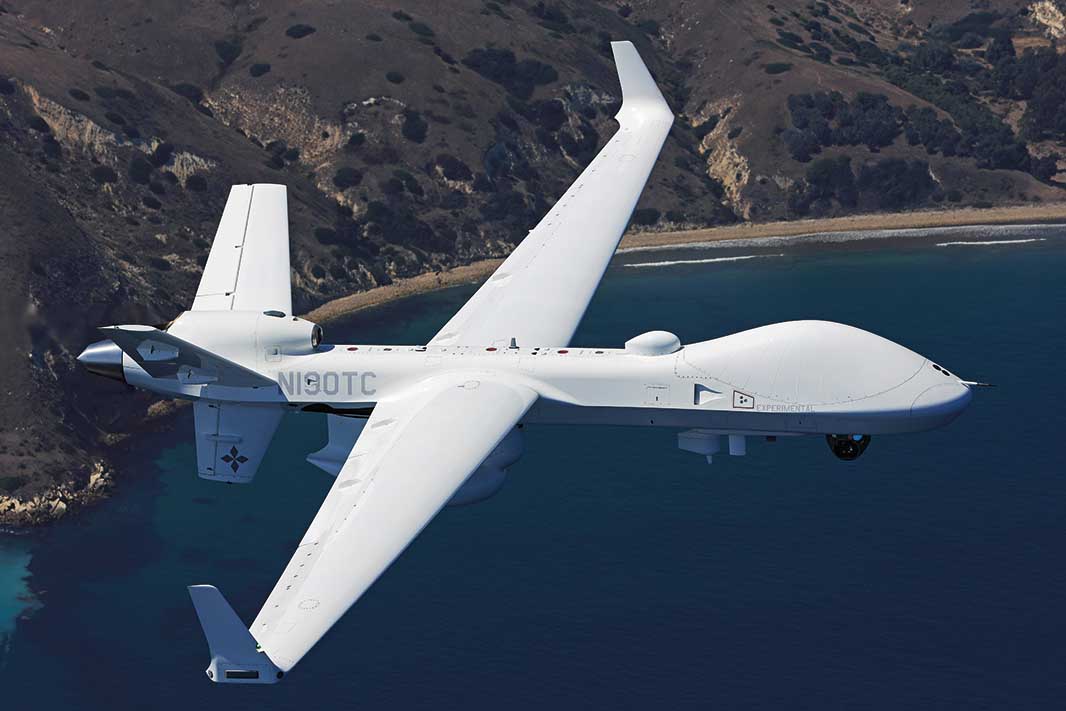
The MQ-9B is not a small tactical drone. General Atomics lists the SkyGuardian with endurance of more than 40 hours, a roughly 79-foot wingspan, satellite communications, automatic takeoff and landing, and a payload architecture intended for electro-optical, infrared, maritime radar, and signals sensors. The maritime SeaGuardian configuration can carry a multimode maritime surface-search radar and an automatic identification system, giving operators a persistent picture of ships that would otherwise require fighters, patrol aircraft, or frigates.
That endurance changes the arithmetic around Taiwan’s gray-zone problem. A drone that can remain on station for a day or more can watch coast guard cutters, maritime militia vessels, and naval formations without burning through the flight hours of an F-16 or the fuel and crew cycles of a patrol aircraft. It is a surveillance asset first, not a strike aircraft. The platform can find and classify a Chinese vessel, but it cannot by itself stop one.
Why Hualien is a logical test site
Hualien offers Taiwan a Pacific-facing base with hardened infrastructure and geographic separation from the island’s crowded western military corridor. It is also exposed to the first problem Beijing would present in a conflict: the People’s Liberation Army would try to crater runways, disrupt satellite links, and destroy ground-control nodes before a long-endurance drone completed its first mission.
The location therefore tests more than the aircraft. It tests whether Taiwan can generate sorties, move maintenance teams, protect fuel and spare parts, and maintain command links while under pressure. An MQ-9B’s advertised endurance is irrelevant if its control station is hit, its satellite access is jammed, or its runway is closed. Anyone who has served on a destroyer understands the difference between a ship’s theoretical range and the number of days it can remain effective. The same rule applies here.
The surveillance gap is real, but the fleet is small
Washington approved a four-aircraft MQ-9B package for Taiwan in 2020 at an estimated value of about $600 million, including ground equipment, sensors, training, and support. Reports that the first two aircraft are now undergoing flight testing suggest that the program is finally becoming visible in Taiwan’s force structure. Four aircraft, however, do not create continuous coverage of the Taiwan Strait, the east coast, and the approaches to the Bashi Channel at the same time.
Assume two aircraft are available for operations while the other two are in maintenance, training, or transit. Even with 24-hour endurance, Taiwan must account for launch windows, weather, crew handover, sensor tasking, communications outages, and the need to keep some aircraft in reserve. The resulting coverage is valuable but narrow. It can support a recognized maritime picture; it cannot guarantee one.
China’s gray-zone campaign is designed to create precisely that workload. Coast guard ships and maritime militia can operate below the threshold that would justify a fighter sortie, yet in numbers large enough to saturate a small surveillance fleet. The PLA Navy can then use the same contacts to mask exercises, missile deployments, or an approach toward Taiwan’s eastern flank. The MQ-9B improves detection. It does not solve the saturation problem.
What the drones change for the United States
For Washington, the sale provides a layer between commercial satellite imagery and crewed reconnaissance. Taiwan can collect its own evidence, share it with partners, and build a record of coercive activity without asking a U.S. aircraft to be present for every encounter. That improves warning and attribution before a crisis becomes a shooting war.
It also creates a more distributed intelligence network. If Taiwan combines MQ-9B feeds with coastal radar, patrol vessels, passive electronic sensors, and allied data, the drone becomes a node in a kill web rather than an expensive camera. Its value will be measured by how quickly a contact becomes a decision: reroute a ferry, alert a missile battery, cue a patrol ship, or expose a blockade rehearsal.
But the United States should not mistake an exportable aircraft for an exportable operating concept. Taiwan needs redundant control stations, mobile ground equipment, anti-jam communications, decoys, runway repair, and replacement sensors. Those items are less photogenic than the aircraft and more decisive in a war.
The hard conclusion
The MQ-9B is a sensible answer to Taiwan’s daily surveillance burden. Its endurance and maritime sensors can reduce the cost of watching China’s gray-zone fleet and give Taipei better warning. The first two aircraft at Hualien are a meaningful milestone.
They are not a deterrent by themselves. Four aircraft cannot maintain a permanent wall around Taiwan, and a drone that cannot survive the opening hours of a conflict is only a prewar intelligence tool. Taiwan should use the SkyGuardians to build a layered sensing network, while spending at least as much attention on hardened control, communications, and dispersal as on airframes. The aircraft are finally arriving. The real test is whether Taiwan has built a force that can still see after China starts shooting.
Sources
- Focus Taiwan, “DEFENSE MQ-9B SkyGuardian drones undergo flight testing in Taiwan,” September 15, 2026.
- Taipei Times, “First SkyGuardian drones begin flight tests in Taiwan,” September 15, 2026.
- South China Morning Post, “Taiwan tests US-made MQ-9B drones to counter PLA gray-zone operations,” September 15, 2026.
- General Atomics Aeronautical Systems, MQ-9B SkyGuardian product specifications.
Taiwan is flight-testing two MQ-9B SkyGuardian drones at Hualien in September 2026. This testing marks a significant step in Taiwan's operational capabilities for maritime surveillance amid increasing pressure from China. The MQ-9B drones, known for their long endurance and advanced sensors, are intended to enhance Taiwan's ability to monitor Chinese maritime activities. However, the limited number of drones poses challenges for continuous coverage of critical areas.
- Taiwan is flight-testing two MQ-9B drones at Hualien.
- The MQ-9B has an endurance of over 40 hours and advanced surveillance capabilities.
- The testing site at Hualien is strategically chosen for its infrastructure and geographic advantages.
- Taiwan's MQ-9B program aims to enhance maritime surveillance against Chinese gray-zone tactics.
- The U.S. approved a package of four MQ-9B drones for Taiwan in 2020.