
Taiwan's 2026 $6.6 Billion Drone Budget Still Needs a Kill Chain
 Marcus Chen
Taiwan's 2026 $6.6 Billion Drone Budget Still Needs a Kill Chain
208,200 one-way attack drones sounds like the right answer to China's invasion problem. It is also the kind of number that can hide the harder question: who finds the target, who keeps tracking it, and who decides which drone gets spent?
Taiwan's Executive Yuan has proposed a six-year NT$210 billion package, about $6.6 billion, for domestically produced unmanned systems. USNI News reported on June 24 that the package would fund up to 208,200 one-way attack drones, 1,446 reconnaissance drones, and 1,320 unmanned surface vessels. Focus Taiwan reported the Cabinet proposal on June 18, noting that the bill is meant to restore drone procurement funding stripped from an earlier defense package by opposition parties.
That is a serious procurement move. It is not a complete defense concept by itself.
The Number That Matters Is 210 Billion New Taiwan Dollars
For years, American planners have talked about turning the Taiwan Strait into a drone-heavy kill zone. The usual shorthand is a hellscape: thousands of cheap systems, launched from dispersed sites, forcing the People's Liberation Army Navy and amphibious forces to fight through a cloud of sensors, decoys, loitering munitions, and surface drones before they ever reach the beaches.
Taipei is now trying to put budget numbers behind that concept. The proposed package is not just an import line. It is explicitly tied to domestic production. That matters because Taiwan cannot assume resupply after a blockade begins. In a serious crisis, drones sitting in a U.S. warehouse or delayed in a foreign military sales queue are not part of Taiwan's order of battle.
The scale also changes the arithmetic. If Taiwan bought 208,200 attack drones over six years, the average annual flow would be roughly 34,700 systems. Spread over 365 days, that is about 95 drones per day coming out of the program pipeline. In wartime terms, that is not a mountain. A few days of intense fires against landing craft, escort ships, engineering units, radar vehicles, and staging areas could burn through thousands of expendable systems.
That is why the procurement is useful but not magical. Quantity gives Taiwan endurance. It does not automatically give Taiwan targeting.
The Reconnaissance Ratio Is The Warning Light
The proposed mix is heavily weighted toward shooters. By the reported numbers, Taiwan would buy about 144 attack drones for every reconnaissance drone. That may be acceptable if many attack drones carry their own terminal seekers and if Taiwan can feed them target coordinates from other sources. It is dangerous if the reconnaissance fleet is expected to search, classify, track, and update targets across the strait under electronic attack.
Anyone who has served on a destroyer knows the basic problem: firing is usually the easy part. Finding a target, maintaining custody, avoiding fratricide, and getting authorization through a degraded command net are where the system breaks. A drone force built around one-way attack systems still needs radars, electro-optical sensors, electronic intelligence, data links, satellite communications, hardened fiber, mobile command posts, and enough operators to keep the loop moving.
Defense Minister Wellington Koo has described unmanned systems as improving maritime domain awareness and targeting capacity. That is the right phrasing. The question is whether the budget buys a kill chain or mostly buys the terminal weapons at the end of one.
Unmanned Surface Vessels Are The More Interesting Line Item
The 1,320 unmanned surface vessels may matter more than the headline drone count. Taiwan's geography is brutal for an invader, but it is also brutal for defenders trying to hold sensors forward. The Strait is narrow enough for missiles, artillery rockets, loitering munitions, and shore-based radars to matter. It is also crowded, weather-exposed, and vulnerable to jamming.
Drone boats can scout approaches, force Chinese escorts to reveal themselves, complicate minesweeping, and threaten landing ships at the worst possible moment. Ukraine's use of unmanned surface vessels in the Black Sea has shown that cheap maritime systems can impose caution on a larger navy. Taiwan's case is different. The PLAN would be operating close to home, under a dense air and missile umbrella, with a much shorter repair and logistics chain. Still, a mass of small unmanned craft around likely landing lanes would make the amphibious timeline less clean.
The problem is survivability before launch. Fixed warehouses, obvious coastal staging areas, and centralized control nodes are target folders for the PLA Rocket Force. If the drones are not dispersed, camouflaged, moved regularly, and tied to redundant communications, the inventory number will look better in peacetime than on day one.
The MQ-9 Arrival Shows The High-End Gap
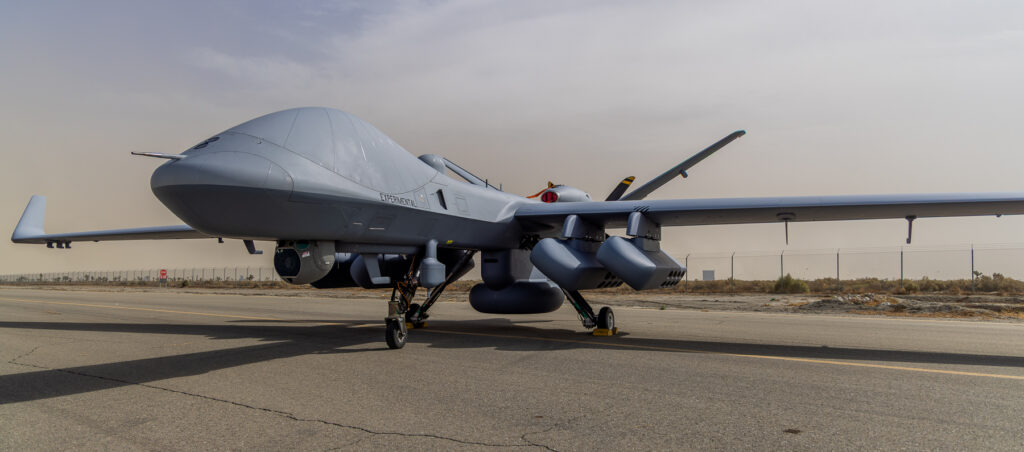
USNI also noted that Taiwan's first MQ-9 SeaGuardian arrived this week ahead of flight trials. Taipei Times reported earlier that the first batch of SkyGuardian drones had arrived in Taiwan. That is a separate program from the domestic drone budget, but it explains the architecture Taiwan is trying to build.
Small drones can saturate. Larger remotely piloted aircraft can watch, relay, and help build the maritime picture. The MQ-9B family can stay aloft far longer than quadcopters or small loitering munitions and can carry maritime surveillance payloads. But in a Taiwan fight, big drones will be high-value, high-signature assets. They may be useful in gray-zone monitoring and the early crisis phase. Once missiles are flying, Taiwan should assume every large airborne sensor will be hunted.
That means the domestic drone budget cannot depend on a handful of exquisite unmanned aircraft to make the rest of the system work. The kill chain has to degrade gracefully. If an MQ-9 is shot down, if a coastal radar is jammed, if a command post loses satellite communications, the smaller systems still need local targeting options and mission authority.
Industry Is The Center Of Gravity
The most important part of the Cabinet proposal may be the word domestic. Taiwan's defense industry has to learn how to build cheap systems fast, repair them faster, and upgrade software constantly. A six-year budget can create production lines, but production lines do not automatically create wartime output. Suppliers need motors, batteries, guidance components, explosives, radios, composite materials, test ranges, and trained technicians.
The PLA will not give Taiwan a clean mobilization period. If Beijing chooses coercion before invasion, it can use cyberattacks, port pressure, airspace harassment, and gray-zone maritime activity to stress the supply chain before a shot is fired. Taiwan's drone program therefore needs stockpiles as much as factories. It also needs boring logistics: containers, generators, spare propellers, battery charging discipline, and enough pre-surveyed launch sites to keep crews from improvising under fire.
Washington should pay attention for a selfish reason. This is the first island chain problem in miniature. The U.S. and its allies keep buying exquisite platforms, then rediscover that a fight near China's coast demands disposable mass. Taiwan is at least trying to buy the disposable part. Now it has to prove it can connect that mass to sensors and command networks that survive contact.
The Hard Part Comes After The Purchase Order
Taiwan's drone budget is the right instinct. It puts money behind asymmetric defense, domestic production, and maritime denial. It also exposes the next weakness.
The drone count can impress legislators. The kill chain has to impress the PLAN.
If Taiwan buys 208,200 attack drones but cannot move target data through a jammed, bombarded, politically contested battlespace, it will have built an arsenal of disconnected flying explosives. If it buys the sensors, control nodes, training cycles, and dispersal plan around them, the same number becomes a real operational problem for China.
The difference is not the drone. It is the system around the drone. That is where Taiwan's $6.6 billion will either become deterrence or inventory.
Taiwan proposed a $6.6 billion budget for 2026 to procure 208,200 one-way attack drones, 1,446 reconnaissance drones, and 1,320 unmanned surface vessels to bolster its defense against China. The initiative emphasizes domestic production to ensure operational capability during a potential blockade. However, the effectiveness of this procurement hinges on establishing a reliable kill chain for target acquisition and command integration.
- Taiwan proposed a $6.6 billion budget for drone procurement in 2026.
- The package includes 208,200 one-way attack drones, 1,446 reconnaissance drones, and 1,320 unmanned surface vessels.
- The proposal aims to enhance Taiwan's defense against potential Chinese invasion.
- The focus is on domestic production of unmanned systems to ensure self-sufficiency during a blockade.
- The effectiveness of the drone program depends on the integration of targeting and command systems.