
Taiwan's 2026 NT$1 Trillion Defense Budget Still Won't Buy Staying Power
 Marcus Chen
Taiwan's 2026 NT$1 Trillion Defense Budget Still Won't Buy Staying Power
Taiwan is moving another NT$145.7 billion, about US$4.6 billion, into defense this year. That pushes total defense spending past NT$1 trillion for the first time, as Reuters and the South China Morning Post reported this week. The headline number will get attention in Washington because it looks like movement at last. The problem is that money committed in a budget cycle is not the same thing as combat power delivered to units, loaded into magazines, dispersed across hardened sites, and sustained under fire for weeks.
That distinction matters in the Taiwan Strait. Anyone who has served around naval planning knows the first question in a contingency is not how much a government authorized. It is how many days of fighting the force can actually support once ports are disrupted, runways are cratered, and resupply is contested. Taiwan's budget increase helps. It does not solve that problem.
What the Extra Money Actually Changes
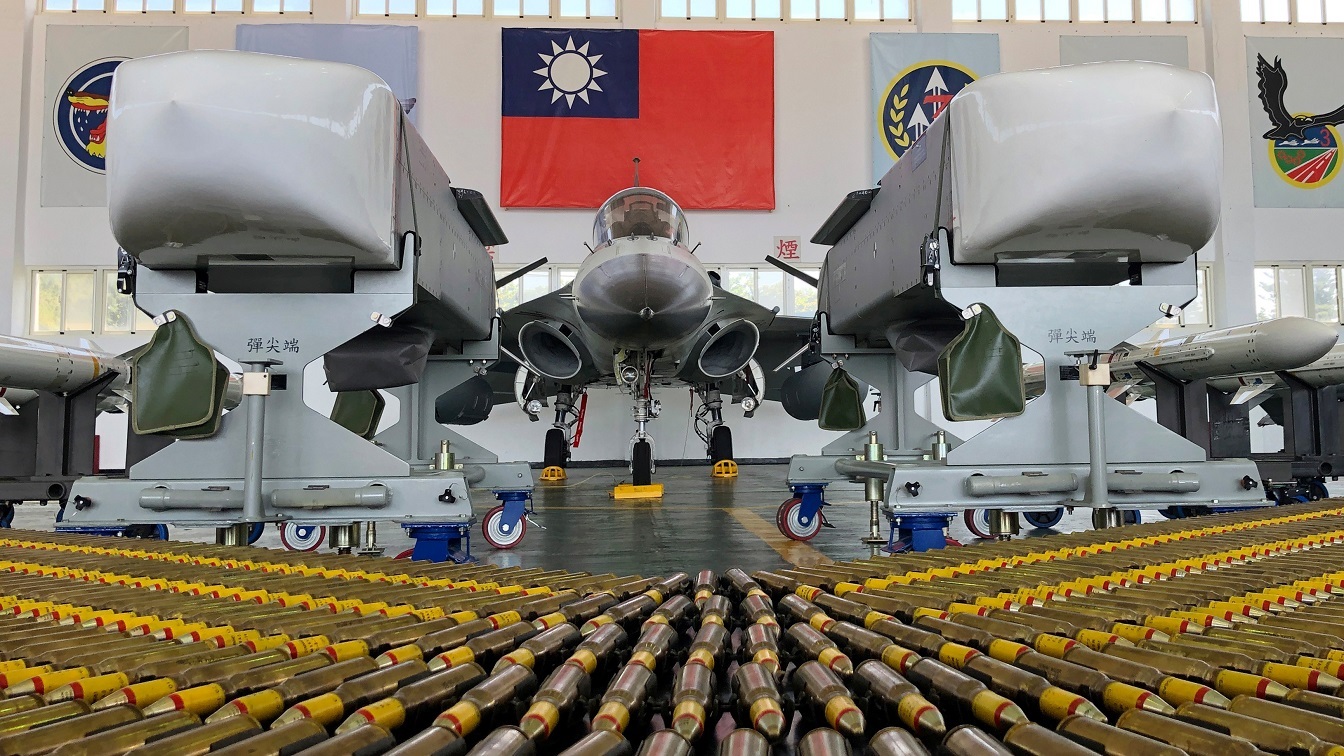
The additional package appears aimed at drones, munitions, and broader defense reinforcement. That is the right direction. Taiwan does not need more symbolic hardware purchases nearly as much as it needs volume: more expendable drones, more anti-ship and air-defense interceptors, more mobile launchers, more repair capacity, and more stockpiled fuel and spare parts. In a blockade or opening strike scenario, the side that can keep shooting after the first 72 hours matters more than the side that held the better press conference.
There is also a basic arithmetic point here. Taiwan is trying to cover an island-wide defense problem against an opponent that can rotate far larger air and naval forces, absorb losses more easily, and keep industrial output running from depth. Beijing can pressure Taiwan from multiple axes: missile fire from the mainland, naval coercion in the Strait, coast guard and militia pressure east of Taiwan, and cyber or infrastructure disruption at the same time. NT$145.7 billion is real money. It is not enough to erase the mass differential.
- It can buy more of the items Taiwan actually expends in a fight, especially drones and precision munitions.
- It can speed deliveries or reduce some of the damage from earlier legislative cuts and freezes highlighted by The Diplomat and Taiwan media.
- It cannot by itself create the wartime logistics system Taiwan still lacks.
The Magazine Problem Is Bigger Than the Budget Problem
Marcus Chen's rule for Taiwan is simple: count launchers, count reloads, then count how long they survive. Taiwan has improved the launcher side of the equation. It is fielding more mobile systems, and recent reporting on coastal and island defenses shows Taipei understands the need to contest the Strait rather than wait for a landing on the beaches. But launchers without deep magazines become one-shot political theater.
Take anti-ship defense. Taiwan's Hsiung Feng series and Harpoon purchases matter because they force the PLA Navy to fight for sea control instead of assuming transit. But anti-ship missiles only shape the battlespace if there are enough rounds to absorb decoys, survive first-wave suppression, and keep firing after dispersed batteries relocate. The same logic applies to air defense. A missile inventory looks large on paper until it has to cover bases, ports, command nodes, and civilian infrastructure under repeated salvos.
That is where the new spending should be judged. Not by whether it crosses a symbolic trillion-dollar threshold, but by whether it increases reload depth, maintenance resilience, and replacement flow. If the answer is mostly drones and munitions, good. If the answer is delayed procurement, politically attractive add-ons, or infrastructure that will not be operational for years, the strategic effect is limited.
Why Beijing Will Not Be Impressed
Beijing watches trends, not single budget moments. From its perspective, Taiwan is still trying to convert peacetime appropriations into wartime endurance while managing domestic political friction over what gets funded, frozen, or delayed. Crossing NT$1 trillion does not change the central Chinese calculation: Taiwan remains hardest to coerce when its forces are dispersed, mobile, and able to keep imposing costs after the opening blow.
That means the most important investments are not glamorous. Hardened fuel storage. Rapid runway and port repair. Distributed command and control. Reserve mobilization that works outside PowerPoint. Cheap drones that can be replaced in volume. Mobile coastal defense units that can shoot, move, and shoot again. These are not headline systems, but they are the pieces that turn budget authority into sea denial.
There is a political benefit here for Taipei. The increase signals seriousness to Washington at a time when U.S. officials keep pressing allies and partners to spend more. But American reassurance should not be the metric. The metric is whether a PLA campaign becomes slower, bloodier, and more uncertain.
The Useful Conclusion
Taiwan's extra US$4.6 billion is not meaningless. It is a late correction toward the right categories, and it may ease some of the worst readiness pressures created by earlier budget battles. But budgets do not defend islands. Magazines, mobility, repair crews, and replacement pipelines do.
So the real question is not whether Taiwan can now say it spends more than NT$1 trillion on defense. The real question is whether that money leaves Taiwan with more missiles loaded, more drones ready, more fuel protected, and more units able to keep fighting after the first week. If not, the number is a signal. It is not staying power.
Taiwan increased its defense budget to NT$1 trillion for 2026, adding NT$145.7 billion to enhance military capabilities. The budget focuses on acquiring more drones and munitions, but experts warn it may not significantly improve Taiwan's wartime logistics or combat readiness against larger Chinese forces. Beijing perceives this budget increase as inadequate for Taiwan's defense needs in a potential conflict.
- Taiwan's defense budget exceeds NT$1 trillion for the first time.
- An additional NT$145.7 billion is allocated for defense in 2026.
- The budget aims to enhance capabilities in drones and munitions.
- Taiwan's military readiness is questioned despite the budget increase.
- Beijing views Taiwan's budget increase as insufficient for wartime endurance.