
Taiwan's Drone and Artillery Overhaul Tests Its War Math
 Marcus Chen
Taiwan's Drone and Artillery Overhaul Tests Its War Math
Taiwan is reorganizing parts of its force around drones, artillery, and mobile firepower. That is the right direction. It is also a reminder that buying weapons is the easy part. The hard part is keeping them connected, supplied, and alive after the first 72 hours of a Chinese attack.
The Reform Is Moving Toward Mass and Mobility
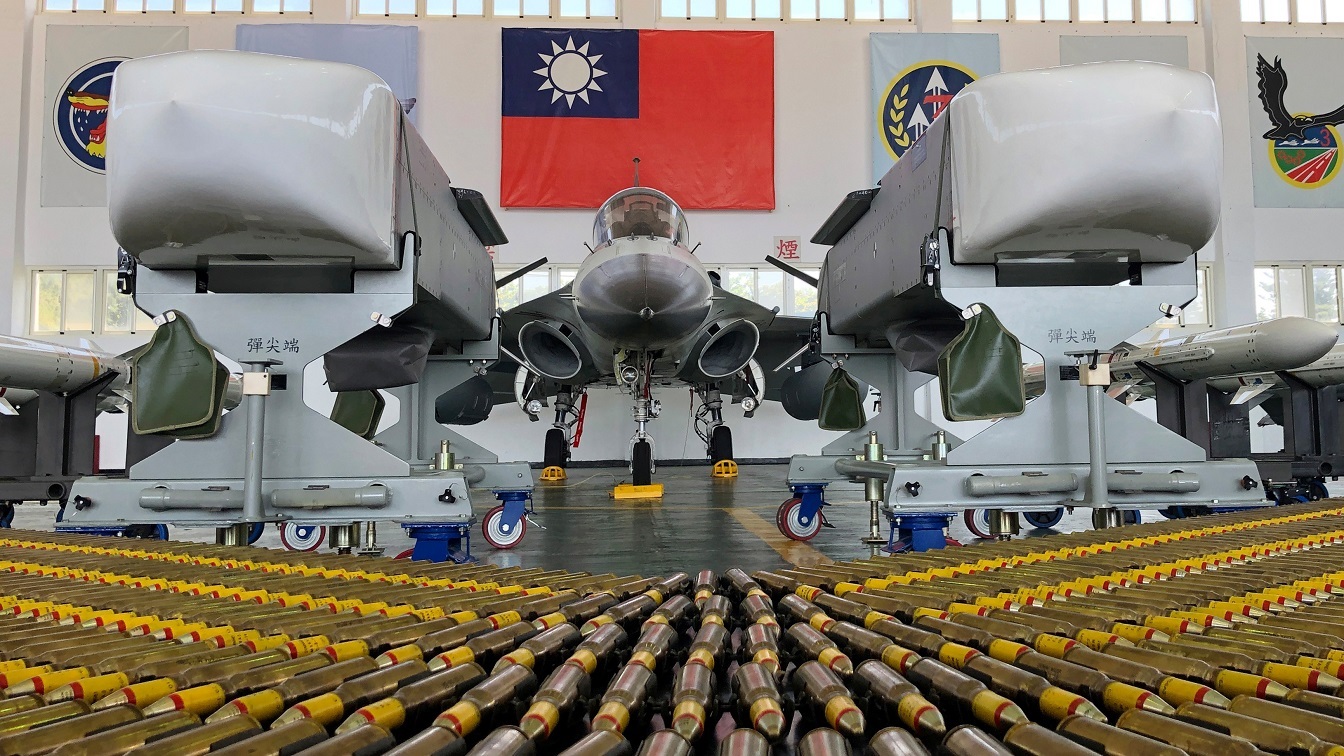
Recent reporting by The Defense Post and Taipei Times describes a Taiwanese military overhaul that will expand artillery and drone formations while placing greater weight on technology and firepower. Separate reporting by the South China Morning Post says Taiwan is developing autonomous drone swarms to confront Beijing's gray-zone pressure. The details matter because they point to a force designed for two different wars: a daily contest below the threshold of conflict and a high-intensity campaign against ships, aircraft, and landing forces.
Taiwan has also announced a large purchase of U.S.-made V-BAT unmanned aircraft, reportedly approaching $1 billion. V-BAT is a vertical-takeoff-and-landing system that can operate without a runway, carry an electro-optical or infrared payload, and remain overhead for many hours depending on configuration. It is useful for finding ships and landing craft, but only if the information reaches a firing unit quickly enough to matter.
What the Numbers Actually Buy
Artillery and drones solve different parts of the same problem. Drones provide persistence, targeting, and battle-damage assessment. Artillery provides the volume of fire. A small unmanned aircraft can identify a convoy; it cannot by itself stop one. A gun or rocket battery can destroy a target; without a resilient sensor and communications network, it may be firing at yesterday's position.
That creates a simple operational equation: sensor coverage multiplied by survivability multiplied by magazine depth. If any term approaches zero, the battery's combat value collapses. Taiwan's move toward mobile artillery is therefore more important than the headline number of new tubes. Mobile launchers can displace after firing, complicating Chinese counter-battery attacks. But mobility consumes fuel, maintenance hours, roads, camouflage, and trained crews. It is not a substitute for hardened command posts or redundant communications.
The same applies to autonomous swarms. A swarm can saturate a radar, force a ship to reveal its emissions, or complicate an amphibious assault. Yet autonomy does not remove the need for data links, electronic protection, launch teams, and rules for human control. Chinese jamming and cyber attacks would target that architecture before they targeted every individual airframe.
The First 72 Hours Are the Test
Beijing's daily pressure around Taiwan already provides a live rehearsal. Taiwan's defense ministry reported tracking 12 Chinese vessels and three military aircraft in one recent reporting period, while broader tallies this month have counted much larger numbers of Chinese aircraft and ships around the island. These encounters are not combat, but they force Taiwan to maintain watch schedules, preserve aircraft hours, and distinguish coercion from preparation.
In a blockade or invasion scenario, the tempo would be radically higher. The People's Liberation Army would combine missiles, electronic warfare, cyber operations, and maritime forces to suppress Taiwan's sensors and isolate units. A drone fleet that cannot be replenished, re-tasked, or protected from jamming becomes a collection of expensive observers. An artillery force without dispersed ammunition points becomes a target set.
The relevant question is not how many drones Taiwan can buy. It is how many useful targeting decisions can survive the first three days of a war.
Why the U.S.-Japan Exercise Matters
The timing also matters. The U.S. and Japan have been conducting Keen Sword 27 with tens of thousands of personnel, while Chinese forces have monitored the activity around the approaches to Taiwan and the Ryukyu Islands. The exercise demonstrates alliance access and interoperability, but it also shows Beijing the broad outline of the network it would need to disrupt.
For Taiwan, the lesson is not to wait for a carrier strike group. U.S. and Japanese forces can add surveillance, air defense, long-range fires, and logistics, but they cannot instantly replace a Taiwanese sensor-to-shooter chain that has been blinded. Taiwan's artillery and drone reform is valuable precisely because it improves the island's own ability to create uncertainty and impose costs before outside reinforcements arrive.
The Industrial Constraint
There is a second war beneath the tactical one: production. Drones are cheaper than fighters, but a serious campaign could consume them at a remarkable rate. Batteries, antennas, optical payloads, jammers, artillery shells, rocket motors, and spare parts all compete for industrial capacity. Taiwan's procurement plan must therefore be judged by replenishment, not by the size of the initial order.
The United States faces the same problem. Washington can transfer sensors and weapons, but shipping replacements across a contested Pacific is not guaranteed. Taipei needs domestic assembly, common control software, repair capacity, and stockpiles distributed across the island. Otherwise the force will look modern on the first morning and hollow by the fourth.
Bottom Line
Taiwan's emphasis on drones and artillery is a sound correction to a force structure that has often leaned too heavily on exquisite platforms. But the reform will work only if it produces a redundant kill chain: many sensors, mobile fires, protected communications, dispersed ammunition, and enough trained people to keep the network running under attack.
The concept is right. The war math is unforgiving. Taiwan does not need the most advanced drone fleet in Asia; it needs one that can still find targets, move fire, and replace losses after China has spent its first missile salvo trying to erase it.
Sources
- The Defense Post, reporting on Taiwan's artillery and drone reorganization, October 26, 2026.
- South China Morning Post, reporting on Taiwan's autonomous drone swarms, October 27, 2026.
- Taipei Times, reporting on Taiwan's technology and firepower-focused military restructuring.
- USNI News, reporting on Keen Sword 27 and U.S. naval activity in the western Pacific.
- Taiwan Ministry of National Defense, daily PLA activity reports.
Taiwan is reorganizing its military forces to enhance drone and artillery capabilities in response to potential Chinese aggression. The Taiwanese Armed Forces are expanding artillery and drone formations, including the development of autonomous drone swarms. A significant purchase of U.S.-made V-BAT unmanned aircraft has been announced. Recent military exercises involving U.S. and Japanese forces demonstrate alliance interoperability and readiness in the region.
- Taiwan is expanding its artillery and drone formations.
- Taiwan is developing autonomous drone swarms to counter Chinese pressure.
- Taiwan has announced a large purchase of U.S.-made V-BAT unmanned aircraft.
- Taiwan's military reform aims to improve resilience against Chinese attacks.
- The U.S. and Japan conducted military exercises near Taiwan.