
Five NATO States Strengthen Europe's Role 2026 — Without Eurofighter and Patriot, the Commitment Remains Political
 Dr. Klaus Weber
Five NATO Countries Strengthen Europe's Role 2026 — Without Eurofighter and Patriot, the Commitment Remains Political
On October 26, the defense ministers of France, Germany, Italy, Poland, and the United Kingdom found a remarkable formula in Paris. Europe is to take on more responsibility for its security, states the E5 declaration. The United States, however, remains an "indispensable Ally." This is diplomatically clever. Strategically, it is primarily an admission: Europe's larger role does not begin with autonomy, but with a better-organized dependence.
The Political Message from Paris
The five countries assess Russia as the most acute and long-term threat to Euro-Atlantic security. They refer to the war against Ukraine, violations of allied airspace, sabotage, and hybrid attacks. At the same time, they promise more political and military leadership within NATO, higher readiness, and closer defense industry cooperation based on common, standardized requirements.
The crucial sentence is found elsewhere: EU initiatives are to complement NATO, avoid duplicative structures, and remain open to non-EU NATO allies under certain conditions. In doing so, the E5 distance themselves from both a purely national procurement policy and a European rhetoric that confuses strategic autonomy with institutional separation. The measure is not the number of summit declarations, but whether a Polish unit, a German brigade, and a British squadron can actually operate together.
Standardization is the Real Test
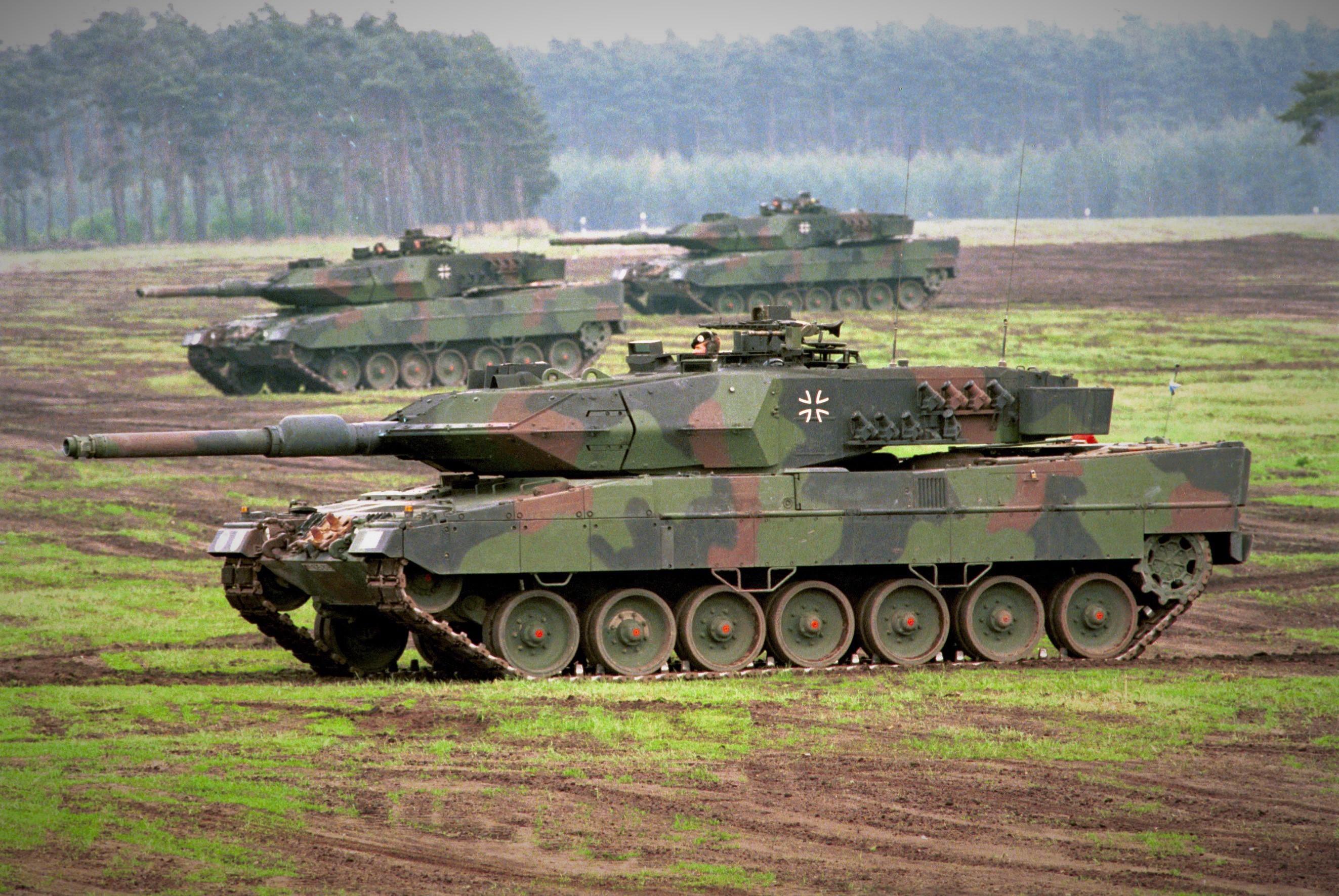
"Common requirements" sounds technocratic, but it is the core of the problem. Europe's armed forces possess capable systems — from the Leopard 2 to the Eurofighter to the Patriot air defense. Their weakness lies less in the individual equipment than in the differing ammunition stocks, data standards, maintenance contracts, spare parts chains, and national release procedures.
A Leopard 2 is only a European contribution when crews, maintainers, and logistics function across borders. A Eurofighter strengthens NATO only when mission data, spare parts, and air refueling are not politically negotiated anew for each deployment. And Patriot remains a scarce capability if Europe buys systems but does not plan missile systems, sensor integration, and re-production together. This is the difference between a European capability and five national business cards.
Ukraine as a Concrete Test Case
The E5 declaration promises Ukraine political, military, and financial support as well as robust security guarantees after a ceasefire or peace agreement. However, the current debate about additional air defense shows how far the political commitment and the material reality are apart. European states can deliver or procure systems in the short term. The more difficult question is who will bear the industrial burden over several years, who will prioritize scarce interceptor missiles, and who will ensure the air defense of Europe and Ukraine simultaneously in case of emergency.
The answer must not consist solely of further American deliveries. Washington remains indispensable for reconnaissance, strategic air defense, command systems, and nuclear deterrence. But that is precisely why Europe must strengthen the areas where it can reduce its dependence: joint orders, larger production lots, compatible spare parts, and reliable financing across election periods. Loans and percentage targets are no substitute for available units.
The Institutional Dilemma
The E5 consciously rely on NATO as a framework and on the EU as a financing and regulatory power. This is sensible. NATO has the military standards and command structures; the EU has money, internal market instruments, and industrial policy levers. However, this division of labor only works if it does not lead to a jurisdictional dispute between Brussels, the capitals, and NATO commands.
Germany will be particularly scrutinized in this regard. Berlin regularly commits to European responsibility but remains slow in procurement, personnel, and industrial prioritization. France demands strategic sovereignty while simultaneously protecting national decision-making spaces. Poland pushes for mass and eastern flank capability, while the United Kingdom wants to remain outside the EU and still shape Europe's security architecture. Italy brings industrial and maritime capabilities but struggles with fiscal pressure. Therefore, the E5 is not a homogeneous leadership block but a negotiation table with five different definitions of responsibility.
The declaration from Paris is a step forward in political coordination, but not yet proof of military integration. Its credibility will be measured by whether "common requirements" lead to joint contracts within twelve months and operational capabilities within five years.
More Responsibility or Just More Burden Sharing
Europe is indeed currently taking on more burdens. However, this does not automatically mean it is becoming strategically more autonomous. As long as critical reconnaissance, air defense, precision munitions, and command infrastructure remain predominantly American, the more precise description is: Europe is becoming more capable within NATO, not independent of the United States.
This need not be a political shortcoming. A strong European pillar can stabilize the transatlantic alliance, especially because it relieves Washington. The dangerous mistake would be to assume that the pillar is already for an independent house. The E5 have named the right institutional framework. Now they must show whether five states with five budgets and five strategic cultures can indeed create a common capability. More responsibility is necessary. But without joint production, it remains primarily a more elegant form of burden sharing.
Sources: GOV.UK, “E5 Defence Ministers' Statement,” October 26, 2026; Al Jazeera, “European states pledge to boost air defence support for Ukraine,” October 25, 2026; Italian Ministry of Defense, information on the E5 meeting in Paris, October 26, 2026.
Five NATO countries, including France, Germany, Italy, Poland, and the United Kingdom, agreed to strengthen Europe's role in security during a meeting in Paris on October 26, 2026. They identified Russia as a significant threat and committed to enhancing military cooperation and support for Ukraine. The U.S. is acknowledged as a crucial ally, while the E5 countries aim to improve defense capabilities through standardized requirements and closer industrial cooperation.
- Five NATO countries agreed to enhance Europe's security role.
- The U.S. remains an indispensable ally for Europe.
- Russia is viewed as the most acute threat to Euro-Atlantic security.
- The E5 countries promise military support to Ukraine.
- The report emphasizes the need for standardized military cooperation.