
Taiwan's First Batch of MQ-9B Completes Test Flights, PLA's Surveillance of the Taiwan Strait's Gray Zone Enters a New Phase
 S.W
S.WThe First Batch of MQ-9B in Taiwan Completes Test Flight, PLA's Surveillance in the Taiwan Strait Enters a New Phase
On September 14, the Taiwan Air Force conducted the first test flight of the first two MQ-9B "SeaGuardian" drones after their arrival in Taiwan at Hualien Base. The four drones ordered by Taiwan were shipped to the island in June this year, and after nearly three months of assembly, testing, and personnel preparation, they finally took off from the eastern airport. This timeline reveals an easily overlooked fact: what Taiwan received was not a "ready-to-use" system, but a set that requires the establishment of ground stations, maintenance, training, and data link processes.
How Far Can the MQ-9B See?
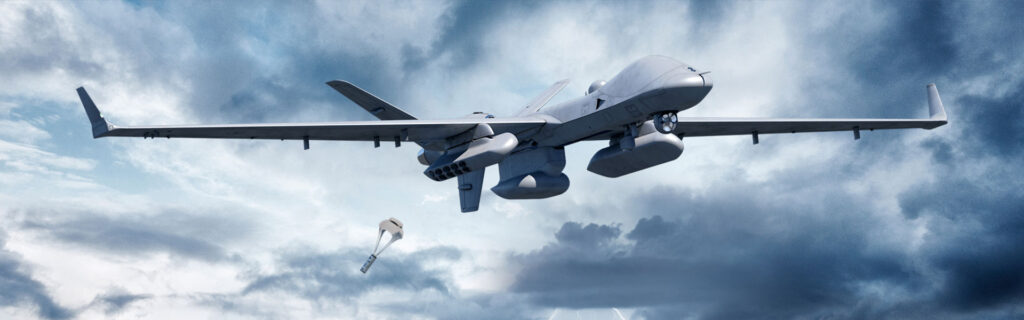
According to the manufacturer's general specifications, the MQ-9B uses satellite communication for beyond-visual-range control, with a maritime configuration endurance of over 30 hours, a standard mission radius of about 1,200 nautical miles, and the capability to integrate maritime search radar, automatic identification systems, and electronic support equipment. Its value lies not in competing for air superiority like a fighter jet, but in maintaining a low-cost maritime observation line for extended periods. For Taiwan, the focus is on monitoring naval and air force activities to the east and southeast, as well as changes in maritime routes under a potential blockade of the Taiwan Strait.
However, parameters cannot be directly equated to battlefield effects. The MQ-9B requires a stable satellite link, reliable takeoff and landing support, and continuous data processing capabilities; if the PLA suppresses airports, communication nodes, or navigation signals at the onset of a crisis, the ability of the four aircraft to maintain continuous operations may be more critical than the endurance figures of a single aircraft.
How It Changes the PLA's Operational Costs
The South China Morning Post cited Taiwanese military sources stating that the primary mission of these drones is intelligence, surveillance, and reconnaissance, aimed at countering PLA and related forces' gray zone activities. The key here is not whether the MQ-9B will immediately detect every military aircraft, but whether Taiwan can convert one-time visual or radar contacts into continuous, verifiable activity records.
In recent years, the PLA has combined the use of military aircraft, warships, and coast guard operations, often creating sustained pressure through high-frequency patrols. Manned aircraft are responsible for rapid response, while drones are suitable for maintaining long-term surveillance at lower-risk distances. If Taiwan can connect the MQ-9B with shore-based radar, naval vessels, and allied intelligence systems, it may reduce reliance on manned reconnaissance aircraft and make PLA coast guard activities in the waters east of Taiwan easier to track and disclose.
However, the scale of four aircraft means it is primarily an incremental sensor capability, rather than a campaign-level force. Considering maintenance, rotation, weather, and training, the number of aircraft in the air at any one time may only be one or two. In simple terms, this is more like tying a knot in a maritime surveillance net rather than weaving a net from scratch. What Taiwan truly needs to address is data link anti-jamming and spare parts support, both of which are the hardest to prove through public imagery.
The Supply Chain is the Focus for Future Observation
The assembly location of the MQ-9B and the U.S. military-certified hangar indicate that Taiwan still relies on the manufacturer and external support in the initial phase. Over the next 12 months, three indicators should be observed: first, when the other two aircraft will complete test flights and form a rotation; second, whether Taiwan will publicly establish a stable operational rhythm at the eastern base; third, whether maritime radar, electronic support, and command systems are truly integrated into the local air defense network.
The author believes that Beijing is more likely to view this capability as an upgrade to its surveillance system rather than a standalone military threat. The PLA's response focus may be on increasing electronic suppression of drone links and bases, arranging decoys and electronic deception, and altering activity rhythms through coast guard and military aircraft. As a result, every hour of aerial surveillance time obtained by Taiwan will become more expensive.
Source and Judgment Boundaries
This article synthesizes reports from the South China Morning Post dated September 15, 2026, specifications from General Atomics Aeronautical Systems, and publicly available information from the Taiwanese military. Currently, there is limited public information on the actual mission radius, weapon configuration, and data link details of the MQ-9B, and related judgments still await verification from subsequent deployment records.
The real question is not whether Taiwan can get two MQ-9Bs airborne today, but whether these four drones can turn a single test flight into continuous maritime situational awareness throughout the year under the ongoing pressure from the PLA.
Taiwan's Air Force conducted the first test flight of two MQ-9B drones at Hualien on September 14. The drones, part of a four-unit order, are designed for intelligence, surveillance, and reconnaissance missions against PLA activities. Their operational success will depend on stable satellite communications and data processing capabilities.
- Taiwan's Air Force completed the first test flight of two MQ-9B drones on September 14.
- Taiwan has received four MQ-9B drones, which were shipped in June.
- The drones are intended for intelligence, surveillance, and reconnaissance against PLA activities.
- The operational effectiveness of the drones depends on stable satellite links and data processing capabilities.