
Taiwan's HIMARS Conducts First Live Fire on the West Coast, PLA Amphibious Landing Must Recalculate 3-Minute Countermeasure Window
 Li Minghui
Taiwan's HIMARS Conducts First Live Fire on the West Coast, PLA Must Recalculate 3-Minute Countermeasure Window for Amphibious Landings
On June 10, the few M142 HIMARS near the mouth of the Dajia River in Taichung caught my attention not for the firepower, but for the relocation time. USNI News cited Taiwanese sources stating that after firing, the launch vehicle can relocate to a new position within 3 minutes; Taiwan Plus revealed that a total of 32 rockets were fired, with 4 failing to launch. This detail is more valuable than the propaganda figures, as it simultaneously exposes the tactics the Taiwanese military desires and the issues of real-world reliability.
The West Coast Launch Alters the Firepower Calculations for the 48 Hours Before Landing
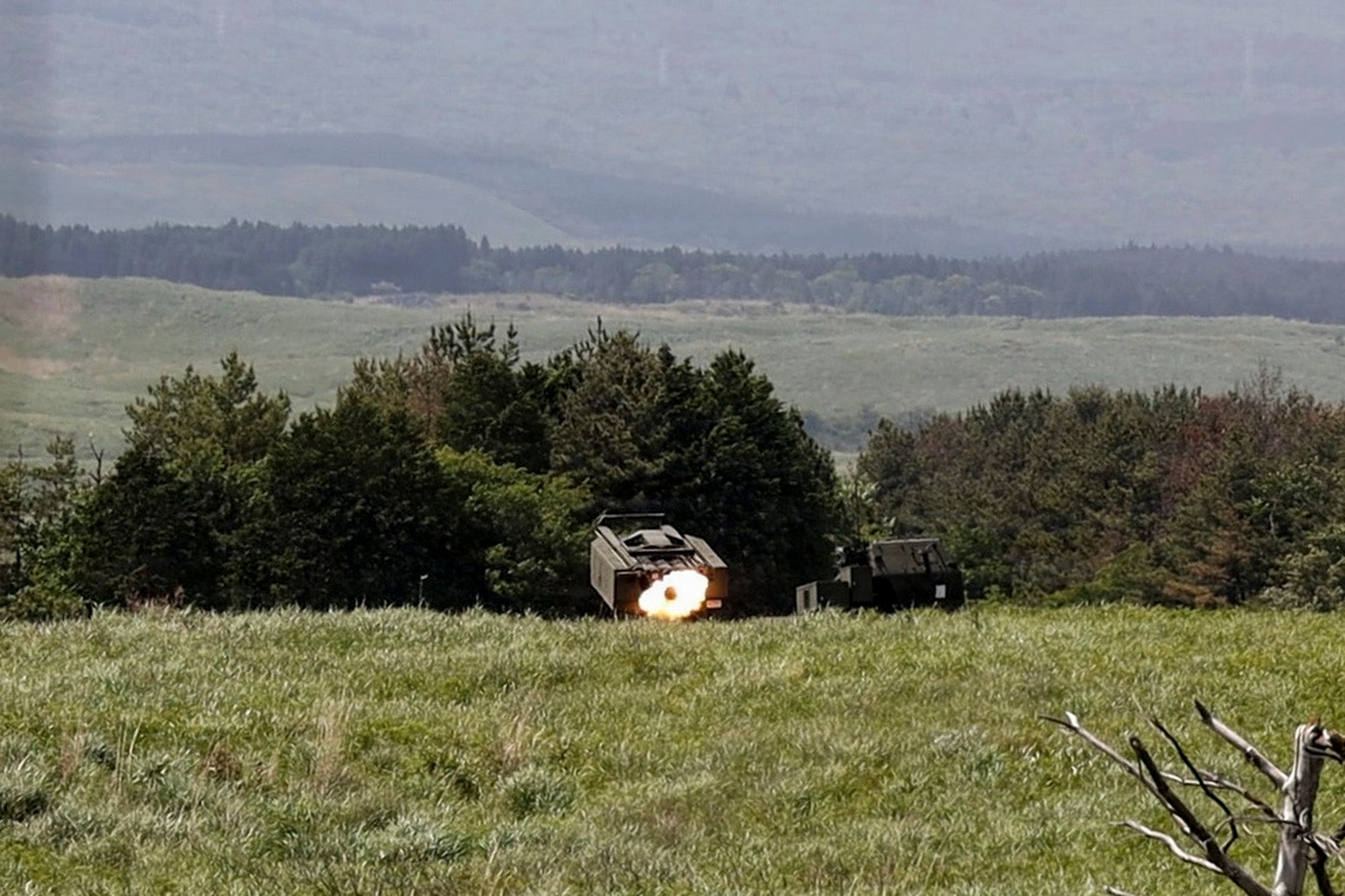
In the past, the Taiwanese military tested HIMARS primarily to validate the system itself; this time, the live fire on the West Coast aimed at the Taiwan Strait carries a different meaning. The Taiwan Strait is approximately 180 kilometers wide, and the M142 is merely a 6-tube launch platform, with the key being the ammunition. The standard GMLRS has limited depth coverage, while the ATACMS can reach approximately 300 kilometers. If longer-range munitions are integrated in the future, coastal ports, assembly areas, temporary loading points, and some airports along Fujian's coast will all be included in the Taiwanese military's operational firepower assumptions.
In simple terms, this does not mean Taiwan suddenly has the capability to counterattack the mainland; rather, it adds another mobile rocket artillery node that must be suppressed during the three phases of the PLA's amphibious landing: loading, transit, and beach assault. For landing forces, the most vulnerable moment is not when the ships are still at sea, but when vehicles, fuel, ammunition, and engineering equipment have just been unloaded from vessels or roll-on/roll-off ships and have not yet formed a deep defense.
3 Minutes of Mobility Seems Short, But It Doesn't Mean It's Impossible to Strike
The survival logic of HIMARS is to quickly leave the position after firing to avoid being targeted by counter-battery radars, drones, and loitering munitions. The figure of 3 minutes sounds appealing, but several prerequisites must be met: roads must be pre-surveyed, there must be enough alternate positions, communication links must not be suppressed, and resupply must keep pace. The densely populated cities in western Taiwan provide a favorable road network for concealed movement, but they also make it easier for reconnaissance to lock onto bottleneck intersections.
I believe the PLA really needs to recalculate not the range of a single HIMARS, but the speed of closure in the detection-location-strike chain. If they continue to handle it with traditional artillery position thinking, they will be led by the opponent's short stay window; if they integrate reconnaissance drones like the WZ-7, BZK series drones, electronic reconnaissance aircraft, long-range artillery, and loitering munitions into a continuous search network, the mobility advantage of HIMARS will be compressed. The problem is that maintaining such a search network requires high-density operation over a long period, which is not inexpensive.
The Four Unlaunched Rockets Indicate the Taiwanese Military is Still Climbing the Learning Curve
Of the 32 rockets, 4 failed to launch, giving a surface failure rate of 12.5%. This cannot simply be interpreted as the system being unreliable, as training rounds, launch procedures, and target range safety restrictions could all affect the results. However, it reminds us that the Taiwanese military still has a distance to cover from receiving the equipment to proficiently operating it. USNI News reported that Taiwan's first batch of HIMARS will be received in May 2025, with plans to increase the total number to 111 by adding 82 more units; from a production and training perspective, this is not an equipment system that can be fully mastered in just one year.
The comparison here is quite interesting. The PLA's amphibious assault emphasizes system scale, while the Taiwanese military's HIMARS emphasizes high mobility in small units. The former is like a large piece of construction machinery, relying on throughput and rhythm; the latter is like an electric wrench, small in itself, but when applied to a critical bolt, it can cause the entire machine to jam. Taiwan's shortcoming lies in its ammunition stockpile and maintenance system, while the PLA's shortcoming is the need to simultaneously suppress airports, air defense, coastal defense, command posts, and this kind of mobile long-range artillery at the beginning of a conflict.
Recent Low Altitude Intelligence Should Not Be Misinterpreted as a Decrease in Pressure
On June 17, Taiwan's defense department reported that from 6 AM the previous day to 6 AM that day, no PLA aircraft were detected circling Taiwan, but 6 PLA naval vessels were active around the Taiwan Strait. This number can easily be interpreted by outsiders as a cooling off, but I do not see it that way. A decrease in air sorties does not mean that maritime surveying, vessel patrols, communication reconnaissance, and gray zone pressures have simultaneously decreased. For targets like HIMARS, what is more important during peacetime is to establish a target database: which roads are passable, which bridges can bear weight, and which warehouses may store ammunition.
Therefore, the significance of this live fire on the West Coast is not that Taiwan has obtained a trump card, but that the technical threshold for the Taiwan Strait landing operation has been raised another notch. If the PLA's future exercises continue to only showcase the number of vessels and landing waves, while publicly displaying less about counter-mobility firepower, counter-drone reconnaissance, and battlefield denial capabilities, that would be the more concerning aspect.
Main reference sources: USNI News report on June 11, Axios report on June 17, Taiwan's defense department report on June 17 regarding activities around the Taiwan Strait.
Taiwan conducted its first live-fire exercise of the M142 HIMARS on June 10 near the Dajia River, launching 32 rockets, with 28 successfully fired. The exercise demonstrated the system's ability to reposition within 3 minutes, impacting PLA amphibious landing strategies. However, 4 rockets failed to launch, highlighting reliability concerns as Taiwan aims to expand its HIMARS capabilities by 2025.
- Taiwan launched 32 rockets from HIMARS, with 28 successfully fired.
- The HIMARS can reposition within 3 minutes after firing.
- The exercise alters the firepower calculations for PLA amphibious landings.
- 4 rockets failed to launch, indicating reliability issues during the exercise.
- Taiwan plans to increase its HIMARS fleet to 111 units by 2025.