
Taiwan's HIMARS Delay Exposes a First Island Chain Firepower Gap
 Marcus Chen
Taiwan's HIMARS Delay Exposes a First Island Chain Firepower Gap
Washington may postpone new Taiwan arms notifications until after the APEC and G20 summits. That is the political headline. The military problem is simpler: every month of delay extends the time Taiwan must defend the first island chain with a force that is still waiting for the weapons it already ordered.
Reuters reported on September 23 that Taipei would maintain close contact with Washington over arms sales, after reporting that the administration was weighing a delay. The South China Morning Post had already reported that the timing of US approvals could be shaped by the diplomatic calendar. For Taiwan, that calendar is measured against delivery queues, training cycles, and the number of launchers that can actually survive the opening days of a war.
The HIMARS Queue Is the Concrete Test
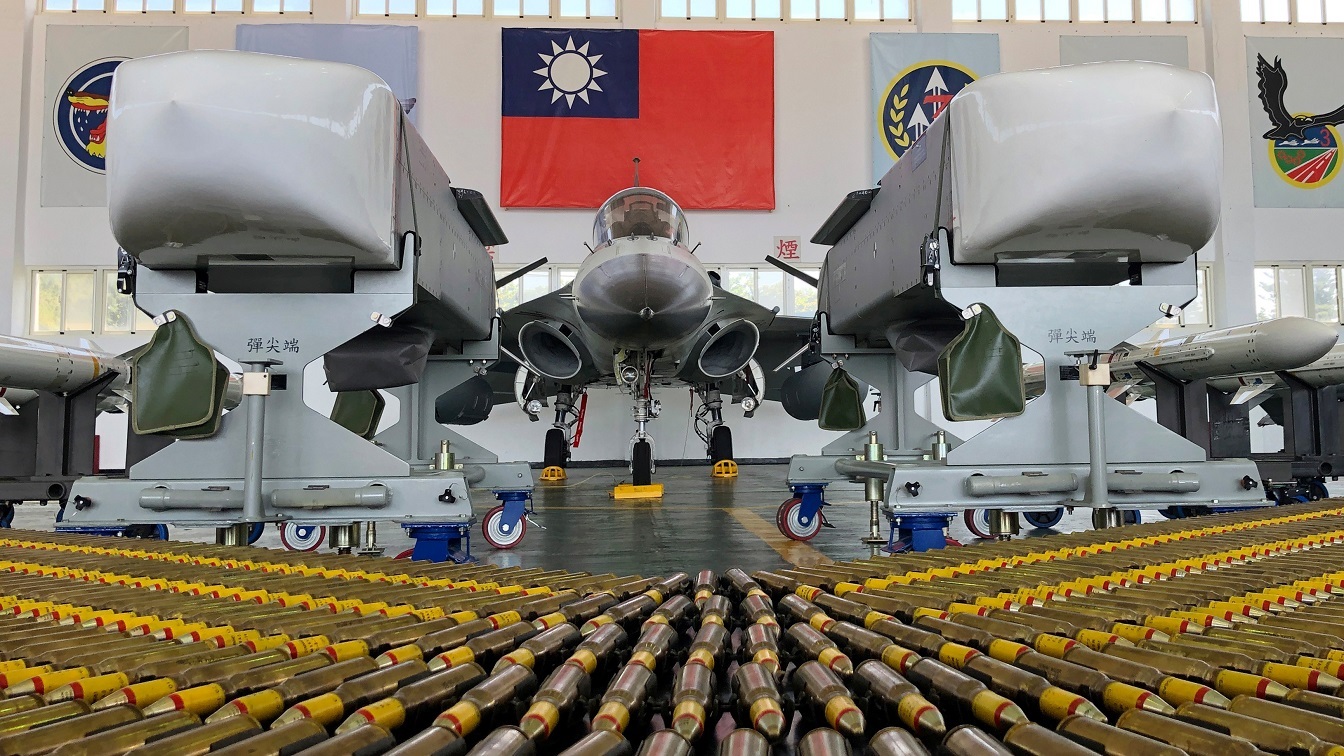
Taiwan's M142 High Mobility Artillery Rocket System purchase is a useful measure because it is not a paper capability. HIMARS combines a truck-mounted launcher with a small crew, satellite-supported targeting, and precision rockets that can be dispersed between firing points. A launcher can relocate after firing, hide under cover, and complicate Chinese efforts to suppress the island's coastal defense network.
But a launcher without its missiles is transport equipment. A missile unit without trained crews, reload trucks, camouflage, communications, and a practiced targeting chain is a collection of expensive vehicles. Taiwan has been buying the full architecture in pieces, while US production capacity is also supporting Ukraine and other customers. The result is a familiar defense-industrial arithmetic: a contract date is not an operational capability date.
The range matters as much as the inventory. HIMARS rockets can threaten landing forces, ports, logistics nodes, and ships inside the battlespace, but only if Taiwan can preserve the sensors and command links that generate targets. China will attack those networks first. The relevant question is therefore not how many launchers Taiwan has purchased. It is how many can fire, relocate, and receive a new target on day three.
Delay Is More Than a Diplomatic Signal
The proposed delay is not the same as cancellation, and it would be wrong to treat it as proof that Washington has abandoned Taiwan. It is still a warning about sequencing. Beijing gets to read the calendar, while Taipei must plan against a force that may not arrive on the calendar promised in the sales announcement.
Taiwan's Ministry of National Defense continued reporting Chinese aircraft and naval activity around the island on September 23. Those daily encounters are not an invasion timetable. They are the operating environment in which Taiwanese units must train, maintain equipment, and build stockpiles. Pressure below the threshold of war consumes readiness without giving Taipei the legal or political clarity of an actual attack.
The diplomatic rationale is obvious. A large arms announcement before a Trump-Xi meeting could be used by Beijing as evidence that Washington is escalating. The administration may prefer to preserve bargaining space. But bargaining space in Washington does not create additional missile magazines in Taiwan. Nor does it shorten the time required to train crews on a new fire-control system.
Cheap Munitions Will Decide the Expensive Fight
Recent US defense discussions have emphasized affordable mass for a Taiwan contingency. That is the correct direction, but the word “affordable” can conceal the real bottleneck. Taiwan needs thousands of weapons, replacement parts, fuel, mobile air defenses, decoys, and redundant communications. It needs them delivered before a blockade, not promised after one begins.
Air & Space Forces reported on September 22 that lower-cost munitions could help the US Air Force in a Taiwan conflict, while also stressing that more would be required. The same logic applies to Taiwan's ground forces. A few exquisite missiles can create a tactical problem for China. Sustained sea denial requires enough weapons to keep creating that problem after the first salvo, after satellite links are degraded, and after launch sites are hunted.
That is why a delayed notification has operational consequences even before a contract is signed. It pushes production, training, and sustainment to the right. The schedule becomes a targeting problem for Beijing: identify which capabilities are still in transit, then plan around the gap.
The First Island Chain Has a Timing Problem
Any sailor who has watched a deployment schedule knows the difference between “approved” and “on station.” Taiwan's defense depends on closing that difference. HIMARS is valuable because it supports sea denial from land, but its effect is cumulative. One battery can be suppressed. A distributed force with multiple reloads, deception, and resilient targeting is much harder to suppress.
Washington should separate summit diplomacy from production decisions. If a notification must wait, procurement, training, and stockpile preparation should not. Taipei should also publish fewer headline totals and more readiness metrics: launchers delivered, crews certified, reloads available, and units able to operate without fixed communications.
The military conclusion is uncomfortable. Taiwan does not need another statement that the United States is committed to peace and stability. It needs a predictable flow of weapons that can survive contact with a Chinese blockade and still fire on the fourth day. Until that flow is real, the first island chain has a firepower gap measured not in miles, but in months.
Sources
- Reuters, “Taiwan to maintain close contact with US on arms sales,” September 23, 2026.
- South China Morning Post, “US weighs delaying Taiwan arms sales until after APEC and G20 summits,” September 19, 2026.
- Air & Space Forces Magazine, “Experts: Affordable Munitions Could Help USAF in Taiwan Conflict, but More Is Needed,” September 22, 2026.
- Taiwan Ministry of National Defense, “PLA activities in the waters and airspace around Taiwan,” September 23, 2026.
- The Diplomat, “On Taiwan, US ‘Strategic Ambiguity’ Is Not Dead Yet,” September 23, 2026.
Taiwan faces delays in the delivery of M142 HIMARS systems, impacting its defense capabilities against potential Chinese aggression. The delays are influenced by political considerations related to upcoming APEC and G20 summits. Taiwan's Ministry of National Defense continues to monitor Chinese military activity in the region, highlighting the urgency for timely arms deliveries to maintain readiness.
- Taiwan is experiencing delays in the delivery of HIMARS systems from the US.
- The delays are linked to political considerations surrounding APEC and G20 summits.
- Taiwan's defense capabilities are at risk due to the lack of timely delivery of military equipment.
- Taiwan's Ministry of National Defense continues to report Chinese military activity around the island.
- Affordable munitions are emphasized as necessary for Taiwan's defense strategy.