
Taiwan's MQ-9B Deployment Will Test China's Maritime Blind Spots
 Marcus Chen
Taiwan's MQ-9B Deployment Will Test China's Maritime Blind Spots
Taiwan's four MQ-9B SeaGuardian unmanned aircraft are approaching operational deployment, according to Taiwan News on November 22. That sounds like a modest procurement milestone. It is more useful to read it as a test of whether Taiwan can turn a long-endurance drone into a reliable maritime intelligence system while the People's Liberation Army Navy (PLAN) works to make the island's approaches opaque.
The Aircraft Adds Time, Not Magic
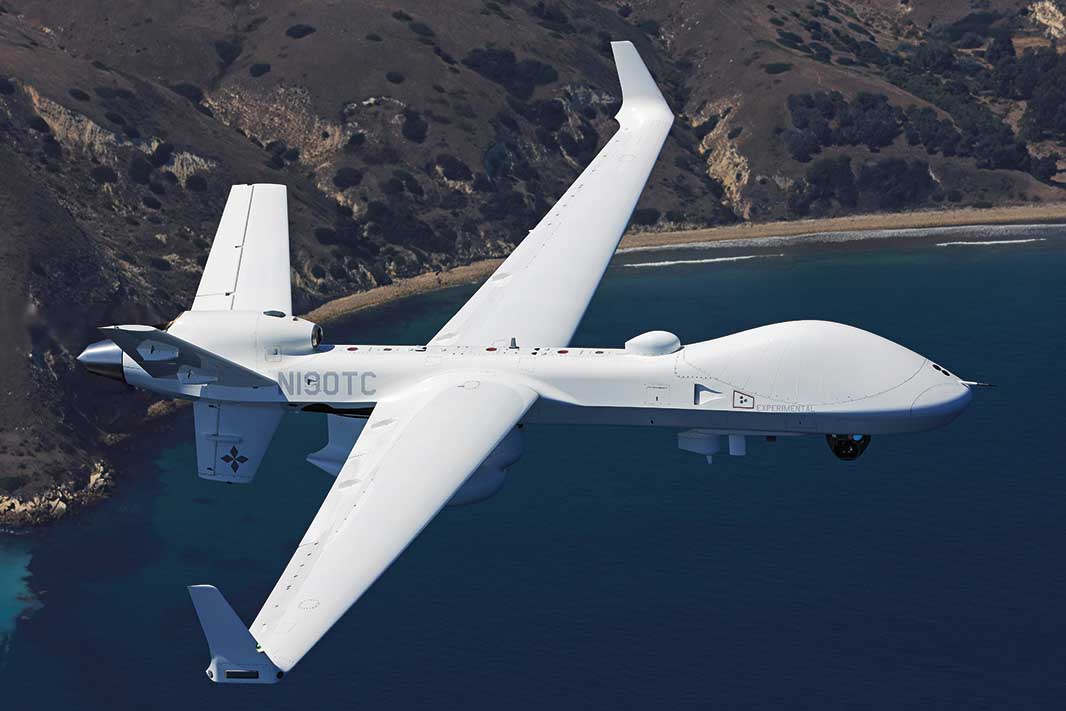
The MQ-9B is a serious surveillance platform. General Atomics lists the SeaGuardian with more than 40 hours of endurance, a 79-foot wingspan, satellite and line-of-sight control links, and a maritime sensor package built around surface-search radar, electro-optical and infrared cameras, and automatic identification system integration. Its value is persistence: an aircraft can remain on station for a full watch cycle instead of forcing Taiwan to rotate a manned patrol aircraft every few hours.
That persistence matters because Taiwan is not trying to find one dramatic target. It needs a continuous track on a large number of Chinese coast guard cutters, naval auxiliaries, survey ships, and combatants operating around the island and through the Bashi Channel. A radar contact that appears once is information. A track maintained across several hours can support targeting, cue fighters, update coastal missile batteries, and expose a pattern of coercion.
The platform is not stealthy, fast, or built to survive inside a dense Chinese air-defense envelope. Its survivability depends on distance, routing, electronic protection, and the assumption that Taiwan can keep its ground stations and communications network functioning. The MQ-9B therefore expands Taiwan's sensor layer; it does not create a new air-defense layer.
The Real Contest Is the Kill Chain
Beijing's grey-zone operations are designed to exploit exactly the gap between detection and action. Chinese maritime forces can use coast guard and maritime militia vessels to create ambiguity, while the PLAN stays close enough to provide escalation control. Taiwan may see the ships, but seeing them is not the same as legally or militarily responding to them.
The four-aircraft fleet also imposes arithmetic. Four airframes cannot sustain four continuous orbits once maintenance, crew training, weather, and launch recovery are counted. Even with 40-plus hours of endurance, the useful number of aircraft on station will be a fraction of the inventory. Taiwan will need to prioritize sectors: the eastern approaches, the waters south of Taiwan, or the routes linking the Bashi Channel to the Philippine Sea. It cannot watch everything at once.
That limitation is not a reason to dismiss the purchase. It is the reason the MQ-9B must be connected to other sensors. Taiwan's P-3C patrol aircraft, surface radars, satellites, fighter aircraft, and coastal units need a common operating picture. The drone's most important output may be a track passed to another shooter, not a weapon released from its own hardpoints. In a crisis, the question will be whether that track reaches the right command node before the target changes identity, direction, or radio signature.
China Will Attack the Network Before the Drone
The PLAN does not need to shoot down every SeaGuardian to reduce its value. Jamming satellite links, spoofing navigation signals, attacking ground-control stations, and forcing Taiwan to operate under a communications blackout may be enough. The PLA has spent years building the ability to contest the electromagnetic spectrum and to combine aviation, missile, cyber, and maritime pressure in a single operation.
That creates a design requirement Taiwan cannot solve with airframes alone. It needs dispersed launch and recovery sites, redundant control stations, alternate data links, hardened fuel and maintenance points, and crews trained to operate with degraded connectivity. A drone fleet parked at one vulnerable base is an expensive sensor waiting for the first missile salvo.
The same logic applies to the United States. Washington approved Taiwan's MQ-9B sale as a way to improve maritime domain awareness, but an export program is not a substitute for a wartime support architecture. The United States can provide software, spares, training, and intelligence connectivity. It cannot assume that a small Taiwanese fleet will remain fully available after the opening hours of a blockade or invasion campaign.
What Success Would Actually Look Like
Taiwan should measure the program against three operational tests. First, can it maintain a legally credible, multi-hour record of Chinese maritime activity without relying on a single communications path? Second, can it distribute the data quickly enough for a missile battery or aircraft to act on it? Third, can it regenerate sorties after losing a ground station, runway, or control team?
Those tests are less glamorous than discussing payloads, but they are the relevant ones. The MQ-9B's endurance and sensor suite give Taiwan more time to observe. They do not guarantee more time to decide. If the data chain is slow, fragmented, or vulnerable to jamming, the drone becomes an expensive camera rather than a combat multiplier.
Taiwan's MQ-9B deployment is still a useful move. Four aircraft will not close the island's surveillance gap, and they will not stop a blockade by themselves. They can, however, make Chinese maritime coercion harder to hide and give Taiwan a better chance of distinguishing routine pressure from preparations for war. The result depends on the network around the drone. China will test that network first.
Sources
- Taiwan News, “Taiwan's MQ-9B Sea Guardians near operational deployment,” November 22, 2026.
- General Atomics Aeronautical Systems, MQ-9B SeaGuardian product information.
- U.S. Defense Security Cooperation Agency, Taiwan MQ-9B remotely piloted aircraft sale notification.
- South China Morning Post, “Taiwan tests US-made MQ-9B drones to counter PLA grey-zone operations,” September 15, 2026.
Taiwan is deploying four MQ-9B SeaGuardian unmanned aircraft to enhance its maritime surveillance capabilities. This deployment, reported on November 22, 2026, aims to monitor Chinese maritime activities and improve Taiwan's intelligence gathering in the face of increasing pressure from the People's Liberation Army Navy. The MQ-9B's advanced sensors and endurance will support continuous tracking of various Chinese vessels operating near Taiwan.
- Taiwan is deploying four MQ-9B SeaGuardian drones for maritime surveillance.
- The MQ-9B has over 40 hours of endurance and advanced sensor capabilities.
- Taiwan's surveillance efforts aim to monitor Chinese maritime activities.
- The deployment is part of Taiwan's strategy to counter Chinese grey-zone operations.