
Tear Off the Disguise! Japan's Type 25 High-Speed Glide Bomb Exceeds Defense Range
August 15, 1945, is the day of Japan's unconditional surrender. On that day, the Japanese Emperor announced the unconditional surrender through a broadcast of the "Imperial Rescript on the Termination of the War." What is the Japanese government doing 81 years later? On August 4, the Japanese government officially released the 2026 edition of the "Defense White Paper," which deliberately distorts the surrounding security situation and exaggerates the so-called "external threats" to pave the way for its military expansion and armament increase.
The new version of Japan's "Defense White Paper" mentions several new types of weapons and systems. Japan refers to the Type 25 High-Speed Glide Bomb as an island defense weapon; is it really for defense?
Military Observer Wei Dongxu: Japan often wraps its development of new weapons, especially offensive weapons, in this so-called defensive attribute packaging. If we look at the performance and operational mode of the Type 25 High-Speed Glide Bomb, it is a typical, outright long-range strike system, and it is certainly intended for offensive combat missions.
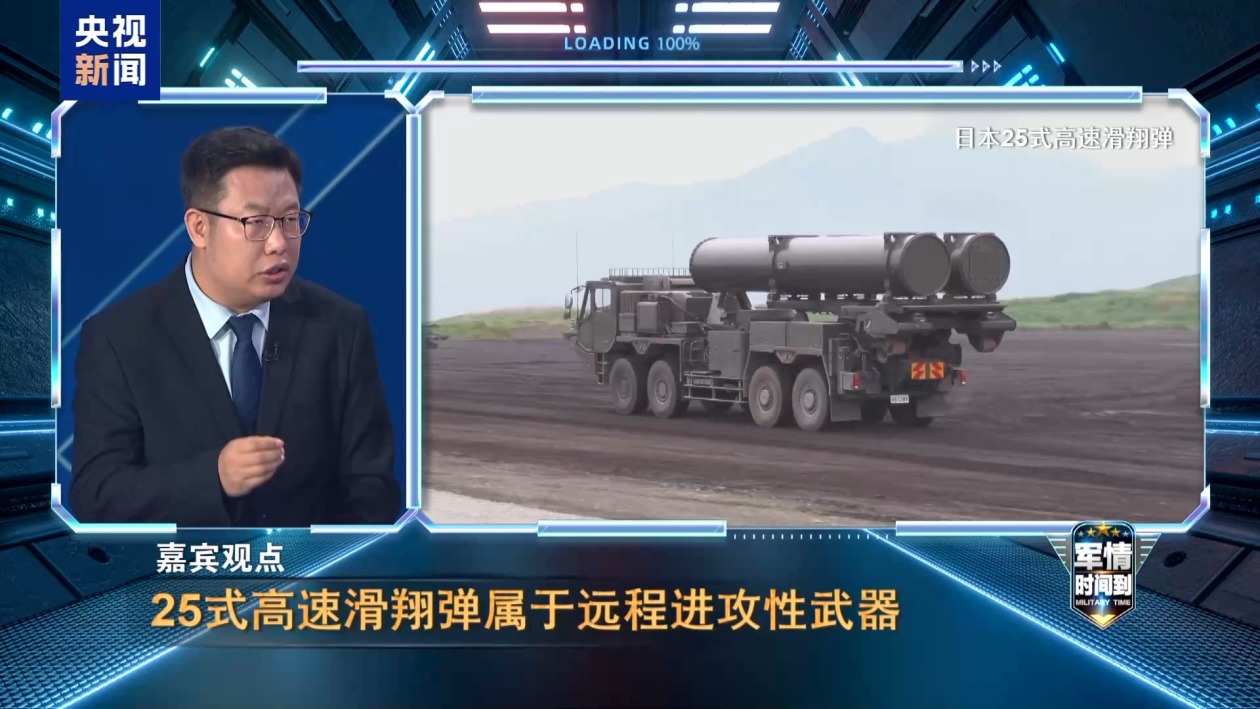
The current Type 25 High-Speed Glide Bomb is the basic model, with a maximum range of about 600 to 800 kilometers. By 2027, the Type 25 High-Speed Glide Bomb will be upgraded to BLOCK 2 technology, at which point it will use a wave-riding body warhead, and the final range will exceed 2000 kilometers. If it is for the defense of Japan's own islands, there is no need for a range of over 2000 kilometers. Therefore, the Type 25 High-Speed Glide Bomb, including its improved versions, is a typical offensive weapon intended for preemptive strikes. Thus, the "Defense White Paper" should be seen as a declaration of offensive intent.
How strong is Japan's offensive capability?
Military Observer Wei Dongxu: Japan has formulated a three to five-year plan to enhance its missile capabilities. It is taking a two-pronged approach: one leg is domestic research and development, with the Type 25 Glide Bomb and the Type 25 Anti-Ship Missile just beginning to be deployed, and production capacity will take some time to ramp up. Japan has purchased hundreds of Tomahawk cruise missiles from the United States, primarily for the Maritime Self-Defense Force. It combines domestic development with imports to quickly enhance its long-range strike capabilities. Therefore, Japan aims to conduct military interventions not only in the surrounding regions but also seeks to extend its reach and carry out military expansion actions in broader areas.
Japan is developing the Type 25 high-speed glide missile, which is designed for offensive operations with a range exceeding 2000 km. The 2026 Defense White Paper outlines Japan's military expansion, emphasizing new weapon systems and a shift towards offensive capabilities. This includes the procurement of Tomahawk cruise missiles to enhance long-range strike capabilities.
- Japan's 2026 Defense White Paper highlights new weapons systems.
- The Type 25 glide missile has a range of 600-800 km, with future upgrades expected to exceed 2000 km.
- Japan is combining domestic development with imports to enhance its military capabilities.
- The focus is on offensive capabilities rather than purely defensive measures.