
Thales Australia tackles heavy battlefield logistics with new big-rig robot

PERTH, Australia — Imagine an unmanned ground vehicle large enough to cart a 20-foot container around the battlefield, as well as possessing sufficient power to run a radar or launch a barrage of missiles.
Thales Australia says it has built just such a robot.
The company unveiled its BladeHaul extra-large, heavy-duty UGV on Oct. 6, the opening day of the Land Forces 2026 exhibition being held in Perth, Western Australia.
Looking something akin to an aircraft tug, the BladeHaul relies on the chassis and driveline of Thales Australia’s popular Bushmaster 4x4 protected mobility vehicle that is in widespread Australian Army use.
According to its designer, this uncrewed vehicle “is engineered to outperform all existing and planned counterparts in payload capacity and operational flexibility.”
Official specs list a payload capacity of 10-plus tons for this cargo UGV, and a driving range comparable to that of the Bushmaster’s 600-plus kilometers.
The Bushmaster’s original mechanicals have been replaced by a hybrid energy and battery storage solution from 3ME Technology, Thales Australia’s partner in the effort.
3ME Technology has extensive experience in the mining sector, and it previously developed a hybrid-engined Bushmaster vehicle.
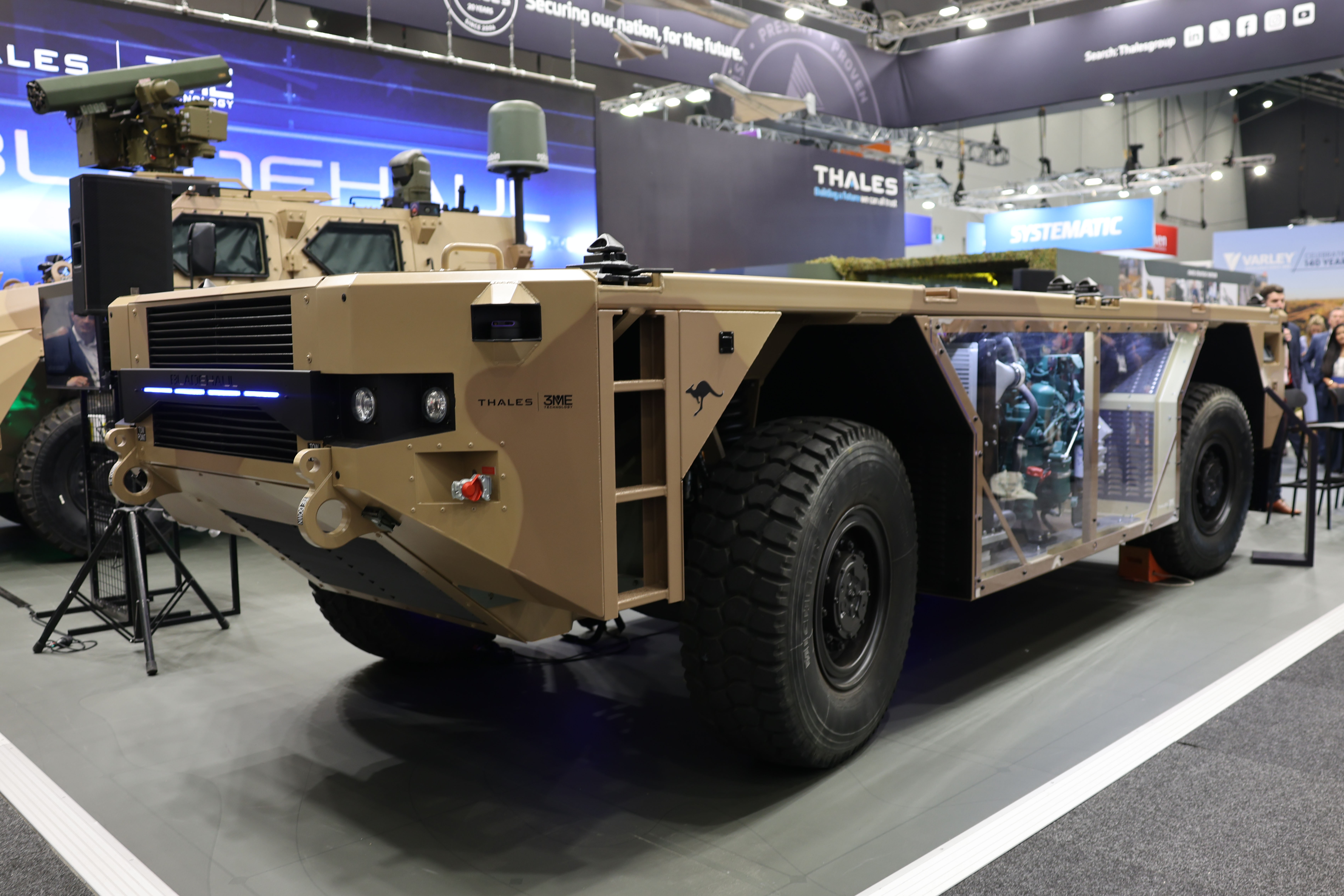
For the BladeHaul the company has assembled a 660V power system that offers 110kWh of power.
Justin Bain, CEO of 3ME Technology, said: “Working with Thales Australia brings together the best of Australian innovation, combining 3ME Technology’s systems engineering and platform development capabilities with the Bushmaster’s proven performance and established manufacturing base. Together we’re delivering an entirely new XL-UGV at a time when demand for contested logistics and remote power solutions for littoral environments is present and growing.”
Thales Australia envisages three potential use cases for the BladeHaul: as a cargo mover in zones of contested logistics; as a mobile and enduring power source for other equipment; and as a highly mobile platform for sensors and effectors.
The vehicle could therefore find utility in tasks such as carrying coastal anti-ship missiles, as a counter-drone system, mounting an air surveillance radar, reloading munitions or detecting mines. For the latter mission, it could have a mine plow or rollers mounted on the front.
The manufacturer says the vehicle’s applications are limited only by the imagination of the user. For example, it could carry containerized missile systems or launch drone swarms, one official told Defense News.
Alternatively, it could generate and supply power for a field hospital, a command post or simply act as a standalone generator. It offers a 1MW of power. To put that in perspective, 1MW could simultaneously power 1,000 homes.
To add to its versatility, the BladeHaul 4x4 UGV can fit in transport aircraft like the C-130 and A400M.
The BladeHaul is not yet ready for action, however. Work on the project began 18 months ago, with progress really accelerating over the past six months, but it does not yet have a working autonomy system.
Thales Australia signed a memorandum of understanding with Deakin University at Land Forces 2026 to develop its autonomy suite. This will build upon the suite used on the smaller Guardian Angel UGV unveiled by Thales earlier this year. It will be capable of remote, fully autonomous or follow-me operations, for example.
Thales Australia said in a statement: “By integrating advanced autonomy that enables human-machine teaming, hybrid technology, heavy payload capacity and power generation within a single platform, Thales Australia and 3ME Technology are delivering a next-generation solution that enhances operational readiness and supports Australia’s commitment to sovereign defense innovation.”
The BladeHaul is aimed at the Australian Army, but its appeal extends to any land force, according to the manufacturer.
The vehicle has no V-shaped hull to protect against underbody blasts, as there is no crew aboard. However, ballistic protection could be added to it depending on the function.
Bain said there is interest in a UGV version able to carry a 40-foot container too. “If there’s sufficient demand, we may look at that.”
Thales Australia unveiled the BladeHaul extra-large unmanned ground vehicle (UGV) in Perth on October 6, 2023. The UGV is designed for heavy battlefield logistics, capable of carrying over 10 tons and generating 1MW of power. It can serve various roles, including transporting missiles and providing power to military operations. Development of its autonomy system is underway in partnership with Deakin University.
- Thales Australia unveiled the BladeHaul UGV on October 6, 2023.
- The BladeHaul has a payload capacity of over 10 tons and a driving range of 600+ kilometers.
- It can serve multiple roles including cargo transport, power generation, and as a platform for sensors and missiles.
- The vehicle is designed to fit in transport aircraft like the C-130 and A400M.
- Development of an autonomy system is ongoing in collaboration with Deakin University.