
The 2026 Agreement Between America and Iran Opens Hormuz Within 30 Days and Reveals the Gulf's Dependence on Patriot and THAAD
 Ahmed Al-Rashid
The U.S.-Iran Agreement 2026 Opens Hormuz Within 30 Days and Reveals Gulf Dependence on Patriot and THAAD
On June 15, 2026, the real news was not that Washington and Tehran had accepted a 14-point framework to end the war and reopen the Strait of Hormuz. The military news was that Gulf countries found themselves once again waiting for a U.S. and Iranian decision regarding their most vital maritime artery, while Patriot and THAAD batteries and long-range radars remained powerless alone to convert purchasing superiority into decision-making independence.
An Agreement That Opens the Sea but Does Not Close Military Accounts
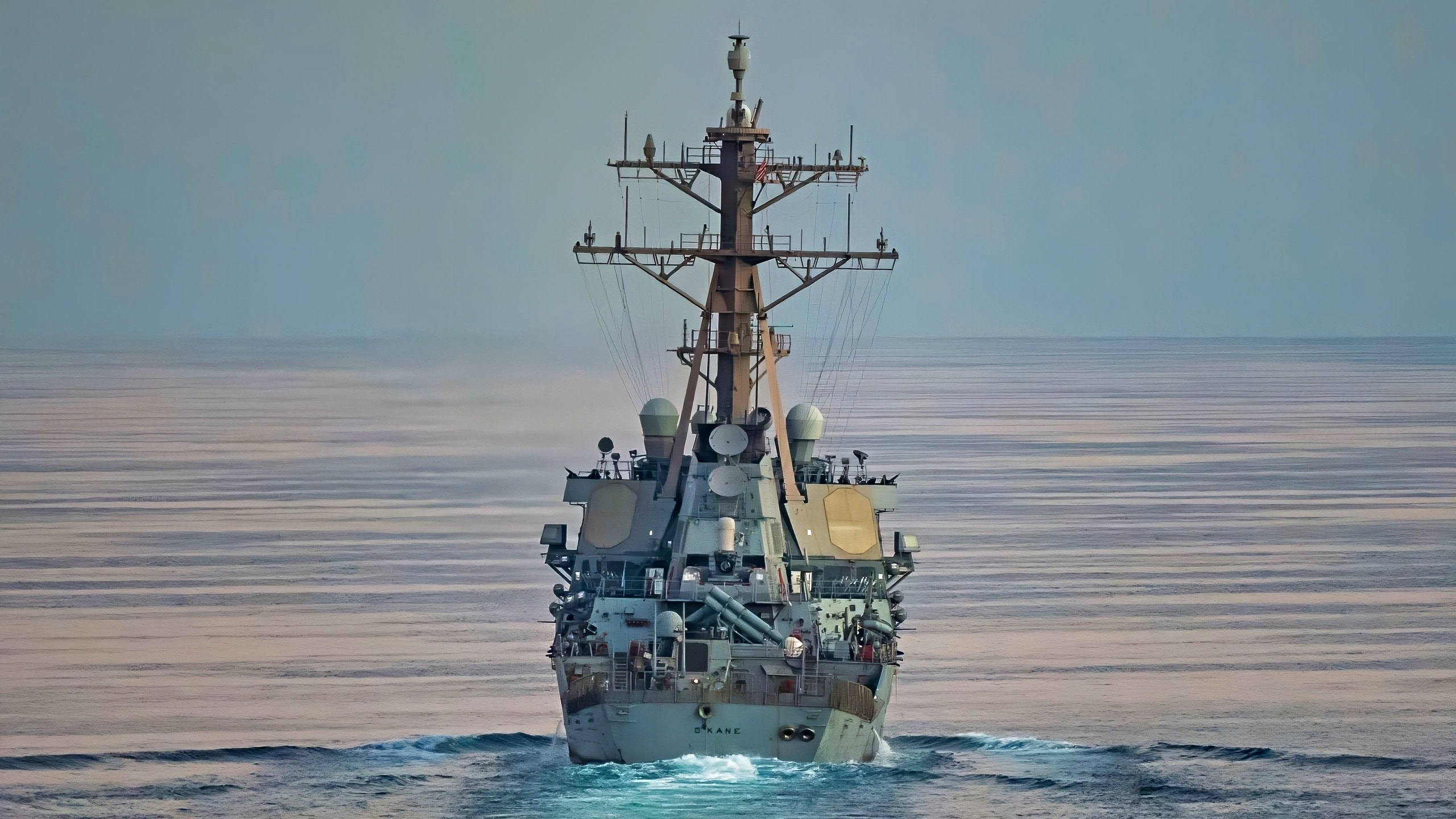
According to The National, the Strait of Hormuz is expected to return to pre-war navigation levels within about 30 days after mines are cleared and maritime coordination is established. The framework includes 14 points, a partial release of frozen Iranian funds that could amount to $24 billion, and a subsequent 60-day period to discuss the nuclear file, sanctions, and issues related to the International Atomic Energy Agency. These are significant figures, but they are not enough to understand what has transpired. The strait does not open with just a political statement; it opens when commercial ships are convinced that mines, fast boats, suicide drones, and coastal missiles no longer threaten the hull of the ship, its crew, and the insurance companies backing them.
CBS News confirms that U.S. Secretary of Defense Pete Hegseth spoke about the immediate start of the process to reopen the strait, but he linked it to a "permissive" environment and Iran's behavior. Here lies the detail that should not be lost amid the headlines of peace. The United States can mobilize mine sweepers, maritime drones, reconnaissance aircraft, and Aegis destroyers, but it cannot make the threat zero if Tehran continues to view the strait as a bargaining chip for deterrence. The Iranians did not buy a Hormuz card from the market; they built it over decades through narrow geography, a long coastline, and a Revolutionary Guard doctrine that sees maritime disruption as a cheaper alternative to conventional battle.
Patriot and THAAD Do Not Guard the Strait
In the Gulf, we always hear that the response to Iranian missiles is more Patriot PAC-3 and THAAD. This is partially true, and incorrect if it turns into a complete doctrine. Patriot, especially the PAC-3 MSE, is designed to intercept tactical ballistic missiles and some aircraft and drones within a relatively limited umbrella around vital targets. THAAD operates at higher altitudes against ballistic missiles both inside and outside the lower atmosphere. However, neither Patriot nor THAAD solves the problem of a naval mine in a transit channel, a fast boat carrying explosives, or a small drone flying at low altitude near the coast.
Any military personnel who have served in the region know that the Gulf does not suffer from a lack of equipment alone. Saudi Arabia, the UAE, Qatar, Kuwait, and Bahrain have purchased layers of air defense from the U.S. and Europe, some of which have added advanced radar and command and control systems. The problem is that integrated defense is not a shopping list. Integrated defense is a decision network. Do the Saudi, Qatari, and Emirati batteries exchange a single aerial image in real-time? Does a naval commander in Bahrain immediately know what the land radars in the UAE see? Are there common rules of engagement against an Iranian drone passing over disputed waters? These questions are more important than the number of launchers.
Practically, what the Hormuz agreement revealed is that the United States remains the central node in the Gulf security network. It is the one negotiating with Iran, it is the one that raises or maintains the maritime blockade, it is the one that Europeans ask to expedite the reopening of the strait, and it is the one leading the most sensitive part of risk removal. Gulf countries have the money, ports, bases, and direct interests, but they do not yet have an independent mechanism that makes them a decisive party in managing the corridor through which a critical part of their exports and political energy passes.
Lebanon Reveals the Limits of the Deal
The matter does not stop at Hormuz. The Guardian reported that Benjamin Netanyahu announced the continued presence of Israeli forces in security areas in Lebanon, Gaza, and Syria "as long as necessary," even though the U.S.-Iranian framework speaks of a cessation of operations on all fronts, including Lebanon. Hezbollah welcomed the agreement conditional on Israel's commitment, but sporadic strikes in southern Lebanon continued. This is not a marginal detail; it is a test of the limits of any understanding with Iran when Israel is not a full party to it, and when militias, governments, and regular armies move at different rhythms.
For the Gulf, Lebanon is not a distant theater. If the Lebanese front remains flammable, Iran retains a pressure card on Israel and the United States, while Israel maintains the freedom to act against any Arab perception of stable calm. Hence, the Gulf question becomes more complicated than "Will Hormuz be opened?" The question is: Can Riyadh, Abu Dhabi, and Doha build a security perception that does not rely solely on preventing a missile after it is launched, but on reducing the ability of regional parties to use fronts as an open market for bargaining?
Pakistan and Qatar Enter Through Mediation
Al Jazeera states that Pakistan played a pivotal role in mediation after more than 100 days of war, while other reports indicate a key Qatari role and Turkish and Egyptian support. This is important because it shows that the security architecture in the Gulf is no longer purely American, but it has also not become purely Arab. Qatar has a channel with Tehran and Washington. Pakistan has a military and historical relationship with the Gulf, while also having geographical and sectarian sensitivities towards Iran. Turkey and Egypt want a place in any new regional arrangement. Amid this map, Gulf Cooperation Council countries seem to be funding most of the cost of risk, but they do not hold the settlement lever alone.
In my opinion, the biggest mistake Gulf capitals can make after this agreement is to consider it a return to pre-war conditions. The return of navigation within 30 days does not mean the return of deterrence within 30 days. Insurance companies will ask about risks. Shipping companies will ask about guarantees. Armies will ask about rules of engagement. And Iran will ask, in its own way, about the political price of not closing the strait again. Here, celebratory statements and shiny operation room photos will not suffice.
The Price of Oil and the Price of Independence
The drop in oil prices after optimism about reopening Hormuz, as mentioned by The Wall Street Journal, gives the markets a temporary signal of relief. However, the market does not measure everything. A barrel of oil may drop today because traders expect tankers to cross, then rise tomorrow if a single incident occurs near a commercial ship. Maritime security is not built on the daily mood of prices, but on a continuous ability to detect threats, neutralize them, and explain that to the world in a way that convinces shipping companies before politicians.
Therefore, the practical lesson for Gulf countries is not just to buy an additional copy of Patriot or request a new THAAD battery. What is required is harder and less attractive in pictures: a joint maritime and air command center operating 24 hours, automatic early warning exchange, a stockpile of interceptive munitions sufficient for a long war, not just a week of display, a regional force for mine removal, and written rules of engagement that do not change with every political crisis. The old military adage says that a weapon that does not fit into a system becomes an expensive ornament. In the Gulf, this ornament has cost hundreds of billions.
The U.S.-Iran agreement may prevent a new round of war now, may gradually open Hormuz, and may give negotiators 60 days to write a more solid text. But it does not resolve the contradiction that Gulf countries have lived with for decades: they want security independence, but they buy it from abroad; they want to deter Iran, but they need Washington to negotiate with Iran; and they want freedom of navigation, but they do not yet have a regional system capable of protecting it without an American leader in the middle of the room. This is the real test after Hormuz, not the image of the signing in Geneva.
The U.S. and Iran reached a 14-point agreement to reopen the Strait of Hormuz by July 15, 2026, contingent on security measures. Gulf states remain reliant on U.S. military support, particularly systems like Patriot and THAAD, to ensure maritime safety. The agreement also involves a partial release of Iranian funds and highlights the ongoing geopolitical complexities in the region.
- The U.S. and Iran agreed on a 14-point framework to reopen the Strait of Hormuz within 30 days.
- Gulf states rely on U.S. military systems like Patriot and THAAD for security.
- The reopening of the Strait is contingent on the removal of mines and coordination at sea.
- The agreement includes partial release of $24 billion in frozen Iranian funds.
- Pakistan and Qatar played key roles in mediating the agreement.