
The 2026 Distributed Maritime Denial Demonstrated by the U.S. Marine Corps NMESIS and Japan's Ground Self-Defense Force Type-25
 Tanaka Takashi
US Marine Corps NMESIS and Japan Ground Self-Defense Force Type-25 Demonstrate 2026 Distributed Maritime Denial in Yonaguni
During the Japan-US joint integrated exercise "Keen Sword 26," scheduled from October 19 to 29, the US Marine Corps' anti-ship missile NMESIS and the air defense system MADIS will be deployed for the first time on Yonaguni Island. The fact that mobile anti-ship and air defense firepower will be positioned on an island approximately 110 kilometers from Taiwan indicates a shift in the focus of the exercise from the grandeur of the fleet to a firepower network connecting islands.
Connecting Islands Instead of Vessels
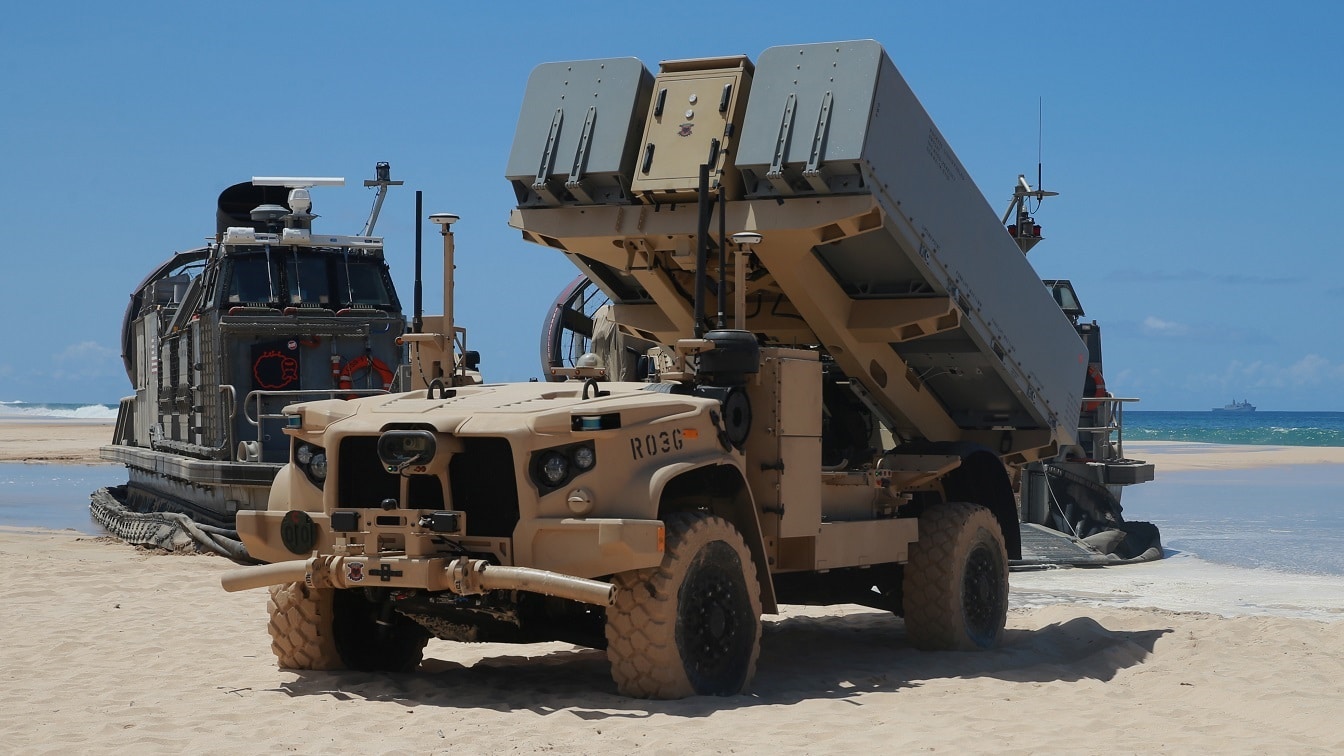
According to Defense News, the range of NMESIS is approximately 185 kilometers, and it is an unmanned launch vehicle operated by a Marine Corps unit of about 12 personnel. By combining this with the Japan Ground Self-Defense Force's new Type-25 anti-ship guided missile, and the improved Type 03 medium-range surface-to-air missile with a range of 1,000 kilometers, Yonaguni, Ishigaki, Miyako, and Okinawa can be utilized not as individual bases, but as a "distributed maritime denial zone" that mutually supports each other.
This year's exercise is expected to involve about 45,000 personnel from the Japan Self-Defense Forces and nine other countries, with the US Army's HIMARS also moving to Ishigaki Island. The fact that an aircraft carrier strike group is not expected to participate is also symbolic. For those protecting SLOC (Sea Lines of Communication), a combination of land-based firepower that is less detectable and can be repositioned enhances survivability more than prominent vessels.
Capabilities and Intentions Are Not the Same
However, it is dangerous to evaluate deterrence based solely on range figures. For missiles to be effective, continuous target information is required from radar, drones, satellite communications, and rapid political decision-making based on rules of engagement. The monitoring facilities on Yonaguni fill a "gap" towards Taiwan, but the island's ports, roads, and power infrastructure are not designed to accommodate large-scale exercises.
In the Japan-US discussions reported by NHK on October 9, Foreign Minister Motegi confirmed the importance of alliance cooperation for regional stability, while also addressing the incident involving the arrest of US Marines in Okinawa. Military distributed deployment cannot be separated from local community acceptance. If local residents' opposition restricts transportation and training times, the greatest advantage of distributed operations—responsiveness—will be lost.
Overlooked Bottlenecks
In my view, the true test of Keen Sword 26 is not NMESIS's launch capability, but whether Japan and the US can share the same maritime domain map and who will authorize the use of firepower to the island units when communications are cut off. There is no need to overestimate China's capabilities, but if intentions are misread, missiles with a range of 1,000 kilometers can become mere fixed targets. The challenge for Yonaguni lies not in a lack of firepower, but in the speed of information and political decision-making that can leverage that firepower.
Sources
The U.S. Marine Corps deployed the NMESIS anti-ship missile system and MADIS air defense system on Yonaguni Island as part of the joint military exercise 'Keen Sword 26' scheduled from October 19 to 29, 2026. Approximately 45,000 personnel from the Japan Self-Defense Forces and nine other nations participated, highlighting a strategic shift towards a distributed firepower network among the islands of Yonaguni, Ishigaki, Miyako, and Okinawa.
- The U.S. Marine Corps will deploy NMESIS and MADIS for the first time on Yonaguni Island during the exercise.
- The exercise will involve approximately 45,000 personnel from the Japan Self-Defense Forces and nine other countries.
- The NMESIS has a range of approximately 185 kilometers and is operated by a 12-member Marine unit.
- The Type-25 missile has a reported range of 1,000 kilometers, enhancing the defensive capabilities of the islands.
- The exercise emphasizes a shift from fleet-centric operations to a distributed firepower network among islands.