
The 25-Kilometer Death Zone Near Pokrovsk Shows a New Mechanism of Russian Infantry Warfare
 Dmitri Volkov
The 25-kilometer Death Zone near Pokrovsk Reveals a New Mechanic of Russian Infantry Warfare
The phrase "almost cut off" usually sounds like the result of a tank group's breakthrough. Near Pokrovsk in May 2026, it means something different: Ukrainian positions on the northern outskirts of the city, according to the 7th Rapid Reaction Corps of the Ukrainian Air Assault Forces, are under such tight observation, electronic warfare, and drone fire that rotation, evacuation, and ammunition resupply turn into a game of hide and seek with death. This is not the effect of one successful Russian assault. It is a more unpleasant reality for both armies — the transformation of tactical depth into a continuous zone of defeat.
The Map is More Important than the Front Line
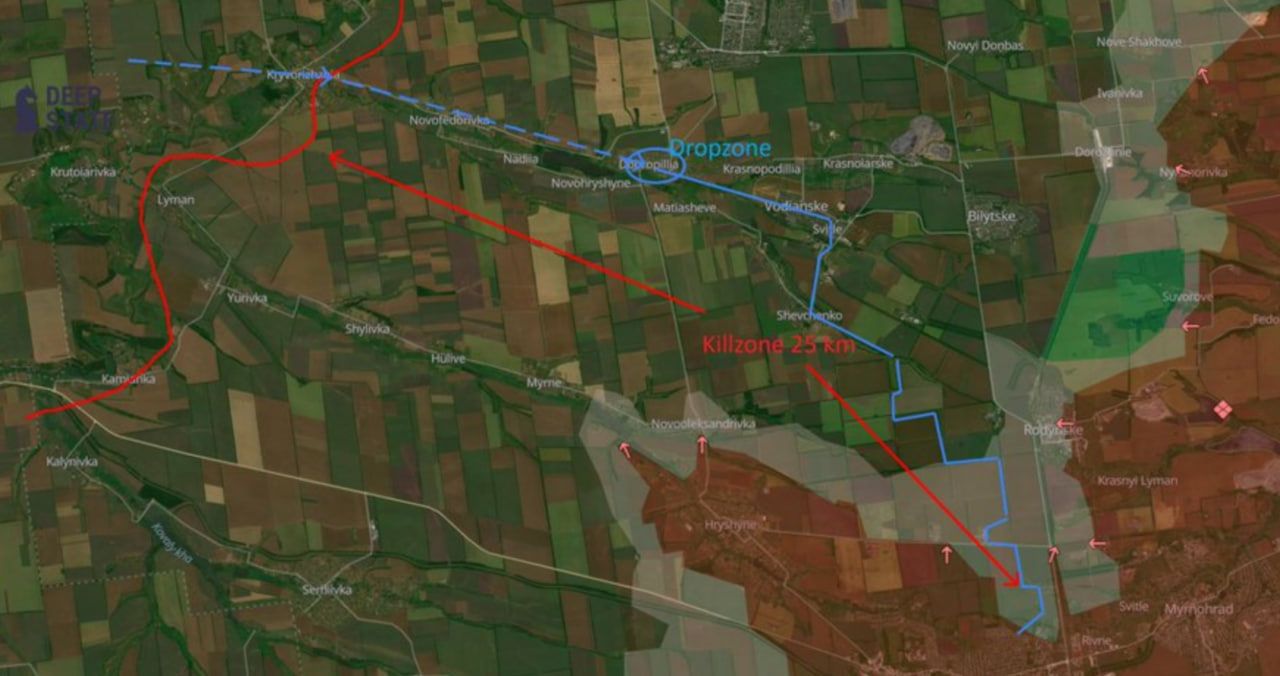
A publication by Kyiv Independent on May 18, citing the 7th Corps, describes northern Pokrovsk and the Hryshyne area as a space where Russian forces hold heights and urban development, deploy observation and electronic warfare assets, and control key logistical routes. The accompanying map from DeepState shows the estimated "killzone 25 km" — not a legal fact or an exact engineering boundary, but a useful operational symbol. It indicates that the modern line of contact no longer coincides with the line of actual risk.
The Institute for the Study of War in its summary for May 18 adds an important detail: Russian forces are attempting to create a network of launch sites for drones to support offensive actions towards Hryshyne, while in the Konstantynivka–Druzhkivka area, a Ukrainian drone platoon commander assessed the depth of increased risk from Russian FPV drones to be about 30 kilometers behind the front line. When these assessments are compared, it becomes clear that this is not a localized story about northern Pokrovsk, but a general trend. The Russian army, having not regained the maneuver warfare of the Soviet model, is building a substitute for maneuver through cheap eyes, a short chain of target designation, and small assault groups.
Why This is Not a Classic Encirclement
In the Soviet military school, encirclement was understood primarily geometrically: to reach the flanks, cut off roads, close the ring, and then destroy or force a retreat. In Pokrovsk, the picture is different. Russian units, judging by Ukrainian and open data, find it difficult to quickly develop success westward towards Dobropillya. Pasi Paroinen from Black Bird Group told Kyiv Independent that Russia has effectively gained control over Pokrovsk and Myrnohrad, but is currently underutilizing this result for further advances. This is an important caveat. The Russian army is capable of creating not only physical encirclements but also functional ones: the road formally exists, yet every vehicle on it becomes a target in advance.
This method aligns well with the current state of the Russian ground forces. After the losses of 2022–2025, they have fewer opportunities for large mechanized strikes, but they possess vast experience in small infiltration groups, artillery calibration, cheap FPVs, reconnaissance UAVs like ZALA and Supercam, as well as electronic warfare that does not necessarily completely "jam" the enemy but disrupts the regularity of their logistics. ISW notes separately that in the Kupiansk direction, the intensity of Russian attacks depends on the weather: on clear days, reconnaissance and FPV drones allow for increased pressure, while in cloudy weather, mortars and artillery gain more weight. This is almost an agrarian calendar of war, only instead of harvests — a schedule of assaults.
Infantry Becomes an Expendable Sensor
The main change near Pokrovsk is not that drones are hindering rotation for the first time. This has been known for a long time. What is new is the connection between drones, artillery, and infantry. Russian infantry is increasingly used as a tool to identify weak points: small groups enter the gray zone, provoke Ukrainian fire, fix supply routes, and then FPVs, mortars, artillery, and guided munitions work on them. The cost of such tactics is high, but the Russian command system currently considers it acceptable because the loss of a squad does not appear as a political event, while the loss of momentum in the offensive does.
This reveals an old Russian institutional problem. An army that cannot reliably provide battalion and brigade-level commanders with freedom of maneuver compensates for this by accumulating fire pressure. It does not so much win space as it makes the enemy's presence in that space economically and physically unbearable. In terms of the Soviet artillery school, this resembles "fire encirclement," but with digital poverty and mass commercial technologies of the 21st century. The old principle remains: first deprive the enemy of movement, then talk about advancement. New means have only made this principle cheaper.
The Cost for Ukraine and the Limit for Russia
For Ukraine, the problem of northern Pokrovsk is unpleasant not only due to the loss of positions. Much more dangerous is the depletion of managed personnel: evacuation groups, drivers, electronic warfare operators, communicators, and commanders of small units. If rotation becomes a rare and expensive event, then the combat capability of the position declines even before its physical capture. This is why Paroinen's statement that some of these positions should have been abandoned earlier sounds harsh but not meaningless. In a drone war, holding a small point can cost more than its symbolic value.
But the Russian method also has a ceiling. A defeat zone 25–30 kilometers wide does not equal an operational breakthrough. To turn it into an offensive, functional logistics, fresh infantry, engineering support, secure communication, and commanders capable of quickly exploiting a Ukrainian retreat are needed. The Russian army often creates pressure faster than it can turn it into maneuver. Therefore, Pokrovsk may not serve as proof of the restoration of the Russian operational school, but rather as an example of its partial replacement: instead of a deep breakthrough — a slow squeezing through a drone blockade.
For NATO and post-Soviet armies, the conclusion is unpleasantly simple. The next line of defense should not be designed as a trench line with a supply road behind it. It should be designed as a network of small depots, false routes, mobile electronic warfare groups, secure transfer points, and pre-prepared retreat corridors. Otherwise, the enemy is not obliged to encircle a city on the map. It is enough to turn the approaches to it into a ledger of losses.
Pokrovsk shows the Russian army in its current form: not brilliant, not flexible, but having learned to do one thing terrifyingly effectively — turning tactical space into a draining machine. This machine does not guarantee Moscow quick victories. But if the Ukrainian defense recognizes too late that the road has become a target, it will pay for every kilometer not with territory, but with lives.
Russian forces maintain control over Pokrovsk and Mirnograd, employing drones and artillery to suppress Ukrainian positions and logistics. A 25-kilometer kill zone has been established, complicating Ukrainian operations. The report highlights the effective coordination of Russian infantry, drones, and artillery, indicating a shift in tactics. Logistical challenges are significant for both sides, particularly affecting Ukrainian capabilities.
- Russian forces have established a 25-kilometer kill zone around Pokrovsk.
- Ukrainian positions are under heavy observation and electronic suppression.
- Russian troops are using small infantry groups to identify weak points in Ukrainian defenses.
- The effectiveness of Russian drone and artillery coordination is highlighted as a new tactic.
- Logistical challenges for both sides are emphasized, particularly for Ukraine.