

Summary and Key Points: Bob Gates killed the F-22 in 2009 at 187 airframes of a planned 381, and the question of building more has been asked and answered twice. A 2010 RAND study priced 75 more jets at about $20 billion. A congressionally ordered Air Force study in 2016, pried loose by FOIA in 2019, put 194 more Raptors at $9.869 billion in start-up costs alone, including $5.768 billion to redesign four subsystems around the out-of-production APG-77 radar and F119 engine, with unit costs of $206 million to $216 million and a program total above $50.3 billion. Christian D. Orr explains why the Air Force said no and is funding a “Super Raptor” instead.
The F-22 Raptor Stealth Fighter Reboot?
Revive, resurrect, and restart the Raptor? Sounds great, but…somebody already tried it.
In the professional opinion of this writer and former U.S. Air Force officer, the 2009 decision by then-U.S. Secretary of Defense (SECDEF) Bob Gates to kill the F-22 Raptor— the world’s first operational 5th Generation stealth fighter—after only 187 airframes were built out of the original 381 planned was one of the worst and most incredibly short-sighted decisions ever to emanate from the Pentagon.
We can’t build any more of them, but one might reasonably ask why we don’t at least try.
The short answer is that the idea was already floated in the previous decade and, metaphorically speaking, shot down.
As for the longer answer as to why it was shot down…
Bottom Line Up Front (BLUF): Dollars and Sense
That’s the usual answer for why promising weapons systems either (A) don’t get built in the first place, (B) don’t keep getting built, or (C) don’t get put back into production, n-est-ce pas?
Going all the way back to 2010, just one year after SECDEF Gates’s Raptor kibosh decision, a 2010 RAND Corporation study estimated restarting the F-22 production line to build just 75 more jets would have cost about $20 billion in inflation-adjusted dollars.
That was just a rough estimate that didn’t even account for the cost of hiring workers at the Lockheed Martin “Skunk Works” plant, integrating newer stealth technologies, or training and equipping additional pilots.
The Devil in the Details
Fast-forward to 2016, and the U.S. military was still focused upon counterinsurgency (COIN) warfare—particularly the fight against the Islamic State/ISIS/ISIL/Da’esh in Iraq and Syria—as opposed to “near-peer”/Great Power competition.
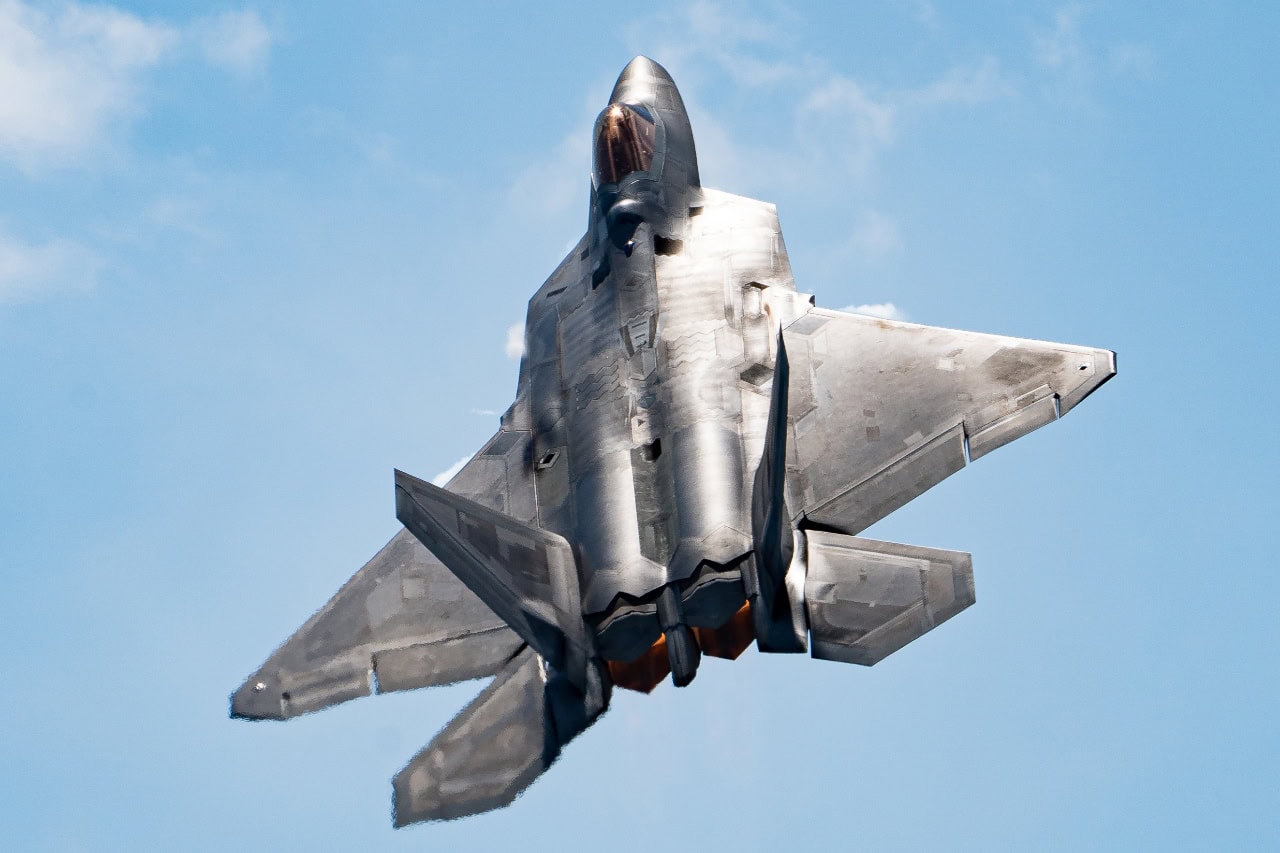
Maj. Joshua “Cabo” Gunderson, F-22 Raptor Demo Team commander and pilot, maneuvers into a climb after a tactical-pitch at the Cold Lake Air Show July 17, 2022, at Cold Lake, Alberta, Canada. The F-22 Raptor’s two Pratt and Whitney F119 Turbofan engines bring a combined 70,000 pounds of thrust in combination with two-dimensional thrust vectoring to enable maximum maneuverability for the multi-role air-to-air stealth fighter. (U.S. Air Force photo by Tech. Sgt. Don Hudson)
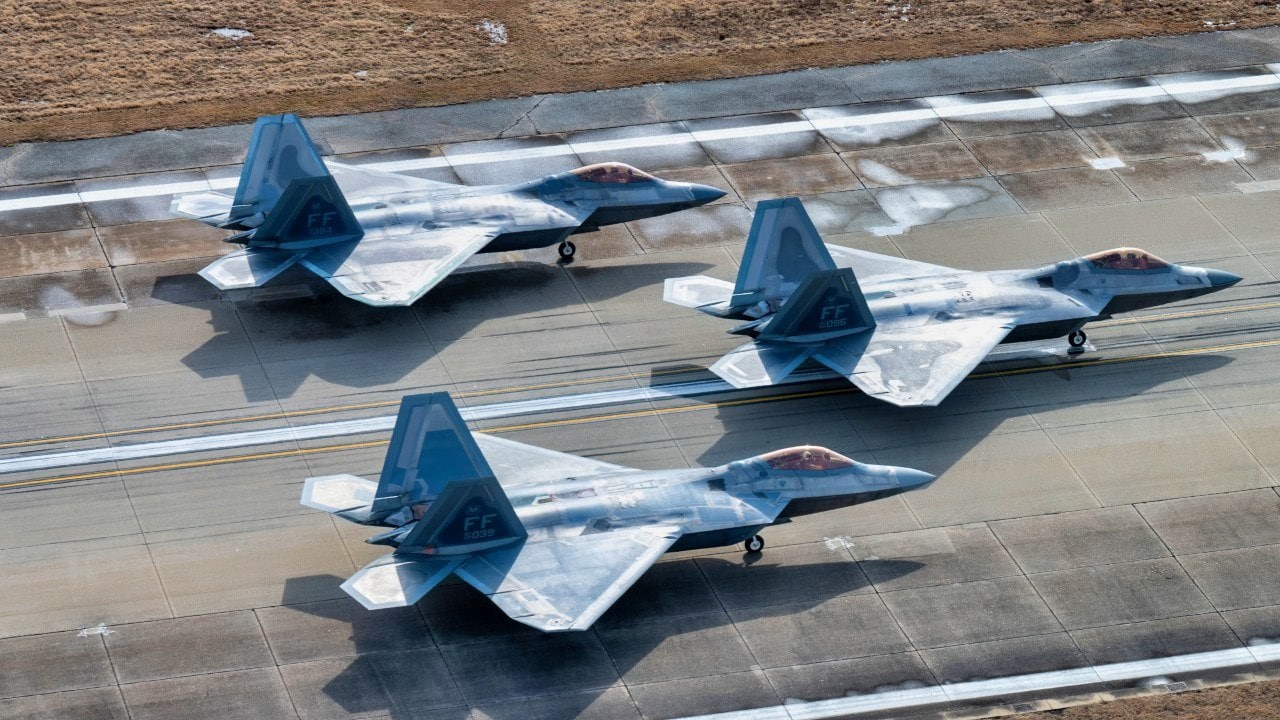
LANGLEY AIR FORCE BASE, Va. – F-22 Raptors from the 1st Fighter Wing sit in position on the runway during the Elephant Walk at Langley Air Force Base, Virginia, Jan. 31, 2025. The surge was designed to showcase the wing’s operational readiness and its ability to rapidly mobilize airpower. The 1st FW operates F-22 Raptors and T-38 Talons, maintaining combat capabilities that enable the U.S. Air Force to execute missions across the globe. With a focus on air superiority, the 1st FW plays a critical role in defending the nation’s interests. (U.S. Air Force photo by Tech Sgt. Matthew Coleman-Foster)
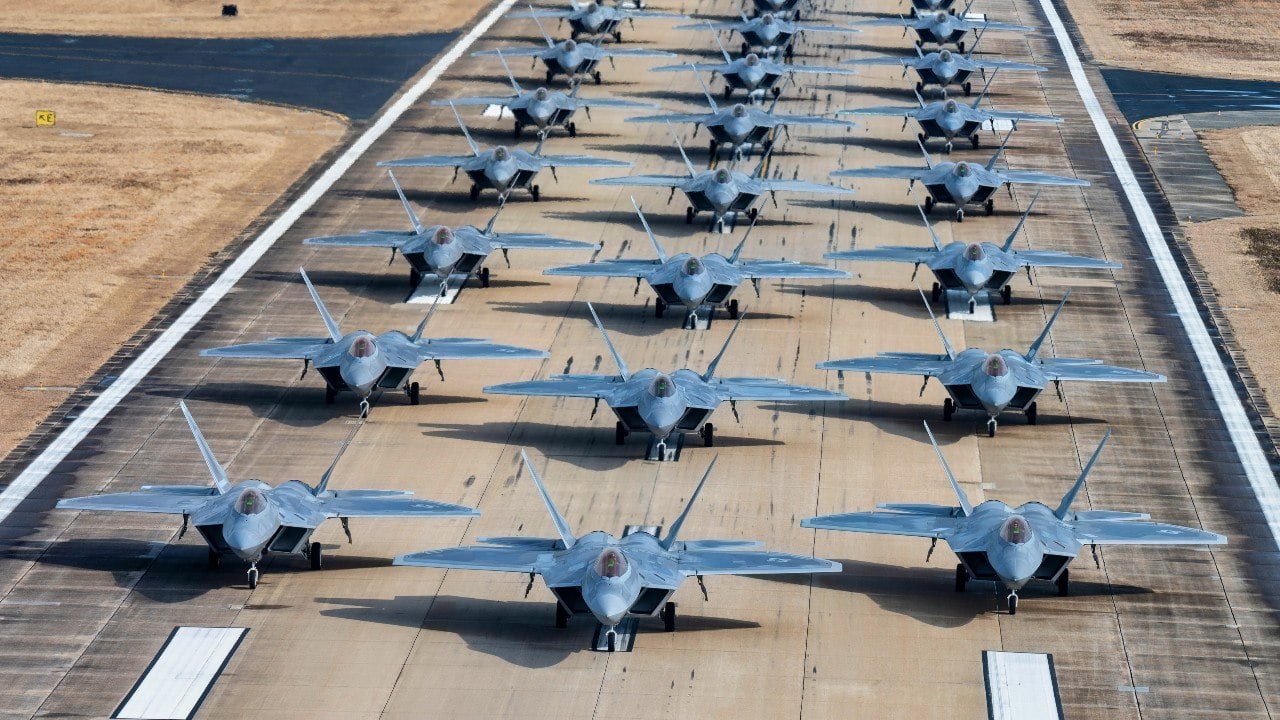
Aircraft from the 1st Fighter Wing conducted an Elephant Walk at Langley Air Force Base, Virginia, Jan. 31, 2025, showcasing the wing’s readiness and operational agility. This demonstration highlighted the wing’s capability to mobilize forces rapidly in high-stress scenarios. The wing’s fleet includes F-22 Raptors and T-38 Talons. As Air Combat Command’s lead wing, the 1 FW maintains unparalleled combat readiness to ensure national defense at a moment’s notice. (U.S. Air Force photo by Tech Sgt. Matthew Coleman-Foster)
Nonetheless, early in that year, Congress mandated that the Air Force examine what it would take to put the super-fighter back into production.
The USAF’s research project concluded in late 2016, and the document—which cost $37,000.00 to produce—was initially classified. Still, in 2019, the ever-vigilant Tyler Rogoway and Joseph Trevithick of TWZ obtained a copy through a Freedom of Information Act (FOIA) request.
Beyond the RAND study’s 75-airframe cost estimate of the RAND study, the USAF study crafted cost estimates and assumptions for what it would take to restart F-22 production and produce 194 more of the warbirds, bringing the total back to the originally planned 381 specimens. Their key findings:
-Non-recurring start-up costs over 5 years totaling $9.869 billion in 2016 dollars, which included approximately $228 million to refurbish production tooling, $1.218 billion to requalify sources of components and raw materials, $5.768 billion to redesign four subsystems, and $1.156 billion in other associated “restart costs,” along with $1.498 billion in “additional government costs.”
-Two key subsystems needing “redesign” would be the AN/APG-77 low-probability intercept (LPI) radar and the Pratt & Whitney F119 engine, neither of which are still in production; Pratt & Whitney is instead focused on building the F135 engine for America’s other stealth fighter, the F-35 Lightning II, which is also a “Skunk Works” product.
-The aircraft’s electronic warfare (EW), communication, navigation, and Identification Friend or Foe (IFF) systems were among those that might also need replacement or substitution with another system.
-The initial unit cost for an order of 194 aircraft would be about $216 million, dropping to around $206 million by the time the last one rolled off the production line, and then leveling out after the service purchased the first 100 aircraft.
-Total procurement cost would be between $40 and $42 billion, with the entire program costing a little more than $50.3 billion.
In short, as stated by then-Capt. (later Lt. Col.) Emily Grabowski, USAF Public Affairs officer, “The Air Force has no plans [to] restart the F-22 production line; it wouldn’t make economic or operational sense to do so.”
Consolation Prize: Improving the Existing F-22s
As any poker or blackjack player can attest, you have to play the hand you’re dealt, or as another saying goes, “When life gives you lemons, make lemonade!” Since no more F-22s will be built, the next best thing is to improve the ones that already exist, and a plan is already underway. Ergo…
…Enter the “Super Raptor.” When the USAF brass released its Fiscal Year 2026 budget request, it asked for $90.34 million to upgrade the F-22. Amongst the upgrades envisioned for that slice of the budgetary pie:
-Paired Infrared Search and Track (IRST) pods, which will allow Raptors to track targets without blowing their cover via radar signal emissions—a massive tactical advantage in stealth-versus-stealth engagements.
-The AIM-260 Joint Advanced Tactical Missile (JATM)—yet another Lockheed Martin product—will replace the active radar-guided AIM-120 AMRAAM (Advanced Medium-Range Air-to-Air Missile; affectionately nicknamed the “Slammer”) and the infrared-guided (IR) AIM-9X “Sidewinder” in the coming years. The JATM carries roughly 30 percent more propellant, and if it uses a dual-pulse motor, it could achieve a range more than 50 percent greater.
Initial test firings from F/A-18 Super Hornets in 2024 suggest that the AIM-260’s engagement envelope could be double the area of the Slammer’s, giving the Raptor overwhelming standoff capability, thus boosting the probability of kill (Pk) for beyond visual range (BVR) engagements.
About the Author: Christian D. Orr
Christian D. Orr is a Senior Defense Editor. He is a former Air Force Security Forces officer, Federal law enforcement officer, and private military contractor (with assignments worked in Iraq, the United Arab Emirates, Kosovo, Japan, Germany, and the Pentagon). Chris holds a B.A. in International Relations from the University of Southern California (USC) and an M.A. in Intelligence Studies (with a concentration in Terrorism Studies) from American Military University (AMU). He is also the author of “Five Decades of a Fabulous Firearm: Celebrating the 50th Anniversary of the Beretta 92 Pistol Series,” whose second edition was recently published.