
The Coast Guard icebreaker nobody wanted just came back from a 133-day Arctic patrol

Source: Task & Purpose
Loading...Strong SignalCredibility: 81%
Report Content
Second chances don’t come around too often, but they did for the U.S. Coast Guard Cutter Storis, an icebreaker that started life as a failed towboat for offshore oil rigs but joined America’s maritime security service in 2024–despite one Coast Guard admiral saying at one point that the ship “may, at best, marginally meet our requirements.”
On Saturday, the ship returned to its temporary home port of Seattle after a 133-day, 17,000-nautical-mile deployment where Storis was the only U.S. surface ship in the High Arctic, the region’s northernmost section, according to a Coast Guard press release.
Along the way, the crew carried out the first law enforcement mission by an icebreaker in more than 20 years when they inspected fishing boats in the Bering Sea. They also practiced firing machine guns in extreme cold conditions; escorted a grounded fishing vessel to safety; tested out small drones in extreme cold and at high latitudes; and monitored Chinese-flagged research vessels, which experts say gather oceanographic information for China’s scientific, commercial and military fleets.
Top Stories This Week
“The crew’s hard work exceeded expectations in turning Storis into an actionable, multi‑mission military vessel,” Capt. Corey Kerns, the ship’s skipper, said in the Coast Guard announcement. “Through their steadfast dedication and operational expertise, Storis has set the definitive precedent for the Coast Guard’s future operations in the Arctic region and Alaska theater of operations.”
Poor start
Storis started life as the Aiviq, and it was designed to tow and anchor offshore oil drilling rigs. But according to a ProPublica investigation, on its maiden voyage in 2012, Aiviq’s electrical system blacked out, one of its engines failed, and it lost control of the oil drill rig it was towing, which meant the Coast Guard had to fly through a storm to rescue the rig’s crew.
After that, oil companies were not interested in Aiviq and neither was the Coast Guard, with one admiral even saying the ship “may, at best, marginally meet our requirements,” according to ProPublica. But by 2024, the Coast Guard had few options to salvage its crumbling icebreaker fleet.
The Coast Guard has had just two polar icebreakers since 2010. Those are the Polar Star, which at 50 years old is 20 years past its expected service life and has a history of barely surviving its annual resupply trip to scientists in Antarctica.
Then there’s the Healy, which at 26 years old has had to cancel missions due to electrical fires. The Healy lost engine power during sea trials off the coast of Washington in July and had to be towed back to port.
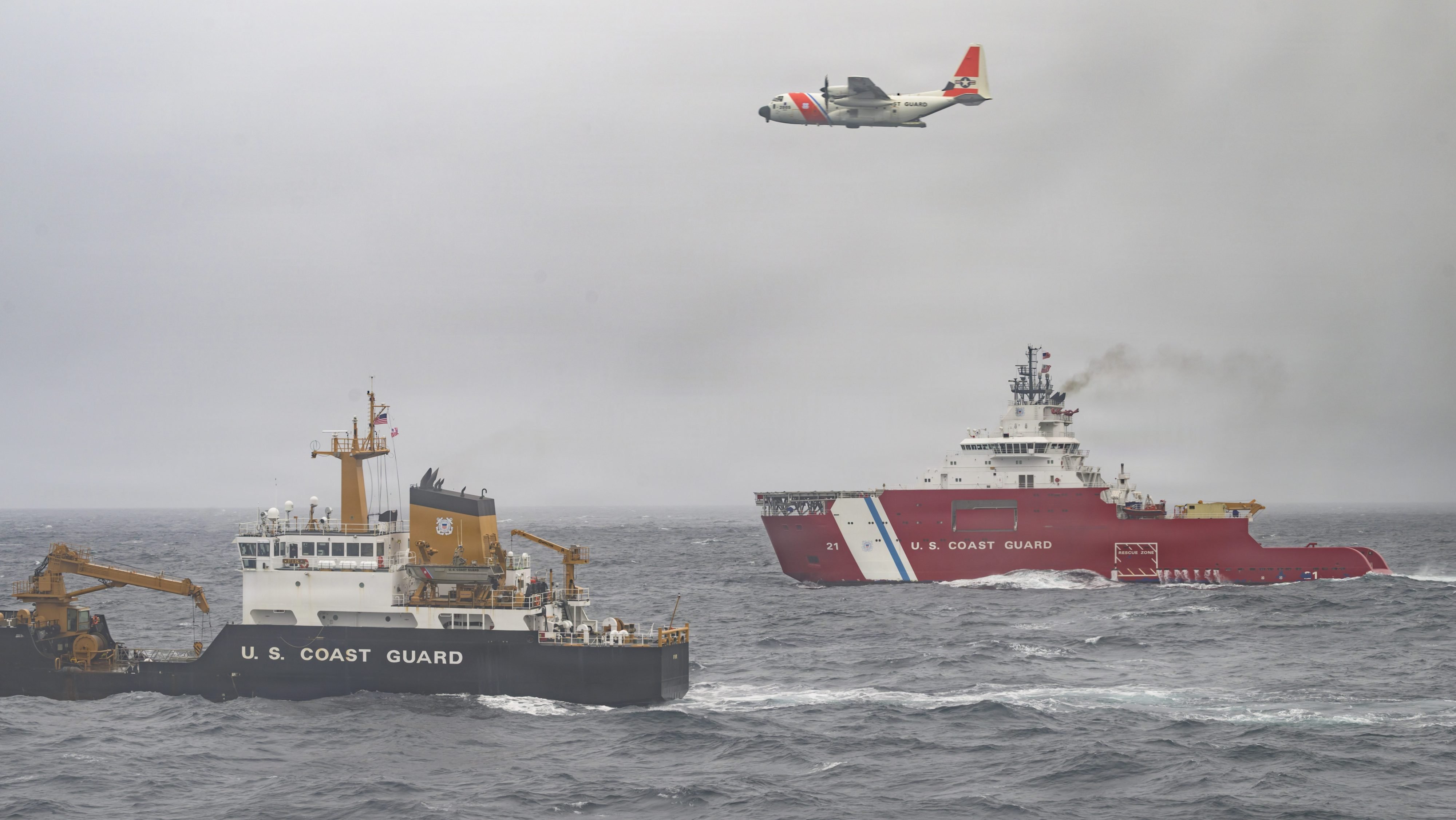 U.S. Coast Guard Cutters Fir and Storis sail alongside each other as a USCG HC-130 aircraft soars overhead during a combined sail in the Bering Sea, July 21, 2026. Canadian Armed Forces photo by Sailor 1st Class Jordan Schilstra.
Urgent need
Melting Arctic ice is opening up new shipping lanes, resources, and potential for conflict with China and Russia, who also want to expand their Arctic presence. China has at least five icebreakers while Russia has more than 40.
Amid a slump in the U.S. shipbuilding industry, Congress made the case that the Coast Guard needed Aiviq to try to close the gap in icebreakers. In 2024, the service bought the Aiviq for $125 million and renamed it Storis. The ship had its maiden military voyage in June 2025 and was commissioned that August.
More icebreakers are on the way. The Coast Guard wants to buy up to 11 medium-weight Arctic Security Cutters, with the first due in 2028. There are also plans for three heavy-weight Polar Security Cutters to replace the current fleet, though the first of those may not arrive until 2033.
That means the Storis will likely play a leading role in the Coast Guard’s Arctic presence for the foreseeable future.
“We are serving in a moment of great change in our service, nation and world,” Kerns said in the release.
The post The Coast Guard icebreaker nobody wanted just came back from a 133-day Arctic patrol appeared first on Task & Purpose.
Classification
Region
North America
Analytical Domain
Operational
Primary Category / Secondary Categories
Military Operations / Logistics
Subcategory
Naval Engagement
SALUTE Report
Size
Crew of the U.S. Coast Guard Cutter Storis
Activity
Completed a 133-day Arctic patrol, conducted law enforcement missions, and monitored foreign vessels
Location
Seattle · Bering Sea · High Arctic
Unit
U.S. Coast Guard Cutter Storis
Time
Returned on Saturday after a 133-day deployment
Equipment
icebreakermachine gunsdrones
Summary
The U.S. Coast Guard Cutter Storis returned to Seattle after a 133-day Arctic patrol, where it was the only U.S. surface ship in the High Arctic. During its deployment, the crew conducted law enforcement inspections in the Bering Sea and monitored Chinese-flagged research vessels. The mission highlighted the Coast Guard's operational capabilities in the Arctic amid increasing geopolitical interest in the region.
Key Facts
- The U.S. Coast Guard Cutter Storis completed a 133-day Arctic patrol.
- Storis was the only U.S. surface ship in the High Arctic during its deployment.
- The crew conducted law enforcement inspections of fishing boats in the Bering Sea.
- Storis monitored Chinese-flagged research vessels in the Arctic.
- The Coast Guard plans to enhance its icebreaker fleet in response to changing Arctic conditions.