
The Day When the 2026 JS Tomahawk Live Fire Questions the Practicalization of Japan-U.S. Counterattack Capability
 Tanaka Takashi
2026 JS Chōkai Tomahawk Live Fire Questions the Realization of Japan-U.S. Counterstrike Capability
For those who have long observed escort ships in Yokosuka, the weight of the brief description that a single ship underwent modifications for about five months on the U.S. West Coast is significant. According to Stars and Stripes, the Japan Maritime Self-Defense Force's Aegis destroyer JS Chōkai is scheduled to conduct live fire training with Tomahawk cruise missiles in the summer of 2026, supported by the U.S. Navy's Third Fleet in the Eastern Pacific. This is not merely a launch test. It marks the moment when Japan's "counterstrike capability" transitions from the words of policy documents to the onboard Mk 41 vertical launch system and the procedures of the crew.
Technical Significance of Chōkai's Modification
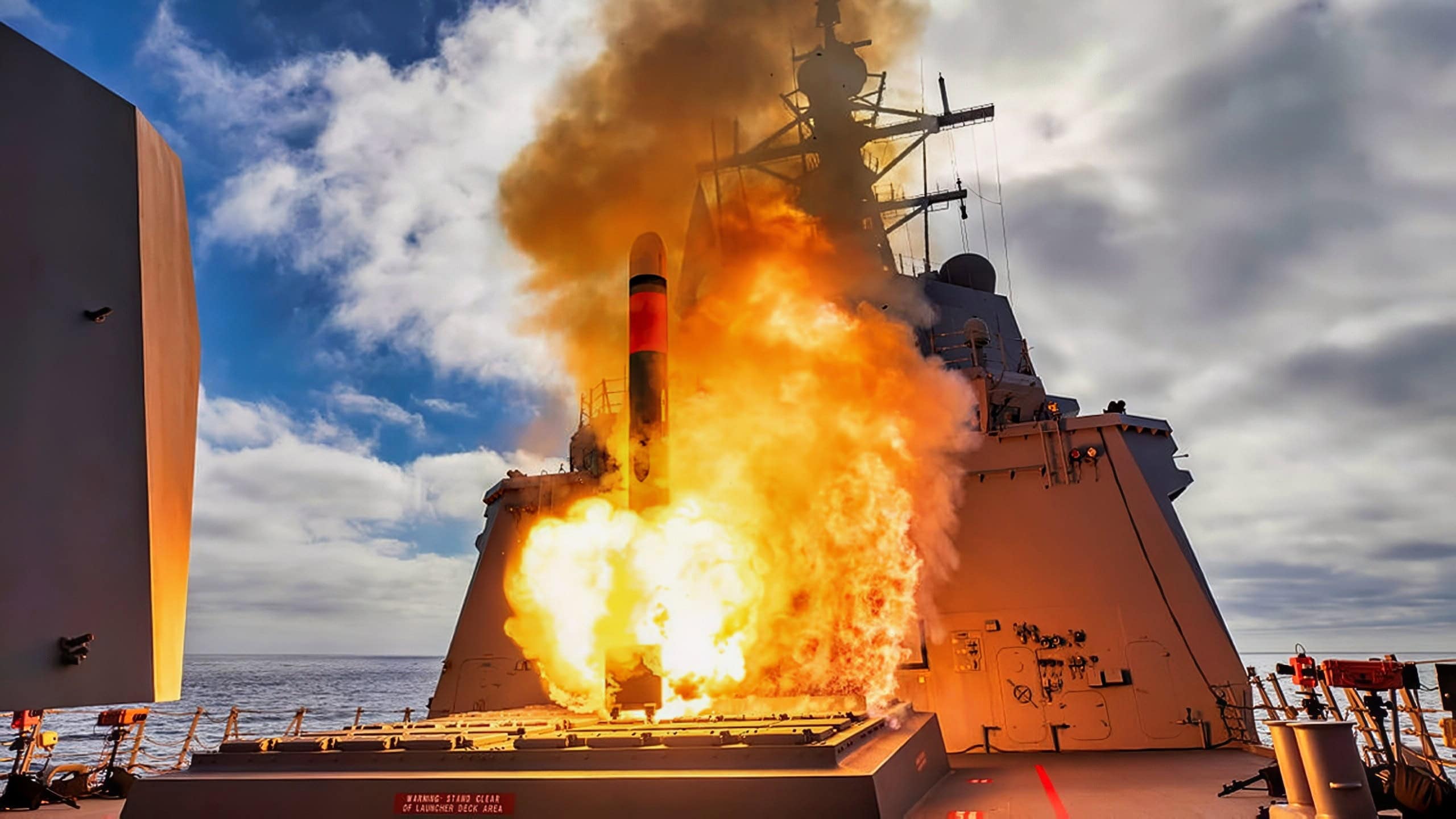
Army Recognition positions Chōkai as the first escort ship in Japan to possess Tomahawk launch capability, analyzing that the modifications include not only the launch tubes themselves but also the combat system, mission planning, and the integration of communication and targeting information. Chōkai is a Kongō-class Aegis destroyer, with a standard displacement of approximately 7,500 tons, a full load of about 9,500 tons, a length of 161 meters, and equipped with 90 cells of Mk 41 VLS. Until now, the focus has been on air defense and ballistic missile defense using SM-2, SM-3, ESSM, and anti-submarine rockets.
Equipping with Tomahawks means that some of these 90 cells will be redirected from "interception" to "strike." Block IV and Block V generally have a range exceeding 1,000 kilometers, combining inertial navigation, GPS, and terrain matching to approach targets at low altitudes. The sale approved by the U.S. in 2023 is said to be worth up to $2.35 billion, including 200 Block IV and 200 Block V missiles. The Ministry of Defense revealed in March 2026 that it would receive the first Tomahawks, but the quantity has not been disclosed.
What is Being Verified in Live Fire is Not the Ammunition, but the Command System
In my view, the focus this time is not on accuracy but on the procedures leading up to the launch. The Tomahawk is not a weapon that can be fired with the push of a button. A long chain is required, including confirmation of target information, creation of mission data, information sharing with the U.S. side, verification of rules of engagement, and post-launch evaluation. The support from the Third Fleet is likely not just to provide a safe maritime area. It serves to measure how far the JMSDF's ships and staff can integrate into the U.S. Navy's mission planning cycle.
This is a welcome development for the Japan-U.S. alliance, but it also leaves structural risks. Even if Japan possesses long-range strike capabilities, if it relies on U.S. military ISR (Intelligence, Surveillance, and Reconnaissance) for much of the target information, the actual operational tempo cannot be determined solely by Japan. For the JMSDF, which has been responsible for SLOC (Sea Lines of Communication) defense, the counterstrike mission carries a different political weight than traditional convoy escort or anti-submarine warfare.
Deterrent Effect Against China and North Korea
It is necessary to distinguish between capability and intent. The Chinese Navy and Rocket Force are expanding their anti-access/area denial capabilities, combining ships, aircraft, and ground-launched missiles from the East China Sea to the First Island Chain. North Korea is also advancing the operation of mobile launchers and solid-fuel missiles, making it difficult to detect them completely before launch. The Tomahawk-equipped escort ship provides Japan with options for maritime launches that do not rely solely on fixed bases, complicating the calculations of adversaries.
However, overestimation is to be avoided. Cruise missiles travel at subsonic speeds and are not universal weapons capable of independently breaching robust air defense networks. If the adversary's missile launchers are mobile, the temporal effectiveness of the targets is short. Rather, the value of the Tomahawk lies in its ability to apply pressure on command and control facilities, air defense radars, and fixed supply bases in the early stages, thereby expanding the operational space for Japan-U.S. air and naval forces.
Overlooked Constraints of Supply and Ammunition Stockpiles
Another point that cannot be overlooked is the inventory issue on the U.S. side. Stars and Stripes mentions that the increased use of Tomahawks by the U.S. in the Middle East may impact additional deliveries to Japan. If the U.S. military's own demand for ammunition rises, the delivery timelines for allies may be politically adhered to, but practically adjusted. Even if Japan advances the acquisition of around 400 missiles, when considering training rounds, live fire verification, reserve ammunition, and wartime replenishment separately, the margin is not that large.
This point also relates to the significance of domestically produced stand-off weapons such as the Type 12 Surface-to-Ship Guided Missile Enhanced Version. The Tomahawk serves as an immediate bridge, enhancing the interoperability of the alliance. On the other hand, the ultimate support for Japan's sustained combat capability lies in a system of equipment that can be maintained, modified, and supplied domestically. Having U.S.-made missiles is not the same as Japan being able to independently continue counterstrike operations.
Will the JMSDF's Mission Culture Change?
During the Cold War, the JMSDF regarded anti-submarine warfare, mine sweeping, and sea lane defense in support of U.S. carrier strike groups as its core missions. There was a practical pride in being defensive. The live fire of Tomahawks from Chōkai adds a new mission to this culture. If escort ships have the option to attack the adversary's missile bases and command posts, the captain's judgment, the staff's planning, and political approval will have to be more closely interconnected than ever before.
What is being questioned in this test is not whether Japan will gain long-range capabilities. It is whether Tokyo and Washington can truly share a short decision-making time that matches the long range.
Technically, the modification of Chōkai is a sufficiently realistic step. Strategically, it increases deterrent options. However, the most challenging issue lies before the launch button. Who confirms the target, at what point does politics approve, and to what extent does it depend on U.S. information? If this part remains ambiguous, even a range of 1,600 kilometers could shrink to a few dozen kilometers of political hesitation in actual combat.
JS Chokai of the Japan Maritime Self-Defense Force will conduct live-fire training with Tomahawk cruise missiles in the Eastern Pacific during Summer 2026. This training, supported by the U.S. Navy's Third Fleet, marks a significant step in Japan's operational capabilities, transitioning from defensive to offensive strike options. The modifications to JS Chokai include the integration of the Mk 41 Vertical Launch System for Tomahawk missiles, enhancing Japan's deterrent posture against regional threats.
- JS Chokai will conduct live-fire training with Tomahawk missiles in Summer 2026.
- The destroyer has undergone modifications to support Tomahawk launch capabilities.
- The U.S. approved the sale of 400 Tomahawk missiles to Japan.
- The focus of the training is on command and control procedures, not just missile accuracy.
- Japan's long-range strike capabilities are intended to deter threats from China and North Korea.