
The Deployment of Japan Coast Guard PL206 Daito Indicates the Communication Warfare of Senkaku Security in 2026
 Tanaka Takashi
The Initial Deployment of Japan Coast Guard PL206 Daito Indicates the Communication Warfare of Senkaku Security in 2026
The white hull of PL201 "Miyako" chases a Chinese Coast Guard vessel beyond the waves. An article published by the Chinese newspaper "Global Times" in early July, which accompanied the Xiamen ship, contains considerable political rhetoric, so its evaluation should not be taken at face value. However, the names and equipment of the Japan Coast Guard vessels listed in the article are details that cannot be ignored when interpreting the gray zone in the East China Sea.
Three Changes Observed on the Ground
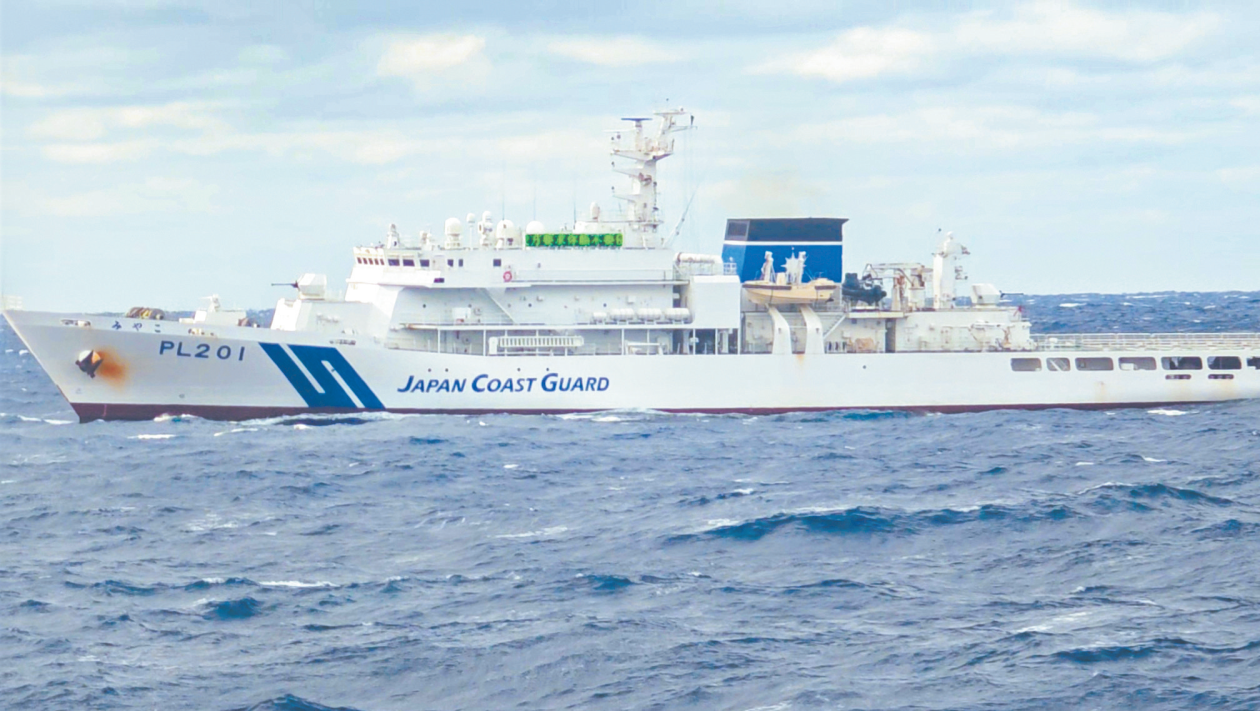
According to the article, when the Chinese Coast Guard's Xiamen fleet entered the contiguous zone around the Senkaku Islands, Japan reportedly deployed vessels such as PL81 "Takedomi," PL201 "Miyako," and PL206 "Daito." There is also a description that the command ship would rotate from the 7th to the 10th, while other patrol vessels would change approximately every 3 to 5 days. Since this is an observation from the Chinese side, the numbers should be taken with caution, but the fact that the 11th Regional Coast Guard Headquarters is rotating ships based on long-term continuous monitoring aligns with recent trends.
- PL206 "Daito" is a newly constructed large patrol vessel of the "Miyako" class, reportedly around 3,500 gross tons.
- This class is reported to be approximately 120 meters in length, capable of speeds over 25 knots, and equipped with two 40mm autocannons.
- According to the Chinese article, communication devices resembling Starlink were observed on PL81 and PL201, which is a new claim from the Chinese side.
Patrol Vessels Are Not Warships, but They Are Not Just Police Vessels Either
The expansion of the Japan Coast Guard is fundamentally different from the increase in the Japan Maritime Self-Defense Force's escort ships. The Coast Guard is a law enforcement agency, and it is natural for them to be the first to respond around the Senkaku area. However, the significance of having ships that are 3,500 gross tons, equipped with 40mm guns, and capable of long-term deployment entering the front lines is different from the coastal defense during the Cold War. This represents a maritime presence aimed at stopping the opponent's establishment of facts in a "pre-war" situation.
In my view, what is more important than the initial appearance of PL206 is not that it came alone, but that it was incorporated into the same rotation as the existing PL81 and PL201. It is not merely a symbolic display of a new vessel; it may have entered the normal formation for frontline operations.
The Introduction of Starlink Will Change the Speed of Command
Nikkei Asia reports that the Japan Coast Guard plans to introduce Starlink to 66 large patrol vessels by the end of fiscal 2025 and add another 16 vessels in fiscal 2026. While the claim that the Chinese side confirmed the devices on PL81 and PL201 requires independent verification, it does not contradict the institutional direction.
The value of satellite communication is not merely that the internet becomes faster. In the Senkaku area, video, navigation tracks, radio communications, and the distance to the opposing vessel can become political issues with just a few minutes of delay. High-speed communication shortens the lines of contact between the 11th District, Tokyo, and potentially between Japan and the U.S. This serves as a deterrent, but it also increases the risk that small navigational decisions on the ground could immediately escalate into diplomatic issues.
Implications for the Japan-U.S. Alliance
What is first needed for Senkaku security is not to deploy escort ships. The ability of the Coast Guard to maintain a law enforcement posture while engaging daily with the normalization of the Chinese Coast Guard will serve as a buffer to delay military escalation by the Japan Maritime Self-Defense Force and the U.S. military. This is a modest task, but like the defense of SLOCs (Sea Lines of Communication), it is a mission that must be continued in peacetime to have meaning.
The issue is not only the Japan Coast Guard's lack of capability. As capabilities increase, the gap between the speed of on-site decision-making and political decision-making becomes more exposed.
Overlooked Risks
While the Chinese article strongly criticizes Japan's "re-militarization," the practical risks are somewhat more complex. With both Japan and China moving large vessels in close proximity and both able to immediately transmit video and communications, unintended contact incidents can easily become material for information warfare. The real challenge lies not in the 40mm gun of PL206 itself, but in how quickly the white ship carrying that gun can invoke political judgment.
Main reference materials: The Global Times article accompanying the Xiamen ship, Nikkei Asia's report on the Coast Guard's introduction of Starlink, and public reports regarding the Mitsubishi/Miyako-class patrol vessels.
Japan deployed three coast guard vessels, including the new PL206, to monitor Chinese maritime activities near the Senkaku Islands from July 7 to 10, 2023. This deployment reflects Japan's ongoing strategy to maintain a maritime presence in response to increasing Chinese incursions in the East China Sea. The vessels are equipped with advanced communication technology, enhancing operational capabilities.
- Japan deployed PL81, PL201, and PL206 to monitor Chinese vessels.
- PL206 is a new large patrol vessel with advanced capabilities.
- Starlink communication devices were reportedly seen on PL81 and PL201.
- The deployment occurred between July 7 and 10, 2023.
- The presence of these vessels is part of Japan's strategy to counter Chinese maritime activities.