

Summary and Key Points: Expert Caleb Larson opens with the F-4 Phantom lore that two ejections ended a pilot’s career because seat G-forces could permanently compress the spine, a Quora-sourced claim he calls unverifiable, then traces the jet: McDonnell’s radar-and-missile interceptor for the Navy that first flew in 1958, entered service in 1960, reached the Air Force as the F-4C in 1963, gained a 20mm M61 Vulcan cannon in the F-4E after Vietnam dogfights, and flew in Japan until 2021.
The F-4 Phantom Is Aviation History
For American F-4 Phantom pilots, two ejections meant the end of their time behind the stick—not because of punishment, but because of the physical toll ejection takes on the body.
Ejection forces exert an incredible amount of G forces on a human spine, and just two ejections would, in most circumstances, be enough to permanently compress a pilot’s spinal column — at least according to one online account on Quora.
While it is difficult to verify the account with any certainty, the F-4 Phantom was nonetheless a remarkable platform.
The F-4 Phantom
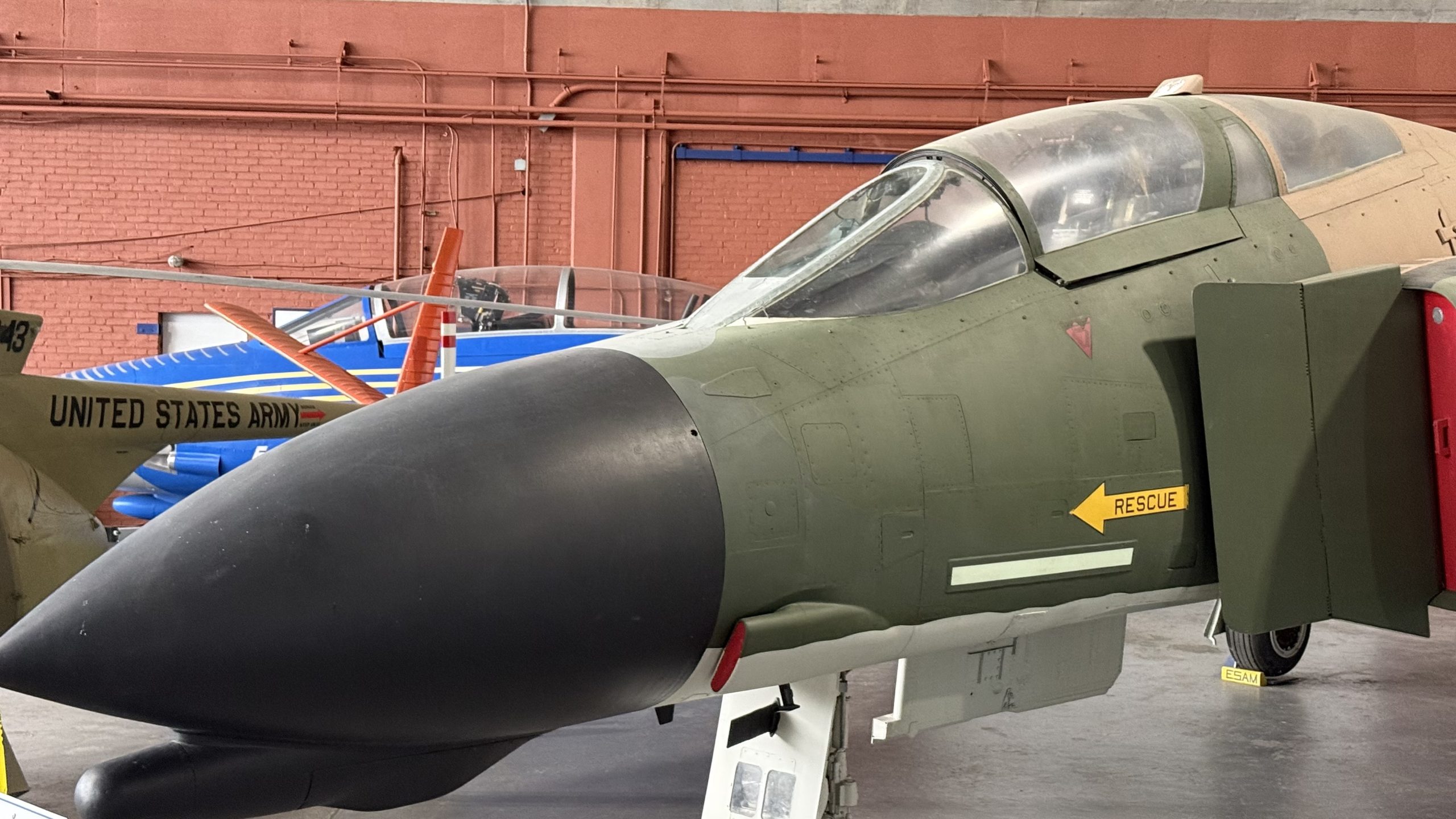
F-4 Phantom. 19FortyFive museum visit and photo shoot.
The F-4 Phantom II was envisioned as a response to an acute Cold War problem faced by the United States Navy.
The question was: how to defend aircraft carriers against high-altitude bombers and Soviet standoff attacks.
The U.S. Navy wanted a fast, radar-equipped interceptor able to engage threats with long-range missiles before they reached the fleet.
McDonnell, the aerospace prime that designed the F-4, first flew in 1958 and entered U.S. Navy and Marine Corps service in 1960.
It was not a direct replacement for any single aircraft, though it was related to the F3H Demon.
The Demon was the U.S. Navy’s all-weather, missile-armed interceptor, but an underpowered design, high fuel consumption, and limited range compromised its performance. McDonnell developed the Phantom as a more powerful successor rather than simply improving the Demon platform.
The F-4, however, quickly outgrew its initial role for the U.S. Navy.
Its speed and radar in particular proved attractive to the United States Air Force, which adopted a land-based variant, the F-4C, in 1963. The U.S. Air Force used it for air superiority interdiction, close air support, reconnaissance, and suppression of enemy air defenses.
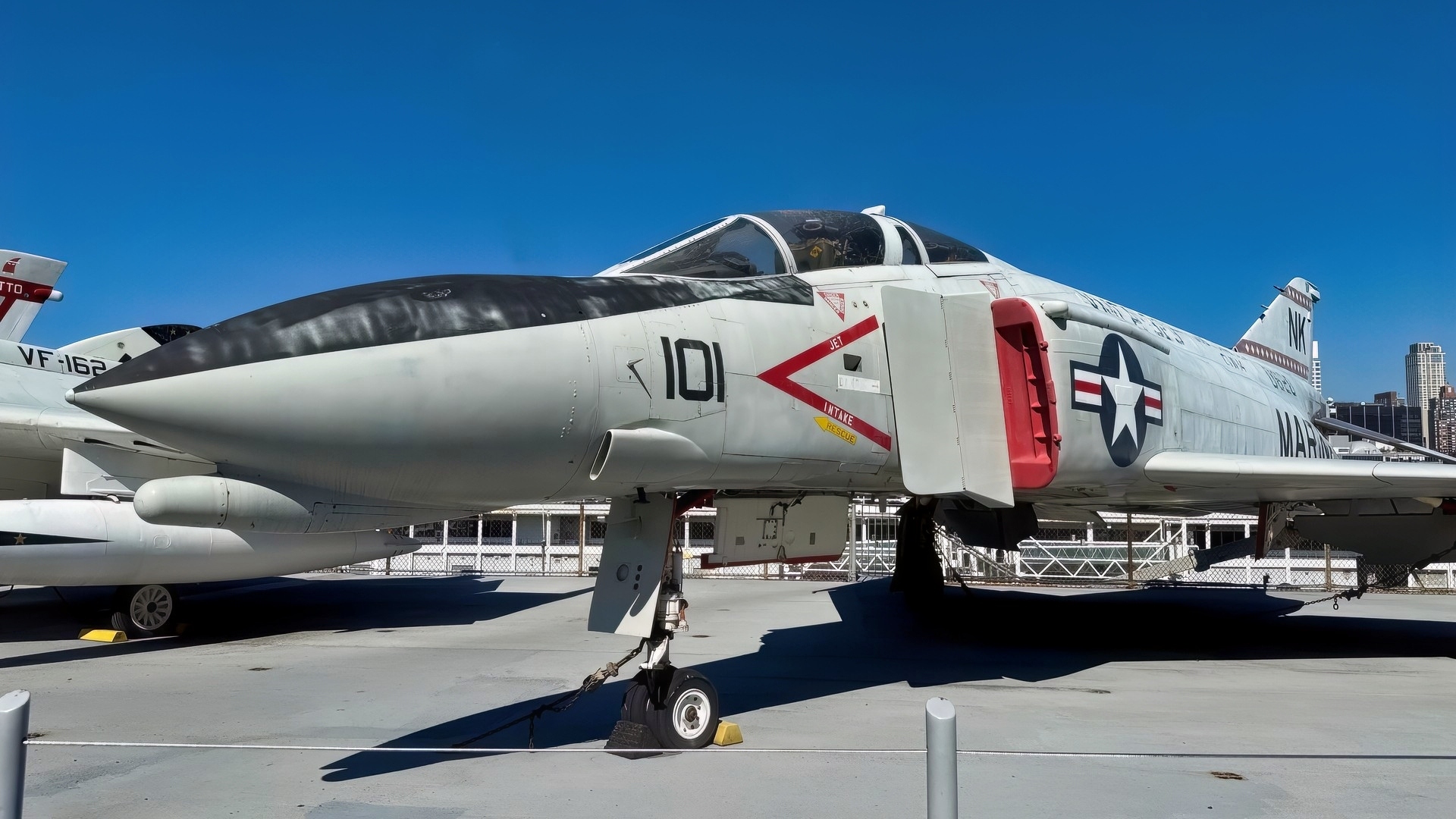
F-4 Phantom Fighter Aboard USS Intrepid Aircraft Carrier 19FortyFive Photo by Harry J. Kazianis
Early Teething Issues
The Phantom reflected the era’s assumptions.
Its designers expected radar and guided missiles to make close-range gun combat—dogfighting—obsolete, so the original F-4 design lacked an internal cannon.
It was also large and heavy, with a two-man crew: a pilot and a radar-intercept officer who controlled the Phantom’s weapons and sensors. But combat experience in Vietnam would dash that theory. The F-4 was forced into visual-range combat against small, more agile North Vietnamese MiGs, often under tight rules of engagement that limited long-range engagements.
Early missiles proved less reliable than anticipated, and the F-4’s weight and design compromised its performance in sustained engagements. A temporary fix was a gun pod, but the added drag made the initial pods unsatisfactory.
The more refined Phantom was the F-4E variant, which integrated a 20mm M61 Vulcan cannon.
Later aircraft incorporated other design features, such as leading-edge slats and smaller aerodynamic improvements, to enhance the jet’s maneuverability.
Though the Phantom would never be as agile as a small, lightweight fighter, it did make the F-4 much more maneuverable and able to engage in the kind of dogfighting pilots were initially taught to avoid.
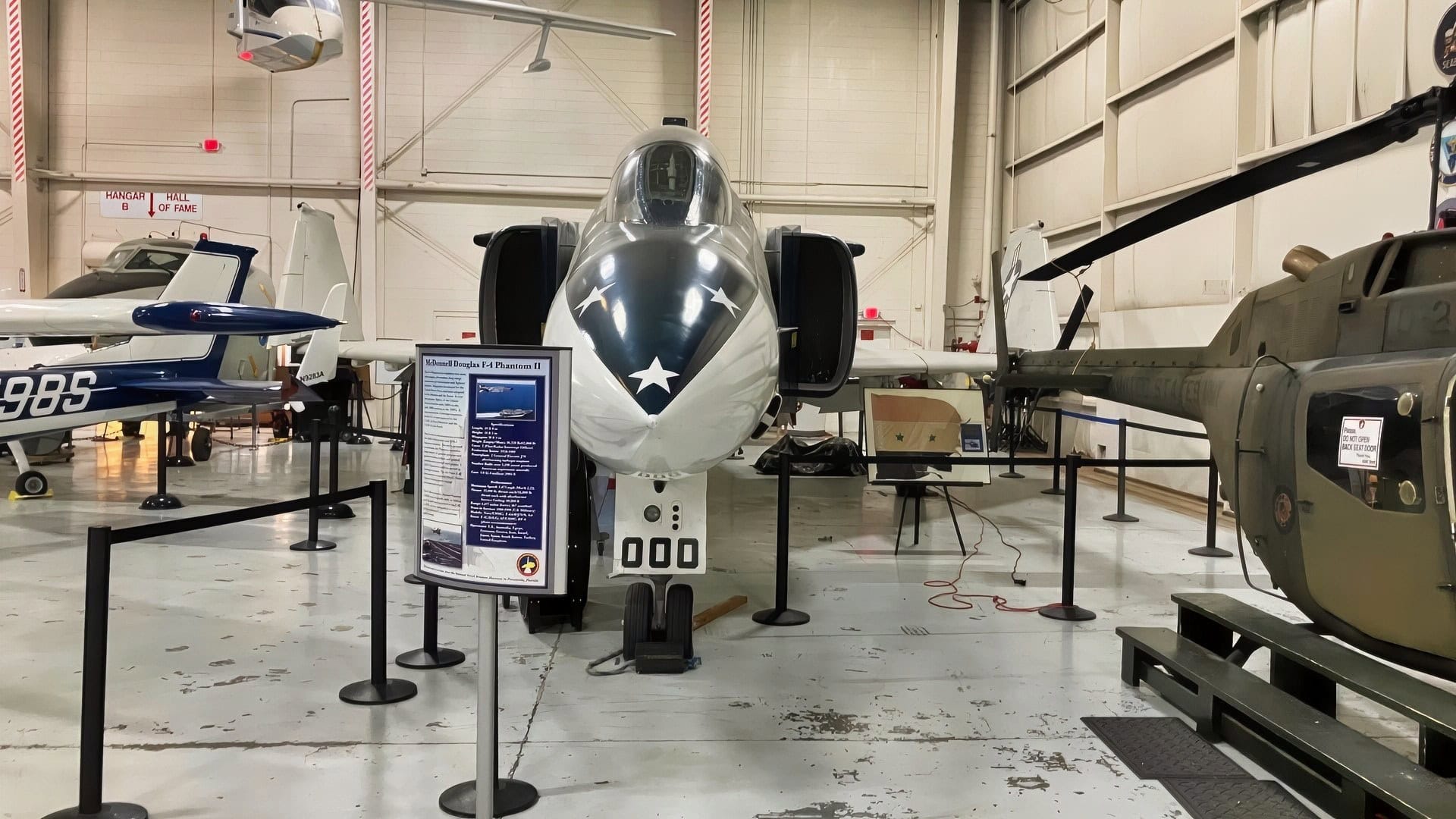
F-4 Phantom Fighter Aviation Museum of Kentucky. Taken by 19FortyFive on March 1, 2026.
An Adaptable Design
The Phantom enjoyed great longevity, thanks largely to its adaptable design.
The U.S. Navy and Marine Corps developed improved variants with better engines, radar, electronics, and superior maneuvering performance.
The U.S. Air Force went in a slightly different direction, and its F-4E variant became the principal American fighter-bomber, while the RF-4 reconnaissance aircraft and Wild Weasel variants stayed in service for years.
Though no longer in service, the Phantom didn’t become obsolete because it stopped functioning well.
Instead, increasingly capable aircraft like the F-14, F-15, F-16, and F/A-18 fighters supplanted it, offering superior maneuverability, better radar, superior dogfighting, and other improvements. By the 1980s, the F-4 Phantom had a large radar cross-section, aging engines, and a mostly analog cockpit architecture.
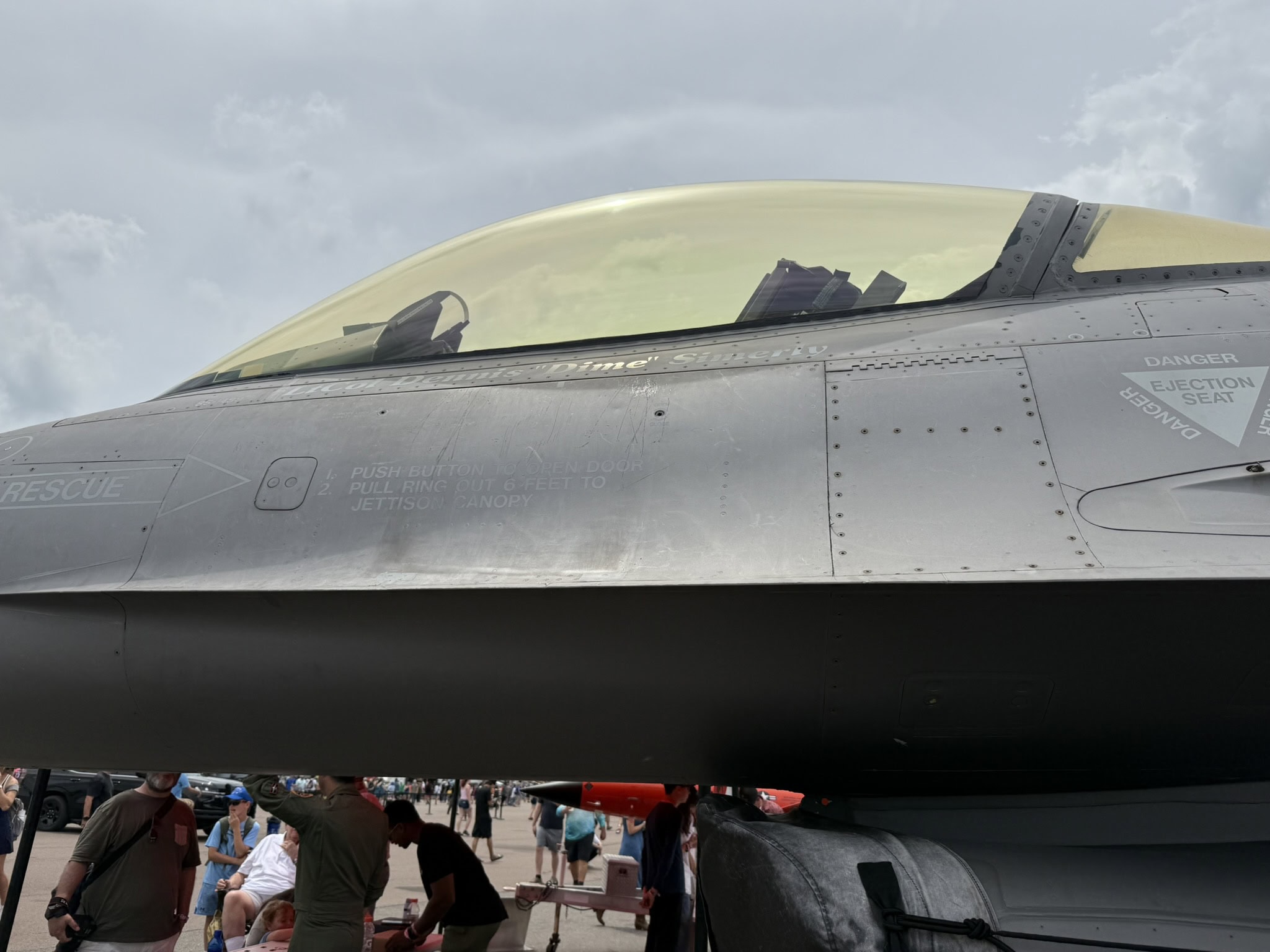
F-16. Image Credit: 19FortyFive.com Taken on 4/19/2026.
Though a brutally powerful fighter that could keep pace, if not outfly, most aircraft, its design was rooted in 1950s technology from the early years of the Cold War.
Interestingly, however, the Japan Air Self-Defense Force flew the jet for about half a century, receiving the jets in the early 1970s and flying them until 2021.
About the Author: Caleb Larson
Caleb Larson is an American multiformat journalist based in Berlin, Germany. His work covers the intersection of conflict and society, focusing on American foreign policy and European security. He has reported from Germany, Russia, and the United States. Most recently, he covered the war in Ukraine, reporting extensively on the shifting battle lines in Donbas and the war’s civilian and humanitarian toll. Previously, he worked as a Defense Reporter for POLITICO Europe. You can follow his latest work on X.