
The first Gripen-F flight in 2026 shows Europe's fighter jet future is being created in Brazil, not in Brussels.
 Dr. Klaus Weber
The first Gripen F flight in 2026 shows Europe's fighter jet future is being created in Brazil, not in Brussels
At 09:40 AM, a fighter jet took off in Linköping, which at first glance seems like just another Saab announcement. In reality, the first flight of the Gripen F is a political statement. The two-seater remained in the air for 40 minutes, testing basic systems and initial flight performance, and in the rear cockpit sat not a Swedish officer, but Brazilian test pilot Lieutenant Colonel Abdon de Rezende Vasconcelos. This is where the real news lies. Europe's most advanced new fighter jet cooperation model of 2026 is not an EU program. It is a Swedish-Brazilian industrial partnership.
A first flight with greater significance than just flight testing
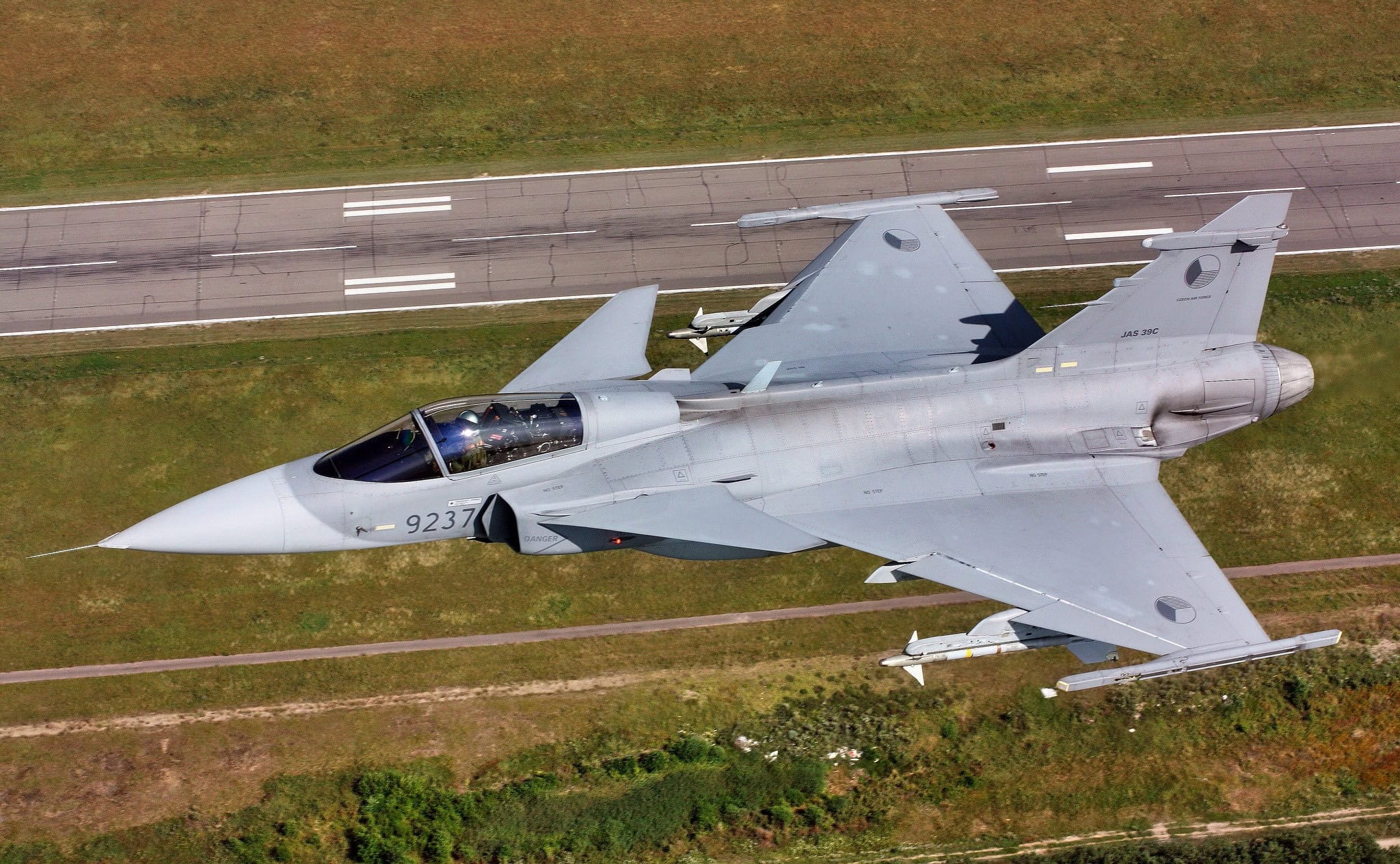
Saab describes the Gripen F as the two-seater variant of the Gripen E. Following the first flight, the actual flight testing phase begins: gradual approvals for speed, altitude, G-load, and angle of attack, as well as testing of rear-seat specific functions. Militarily, this is relevant because the second seat is not just a training position. It opens up possibilities for more complex missions, for sensor and effector management, for command and escort tasks, and in the long term for the division of labor between human and system, which is becoming increasingly important in the age of drone swarms and networked air operations.
But is that enough? A single first flight does not create air power. What is crucial is what becomes organizationally visible behind this flight. Saab emphasizes that more than 350 Brazilian engineers, technicians, and pilots have already been involved in development, production, flight testing, and maintenance. That is the real asset. Europe has been talking about technological sovereignty for years, but here it has not been formulated as a summit declaration, but has been built as training, production, and testing capability.
Why Brazil is closer to real participation today than many European partners
In July, Saab and Embraer agreed on a framework for the possible production of 20 additional Gripen aircraft at the Gaviao Peixoto plant in Sao Paulo. Embraer is to take over assembly, thereby complementing the final assembly line in Linköping. In March, the first Gripen E produced in Brazil was already presented. In August, the now developed Gripen F flew for the first time. This creates a clear line: technology transfer, local assembly, testing participation, followed by capacity expansion.
This very line is missing from the large European prestige programs. Europe's defense debate still confuses participation with work package quotas. But those who only supply subassemblies do not possess sovereignty. Those who assemble, test, train, and later expand themselves at least have a stake in it. Brazil has thus worked its way closer to real industrial co-responsibility in a decade than some European states have in their own so-called future projects.
This is uncomfortable for Germany, France, and the EU. Because the central European question is no longer just whether Europe spends enough money on fighter jets. It is whether Europe is still capable of organizing industrial cooperation in such a way that money also translates into mastery. The Gripen F first flight is small compared to the volumes of FCAS or F-35. But it shows something that the larger programs often lack: a functioning governance between political ambition and industrial implementation.
The strategic value lies in the model, not just in the pattern
Saab itself points out that the two-seater variant is intended to accelerate training and improve operational performance in demanding missions. Additionally, Brazilian Gripen E aircraft were deployed for the first time outside Brazil in a multinational exercise during SALITRE 2026 in Chile in July. Six aircraft participated in air defense, escort, and patrol tasks with more than 50 missions and over 100 flight hours. This is not PowerPoint interoperability, but practiced operation.
It is precisely here that the European lesson begins. Sovereignty is not the ceremonial possession of a design. Sovereignty is the ability to train pilots, keep aircraft available, fly missions in conjunction, and extend the industrial line as needed. Europe's defense policy has been too focused on the first question and has underestimated the following three. That is why the Gripen F flight seems so revealing: Sweden is not simply exporting a product to Brazil. Sweden is exporting a model of controlled participation.
What Europe should learn from this
The political reflex in Europe is often to provide more money and discuss the results later. This leads to programs where the debate over burden-sharing grows faster than the industrial capability. The Gripen F case shows the counter-model. First, people were trained. Then production was shared. After that, local assembly took place. Now joint flying and testing is happening. This is how a defense industry is created that is more than just supply.
- A 40-minute first flight is technically a small step, but institutionally a big one.
- More than 350 trained Brazilian specialists are strategically more valuable than some European summit formulas.
- The possible assembly of 20 additional aircraft in Brazil shows that capacity can be shifted and scaled.
- Interoperability is generated here through joint testing and exercises, not through political rhetoric.
The bitterest point for Europe is therefore a paradoxical one. The louder the discussions in Brussels and the capitals about strategic autonomy become, the more visible it becomes that practical fighter jet cooperation currently works better outside the EU core. Thus, the first flight of the Gripen F was not just a successful test of a two-seater. It was a quiet judgment on the state of European armaments integration in 2026. Europe's future in fighter jet manufacturing is being created where technology is shared, production is learned, and responsibility is transferred. This time it is Linköping and Gaviao Peixoto, not Brussels.
The Gripen F fighter jet conducted its first flight in Linköping in 2026, lasting 40 minutes and testing its systems. This flight marks a significant step in a Swedish-Brazilian partnership, with over 350 Brazilian personnel involved in development and testing. Saab and Embraer plan to produce 20 more Gripen aircraft in Brazil, highlighting a shift in European defense cooperation dynamics.
- The Gripen F fighter jet had its first flight in Linköping on 2026.
- The flight lasted 40 minutes and tested basic systems and performance.
- The aircraft is part of a Swedish-Brazilian industrial partnership, not an EU program.
- More than 350 Brazilian engineers and pilots are involved in the project.
- Saab and Embraer agreed to produce 20 additional Gripen aircraft in Brazil.