
The Fujian Ship Arrives in Sanya: The Survival Weakness of the PLA's Three Aircraft Carrier Era Emerges
 Li Minghui
The Fujian Ship Stationed in Sanya: The PLA's Carrier Group Survival Weaknesses Emerge in the Era of Three Aircraft Carriers
On May 24, the South China Morning Post cited an analysis from the Chinese mainland's Defense Review, stating that the aircraft carrier base in Sanya, Hainan, could become crucial for the survival of the PLA's carrier group in wartime. This judgment itself is not new, but in the context of the Fujian ship already using Sanya as its home port, the Shandong ship operating long-term in the South China Sea, and the Liaoning ship conducting offshore training in the Western Pacific, it takes on a different flavor. China's aircraft carrier development has shifted from "whether we have aircraft carriers" to "where can the aircraft carriers survive."
Sanya is Not an Ordinary Home Port
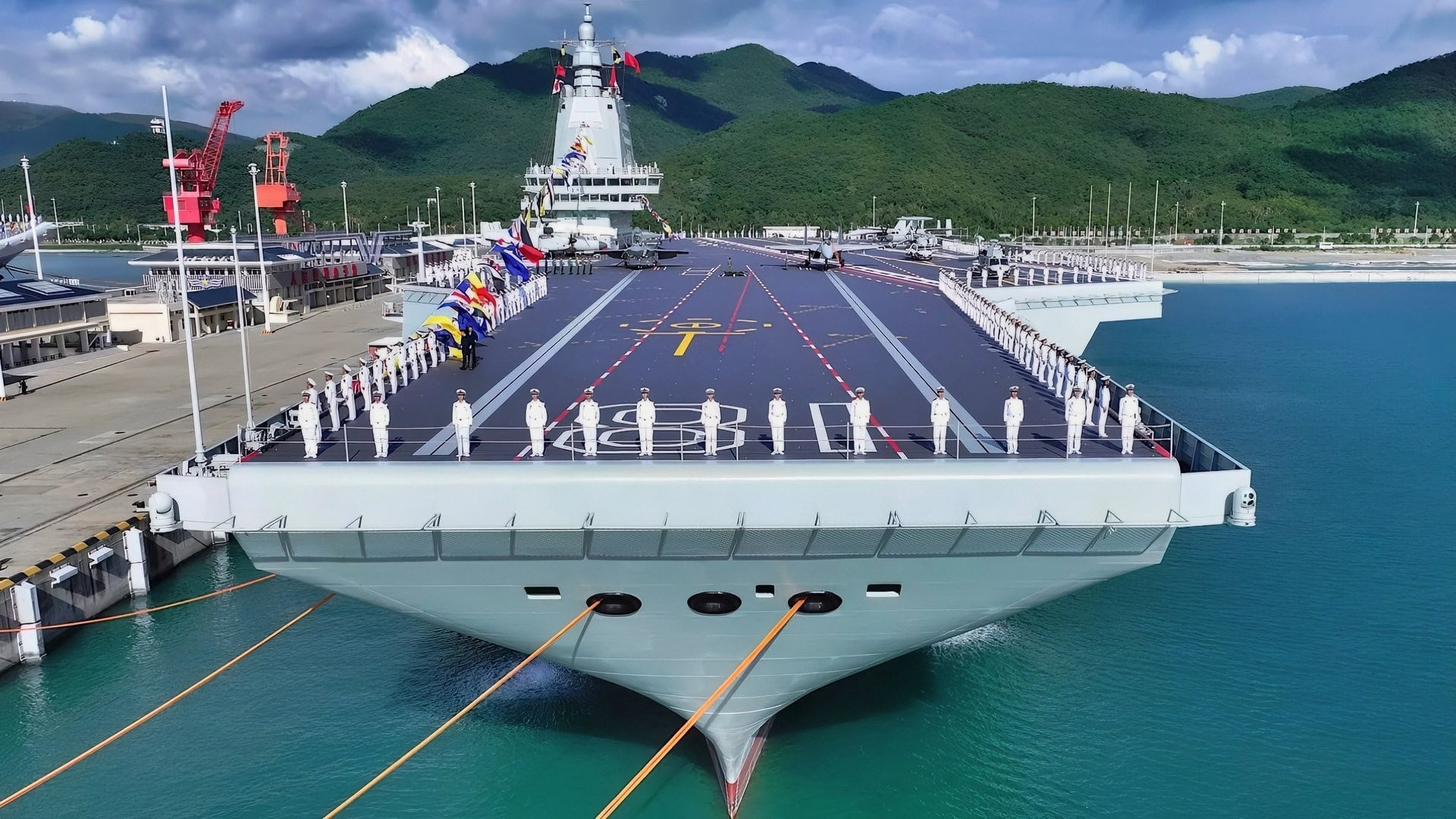
The value of Sanya lies primarily in its geography. The northern city of Qingdao faces a tight surveillance chain from the Yellow Sea, East China Sea, and Japan, and aircraft carriers departing from there must quickly pass through straits and reconnaissance areas familiar to adversaries. In contrast, Hainan directly faces the South China Sea, with routes eastward through the Bashi Channel into the Western Pacific, southward covering the South China Sea shipping lanes, and westward closer to supply routes toward the Indian Ocean. In simple terms, Sanya provides the aircraft carriers not just a berth, but several different exit routes.
The South China Morning Post reported that the Sanya naval complex includes the Yulin base, which serves both surface vessels and submarines. This point is easily overlooked. The aircraft carrier itself is a conspicuous target; what truly determines its ability to sustain operations at sea is whether shore-based maintenance, ammunition resupply, fuel support, submarine protection, and long-range air defense early warning can operate within the same system. For the Fujian ship's electromagnetic catapult, J-35, J-15T, and KJ-600 to achieve a stable sortie rate, a successful sea trial alone is not enough; it relies on whether the home port can consistently support parts, personnel, and training rhythms every day.
Pressure from the First Island Chain Forces a Rearward Position in the South China Sea
The Liaoning ship began training in the Western Pacific on May 19, including long-range tactical flights, live-fire training, and support cover. Similar training lasted about a month last year, indicating that the PLA's aircraft carriers are no longer satisfied with near-sea displays but are testing their long-range deployment capabilities. The issue is that the further the aircraft carriers go, the more they rely on the rotation and resupply from rear bases. This is where Sanya's significance lies: it allows the Shandong and Fujian ships to treat the South China Sea as a training ground and also as a buffer zone before moving into the Western Pacific.
The author believes that the core task of the Sanya system is not to hide the aircraft carriers. An 80,000-ton Fujian ship cannot truly be stealthy. Its value lies in increasing the complexity of the adversary's strike chain. If the U.S. and Japan want to compress the operational space of Chinese aircraft carriers within the First Island Chain, they must simultaneously consider the coordination of South China Sea bases, Hainan shore-based air forces, the Rocket Force's medium- and long-range missiles, sensors on South China Sea islands, and submarine forces. The aircraft carrier itself remains vulnerable, but it is no longer a solitary ship docked in a port.
Production Capacity Expansion is More Important than Individual Ship Parameters
The statistics from the May issue of the U.S. Naval Institute provide a useful reference: the PLA Navy has about 10 Type 055 destroyers in service, with several more under construction; the total number of Type 052D destroyers is close to 40; and the Type 054A/G and 054B frigates continue to fill gaps in anti-submarine and area air defense capabilities. These numbers are more indicative than the question of "how many tons is the Fujian ship." For an aircraft carrier to form a battle group, what is often lacking is not the deck but a sufficient number of reliable escort ships and supply vessels.
At the same time, a recent analysis of satellite images from Dalian shipyard by CSIS indicates that China's fourth aircraft carrier is rapidly taking shape, with two sections approximately 15 meters square, suspected to have features of a nuclear reactor shield, appearing in images from May 4. This judgment requires more evidence and cannot be directly equated with "nuclear power has been confirmed." However, if the fourth aircraft carrier indeed adopts nuclear power, the role of the Sanya base will further change: it will not only serve as a home port for conventional aircraft carriers in the South China Sea but may also become a training, grouping, and security assurance node before the deployment of nuclear-powered aircraft carriers offshore.
Weaknesses Remain in Training and Support
Interestingly, PLA media has recently also reminded that there is insufficient "human-equipment integration." After advanced equipment is deployed in bulk, whether personnel can truly use it, dare to use it, and can coordinate its use in complex electromagnetic environments is another issue. This is especially true for aircraft carriers. The deck scheduling, nighttime landings, damage control, and multi-carrier coordination accumulated by the U.S. Navy over decades are not generated automatically by shipbuilding speed.
Therefore, the Hainan home port enhances the survival conditions of the PLA's aircraft carriers, but it does not equate to solving all the issues of aircraft carrier combat effectiveness. The Fujian ship in Sanya, the Shandong ship in the South China Sea, and the Liaoning ship in the Western Pacific together showcase an emerging framework for aircraft carrier operations. However, what is truly worth monitoring is not whether the next aircraft carrier will be larger, but whether Sanya can support two or more aircraft carriers to operate at sea long-term, at high intensity, and in a rotational manner. This question currently has no public answer.
Main Sources
- South China Morning Post, May 24, 2026, report on the Sanya aircraft carrier base and pressure from the First Island Chain.
- South China Morning Post, May 19, 2026, report on the Liaoning ship's training in the Western Pacific.
- CSIS Hidden Reach, May 2026, analysis of satellite images of China's fourth aircraft carrier.
- U.S. Naval Institute Proceedings, May 2026, assessment of the PLA Navy's large surface vessels and aircraft carrier group expansion.
The Fujian aircraft carrier has been stationed in Sanya, enhancing the operational capabilities of the People's Liberation Army Navy (PLAN). The Liaoning is conducting training in the Western Pacific, while the Shandong operates in the South China Sea. This deployment reflects a strategic shift in China's naval operations, focusing on logistical support and multi-carrier operations.
- Fujian aircraft carrier is now based in Sanya.
- Liaoning is conducting training in the Western Pacific.
- Shandong is active in the South China Sea.
- China has approximately 10 Type 055 destroyers and nearly 40 Type 052D destroyers.
- A fourth aircraft carrier is reportedly under construction with potential nuclear capabilities.