
The Gulf Strait Authority and the Demands of Qatar, Saudi Arabia, and the UAE Delay Trump's Strike on Iran in 2026
 Ahmed Al-Rashid
The Persian Gulf Strait Authority and the Requests of Qatar, Saudi Arabia, and the UAE Postpone Trump's Strike on Iran in 2026
On May 18, 2026, the Hormuz crisis was no longer just a question of a passing ship or a waiting tanker. Iran announced a new entity called the Persian Gulf Strait Authority to manage traffic in the strait, and continued through Pakistan to exchange a modified version of a 14-point plan, while Donald Trump stated that he had halted a strike that was scheduled against Iran at the request of the leaders of Qatar, Saudi Arabia, and the UAE. On the same day, the Barakah nuclear station remained in the background of every Gulf calculation following the drone attack that sparked international condemnation and concern from the International Atomic Energy Agency. These are not three separate news items. This is one equation: whoever controls the rhythm of the strait pressures the economy, and whoever fears for their nuclear stations and ports pressures Washington, while those managing negotiations through intermediaries try to turn time into a weapon.
Hormuz Transforms from Threat to Institution
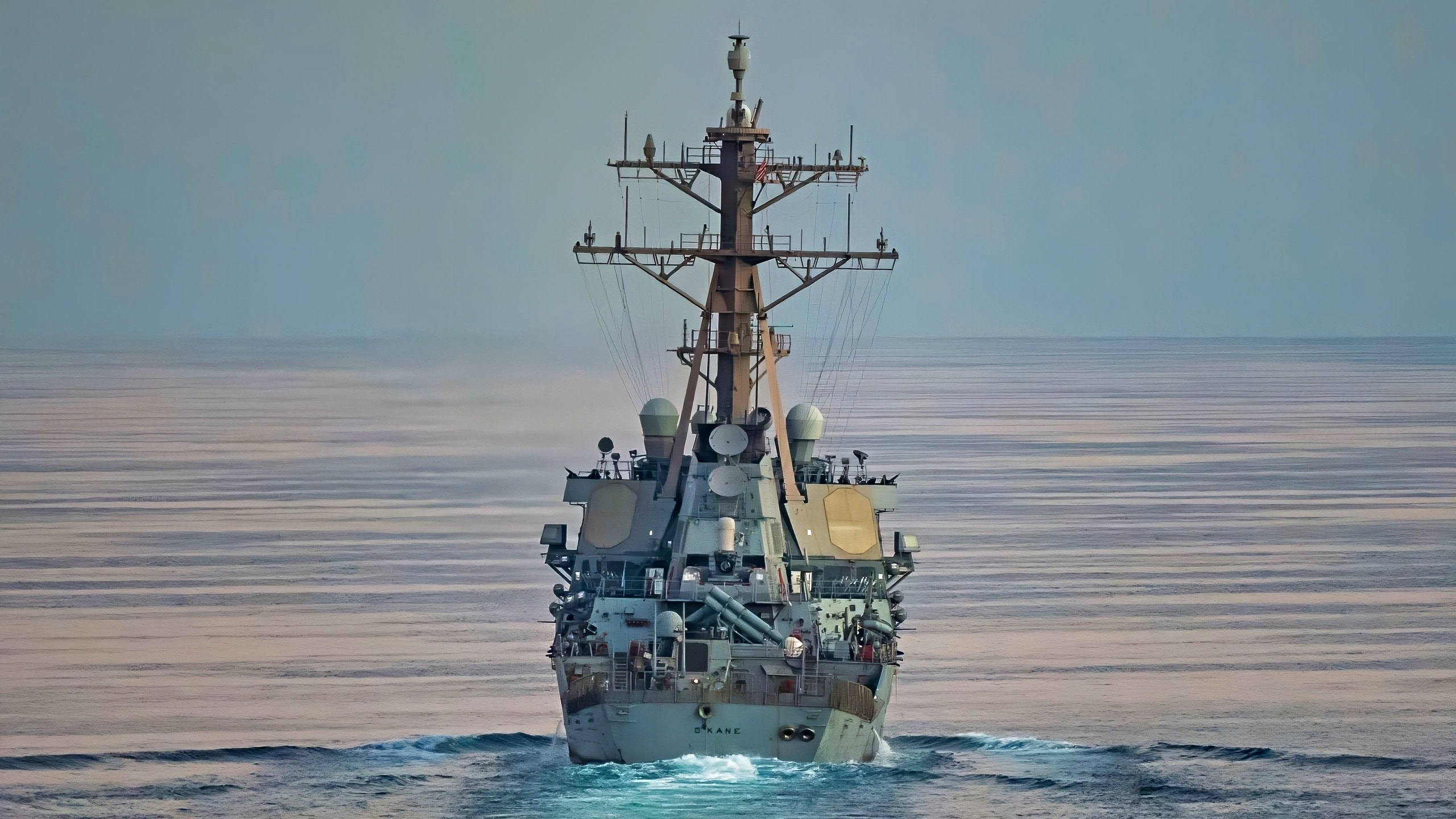
According to The Hindu, the Iranian Supreme National Security Council announced the formation of the Persian Gulf Strait Authority, and the new account stated that it would provide immediate updates on operations in the Strait of Hormuz. The report also indicated that passing ships received instructions via mail linked to the authority to obtain confirmation regarding the rules and regulations. More importantly, Iran no longer describes what it is doing as just a temporary closure, but as “exercising sovereignty” over a passage through which, under normal circumstances, about a fifth of global oil and liquefied natural gas trade flows.
This point is the difference from the previous article regarding the mechanism of fees and passage. There, the question was: Does Tehran impose a price for crossing? Now the deeper question is: Can Tehran establish an office, accounts, instructions, an approval mechanism, and legal language that makes every captain, insurance company, and energy ministry treat the strait as if it were a new licensing system? From a military perspective, an institution is sometimes more dangerous than a fast boat. The boat threatens the ship for a moment. The institution changes market behavior before the ship sets sail.
The 14-Point Plan is Not Peace but Time Management
The Hindu states that Iran presented a new version of the 14-point plan to the United States through Pakistan, and that Tehran is focusing on ending the war, reopening Hormuz, and lifting maritime sanctions, while postponing the more sensitive nuclear files to later rounds. The newspaper quoted an Iranian source, via Reuters, stating that Washington showed flexibility regarding the continuation of limited peaceful nuclear activities under the supervision of the International Atomic Energy Agency, but only agreed to release a quarter of the frozen Iranian assets according to a phased schedule.
This does not mean that an agreement is near. It means that both parties are trying to rearrange the negotiation landscape. Iran wants to separate the cessation of war and the opening of the strait from the final nuclear concession. Washington wants to avoid appearing as if it has paid a political price for restoring navigation. Pakistan is not just a protocol detail here. When Islamabad becomes the channel for messages between Tehran and Washington, it gives Iran a mediator that does not belong to the Gulf system nor to the traditional Omani mediation alone, and gives the Gulf a margin to pressure without appearing as a direct party in the deal.
The Gulf Allies Did Not Stop the War but Delayed the Timing of the Strike
The biggest shift came from Washington. The Hindu quoted Trump as saying he would postpone a military strike that was scheduled against Iran on May 19 at the request of the leaders of Qatar, Saudi Arabia, and the UAE, because “serious negotiations” are underway. The National also featured this in its main headline: Gulf allies convinced Trump to cancel or postpone a strike that was planned to allow for negotiations.
In my estimation, this is an important moment because it does not say that the Gulf has become independent from the United States. That is an exaggeration. But it does say that Gulf countries are no longer content to receive the results of American decisions. Qatar hosts air command and political communications, Saudi Arabia holds the weight of energy and airspace, and the UAE now bears the burden of protecting a nuclear and civilian infrastructure exposed to any escalation. When these three capitals come together on a single request, Washington cannot act as if the theater of operations is just a map in the Pentagon.
The paradox is that Trump simultaneously stated that he ordered the military to remain ready for a wide-ranging attack “at any moment” if an acceptable agreement is not reached. This is the essence of the current American deterrence: the hand on the trigger, but the finger hesitates because the allies close to the range of missiles and drones know the cost of the first shot better than the distant politicians.
Barakah Made the Red Line Civilian, Not Just Military
The drone attack near the Barakah nuclear station changed the risk calculation. The National reported that UN Secretary-General Antonio Guterres said he was “deeply concerned” about the attack, and that it was an additional reason to stop fighting. It also quoted Emirati officials stating that the attack targeted a peaceful energy project, and from Canada, the European Union, the United States, and the International Atomic Energy Agency calls for restraint and protection of nuclear facilities. Official Chinese reports also quoted Rafael Grossi, the Director General of the International Atomic Energy Agency, stating that any military activity threatening nuclear safety is unacceptable.
Here, we should not revisit the previous Barakah article about the air defense gap. The new point is that Barakah has become part of the decision on war and peace. When a drone reaches the vicinity of a reactor, even without a radioactive leak or human casualties, the question is no longer: How many Patriot batteries does the UAE need? The question becomes: Can any new American strike on Iran ensure that power plants, desalination facilities, ports, and data centers in the Gulf do not turn into an open target bank? There is no air defense system that provides a complete answer to this question.
The New Equation in the Gulf
What is happening now is neither an Iranian victory nor a complete American retreat. It is a transition of the crisis to a more complex level. Iran is trying to turn Hormuz into an administrative system that serves negotiations. The United States is trying to retain the option of a strike without breaking the Gulf alliance. Gulf countries are trying to prevent the war from reaching the civilian infrastructure built on post-oil visions.
Any military personnel who has served in the region knows that maritime corridors and air bases do not operate in a vacuum. They depend on stable electricity, maritime security, foreign operating companies, open ports, and a society that does not live under constant alert. Therefore, the most dangerous aspect of the PGSA is not its name, and the most dangerous aspect of postponing Trump's strike is not that it is a cancellation of war, and the most dangerous aspect of Barakah is not that the reactor has stopped. The most dangerous thing is that these three elements have become interconnected: every step in Hormuz affects Washington's decision, and every decision in Washington recalibrates the risk calculation in Abu Dhabi, Riyadh, and Doha, and every drone near a nuclear facility makes the deal less of a luxury and more of a necessity.
The Gulf does not ask America to leave, nor can it practically ask for that. But it tells it something more precise: Do not fire from above our homes and then ask us to manage the fire alone. This is the unspoken sentence behind the request for postponement, and it is also the real military lesson from May 18.
Sources
- The Hindu, May 18, 2026, Iran officially announces new body to manage Strait of Hormuz.
- The Hindu live, May 18, 2026, Iran-Israel war LIVE, including the paragraphs attributed to Reuters regarding American flexibility and limited nuclear activities.
- The Hindu, May 18-19, 2026, Trump says delaying Iran attack at request of Gulf leaders.
- The National, May 18, 2026, Iran war latest and Barakah/UN/UAE coverage.
- The National, May 18, 2026, Iran presents new proposal to end war as Trump warns clock is ticking.
- IAEA/UN/UAE reports as quoted by The National and official Chinese reports on Rafael Grossi's statement regarding the safety of nuclear facilities.
Iran announced the formation of the Persian Gulf Strait Authority to manage traffic in the Strait of Hormuz on May 18, 2026. President Trump delayed a planned military strike against Iran at the request of leaders from Qatar, Saudi Arabia, and the UAE. The situation reflects a complex interplay of military readiness and diplomatic negotiations, particularly concerning Iran's nuclear activities and regional security dynamics.
- Iran announced the formation of the Persian Gulf Strait Authority to manage the Strait of Hormuz.
- Trump delayed a military strike against Iran at the request of Gulf leaders.
- Iran presented a new 14-point plan to the U.S. via Pakistan.
- The Barakah nuclear power plant is a significant concern in the context of military actions.
- Gulf allies are influencing U.S. military decisions regarding Iran.