
The Hormuz Agreement 2026 Opens the Strait but Reveals the Gap in Joint Gulf Defense
 Ahmed Al-Rashid
The Hormuz Agreement 2026 Opens the Strait but Reveals a Gap in Joint Gulf Defense
On June 14, 2026, the issue was not merely whether the Strait of Hormuz would open or not. The more important matter, from a military perspective, is that the opening of the strait came in a draft agreement between the U.S. and Iran that does not present the Gulf Cooperation Council as a collective decision-maker, despite the fact that the backbone of the Gulf economy passes through there every day.
The Strait as a Negotiation Item, Not Just a Shipping Route
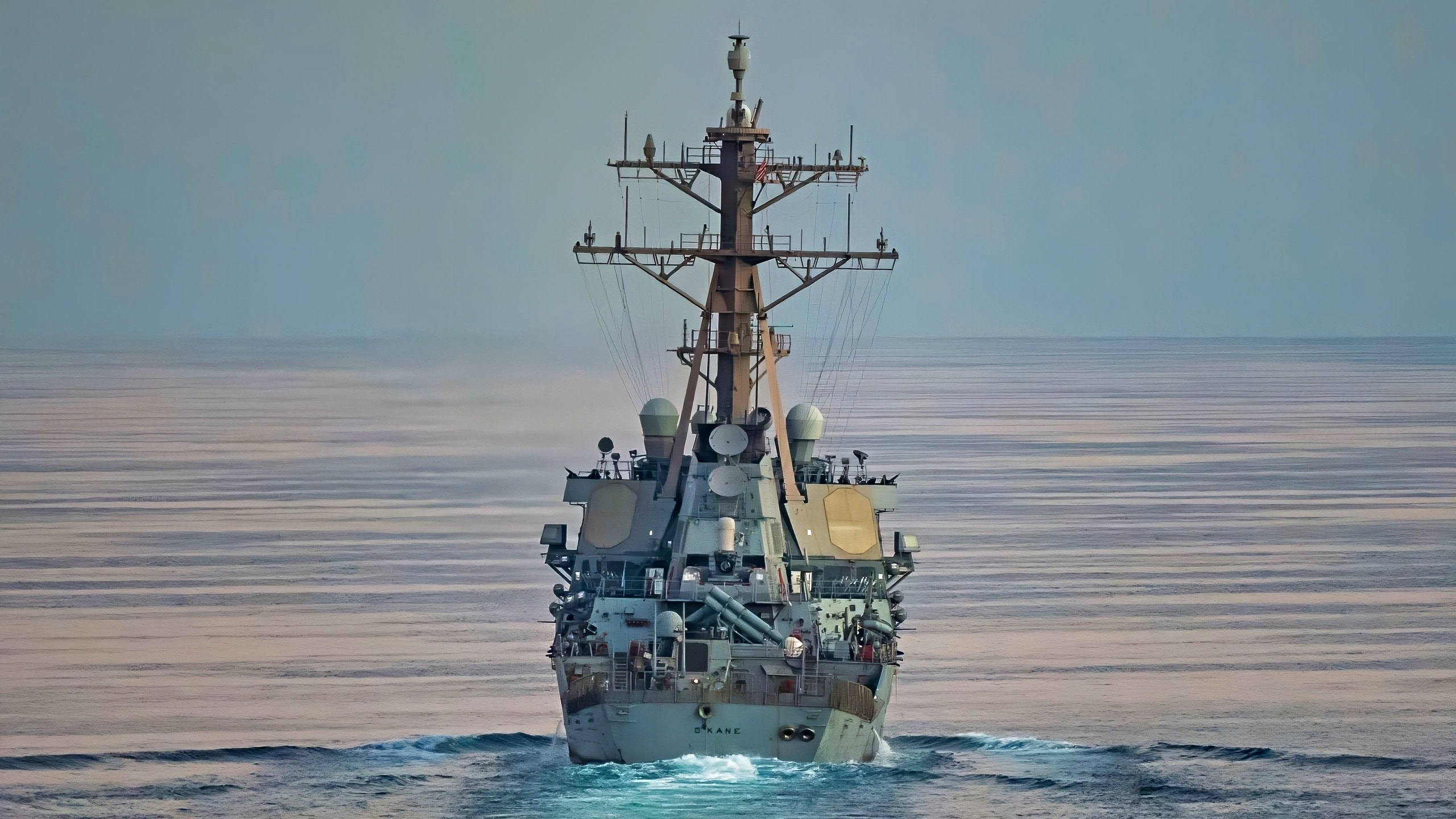
According to what Sky News reported from a senior Iranian official, the draft agreement includes that Iran will immediately reopen the Strait of Hormuz to commercial vessels and that Washington will lift its maritime blockade on Iranian ports. The draft also discusses an Iranian commitment not to produce or acquire nuclear weapons, not to expand facilities or enrich uranium during the negotiation period, and to explore a mechanism for reducing high-enriched uranium stockpiles within 60 days. The same account also mentions a U.S. release of $25 billion in frozen Iranian assets and a temporary exemption allowing Tehran to sell oil and collect its revenues.
These are not financial details separate from security. Every dollar that returns to the Iranian treasury, every tanker that crosses Hormuz, and every marine insurance premium that rises or falls enters into the same deterrence equation. It is a mistake for Gulf capitals to read this agreement as merely a temporary relief for the markets. The strait has now become an official negotiation card, meaning that Iran has succeeded in making the security of the maritime corridor part of the price of war and peace.
Notably, the Guardian reported on the same day that Tehran had not yet made its final decision, and that hardline Iranian factions object because they see the agreement as taking away Iran's leverage in Hormuz. This sentence is enough to understand the essence of the crisis. If hardliners in Tehran view the strait as a lever of influence, how can the Gulf treat it as merely an American maritime responsibility?
The Strike in Beirut Says the Agreement Does Not Close Fronts
At the same time that Qatar and Pakistan were pushing for an electronic signature format between Washington and Tehran, Israel announced that it had struck Hezbollah infrastructure in the southern suburbs of Beirut in response to gunfire directed at its territory. Evacuation orders were also issued for dozens of villages in southern Lebanon. The Associated Press described the timing as a strike on the way to a long-awaited U.S.-Iran agreement, and this characterization is important because it reveals a political vacuum at the heart of the understanding.
Israel is not comfortable with an agreement that does not eliminate the entire Iranian missile infrastructure, does not impose a final resolution on uranium stockpiles, and does not link Iran's proxies to a clear implementation mechanism. Hezbollah, for its part, does not need official approval from Tehran to test the limits of the truce. Therefore, the Gulf cannot consider the Hormuz agreement as the end of the war, but rather as closer to a temporary maritime and nuclear truce while keeping the land and missile fronts open.
My experience with armies in the region tells me that a ceasefire does not equal a halt in readiness. In a truce, stockpiles are replenished, target lists are reviewed, and command networks are tested. Thus, the correct Gulf question is not whether Hormuz will open tomorrow, but whether the Gulf warning system can operate if it closes after two months?
Recent U.S. Strikes Provide the Operational Lesson
On June 10, U.S. Central Command announced additional strikes inside Iran against military surveillance capabilities, communication systems, and air defense sites, stating that the strikes targeted threats to U.S. forces and commercial vessels in the territorial waters. This type of operation illustrates a truth known to any air defense officer: control of the sea begins from land and air, not just from the destroyer alone.
If coastal radars, ground control stations, and Iranian air defense systems around Hormuz determine the level of danger to navigation, then protecting the Gulf cannot be reduced to sending more ships. What is needed are interconnected layers: early warning, a shared aerial picture, defense against drones, high-value interceptors like Patriot and THAAD, and naval capabilities to monitor mines, boats, and surface drones.
The problem is that the Gulf possesses many of these assets individually, but does not always have the system that allows them to operate as a single body. Saudi Arabia has depth, space, and advanced American systems. The UAE has operational experience and sensitive port infrastructure. Qatar, Bahrain, Kuwait, and Oman have locations that cannot be bypassed in any maritime crisis. But the threat does not ask about customs borders nor wait for a committee meeting.
The Gulf Defense Dilemma Is Not a Lack of Weapons but Slow Decision-Making
The recent analysis by War on the Rocks about the need for a Gulf shield built on limited trust hit a central point: the Gulf Cooperation Council suffers not only from a lack of institutions but also from a lack of operational routines that work under pressure. The joint defense agreement, unified military command, and working groups with Washington on air and missile defense all exist on paper. But a missile does not wait for paper.
Let’s imagine a simple scenario. A radar in a Gulf state detects a low-flying target over the sea. The best interception battery is in a second state. The threatened port is in a third state. If data exchange, classification, and permission requests begin after the target appears, we have lost half the battle. In air defense, seconds are not an administrative detail but ammunition.
Here, the limits of the arms purchase model as a substitute for building institutions become apparent. A Patriot or THAAD battery does not grant sovereignty alone. Operational sovereignty is knowing who decides, who sees the picture, who fires, and who retains the missile to intercept a more dangerous target after ten minutes. The Gulf has purchased a lot of smart iron, but it has not yet resolved the rules for its collective use.
What Needs to Change After the Hormuz Draft
- First, establishing a limited Gulf warning layer does not mean a complete unified command, but rather an automatic exchange of relevant maritime and aerial radar tracks related to Hormuz, the Arabian Sea, and Bab el-Mandeb.
- Second, agreeing in advance on escalation thresholds. When does an unknown target become a regional threat? Who receives the notification? And what can be executed automatically before ministers return to their phones?
- Third, building a shared intercept stockpile or at least an emergency redistribution mechanism. Saturation attacks deplete missiles in hours, while production lines take months and years.
- Fourth, establishing a permanent maritime cell linking ports, insurance companies, and maritime operations centers, as rising insurance premiums in Hormuz are a security indicator, not just a commercial one.
These steps do not require an ideal political unity. On the contrary, they should be designed on the assumption that trust between capitals is limited. Oman will remain a mediator, Saudi Arabia will weigh Yemen, Iran, and energy calculations, the UAE will view maritime corridors from the perspective of its ports, and Qatar will maintain its own channels. The wisdom lies not in denying these differences but in turning them into an organized division of labor.
Conclusion
If the agreement is signed, it will be said that Hormuz has opened, that oil has breathed, and that war has stepped back. This is partially true. But the colder military reading says that Iran has proven that the strait is a negotiation card, Washington has proven that it remains the operational key, and Israel has proven that the Lebanon front does not wait for the negotiators' approval. As for the Gulf, it remains in its old place: rich in platforms, poor in joint engineering.
The old military adage says that the strength of a wall is not measured by the most beautiful stones in it, but by the gaps between the stones. In the Gulf today, the stones are expensive, but the political and operational gaps are still wide. And this is the gap that no agreement in Hormuz can close.
Sources
- Sky News live coverage on the US Iran draft deal and Strait of Hormuz terms
- The Guardian live coverage of Iran decision timing and Hezbollah Israel escalation
- Associated Press report on Israeli strikes in Beirut before the anticipated US Iran deal
- US Central Command statement on June 10 strikes in Iran
- War on the Rocks analysis on a Gulf shield built for limited trust
Iran and the U.S. are negotiating terms to reopen the Strait of Hormuz, which includes lifting sanctions and addressing nuclear weapons production. Israel conducted strikes in Beirut in response to threats from Hezbollah, indicating ongoing military tensions. Gulf states express concerns about the implications of the agreement on regional security and the need for improved defense coordination.
- Iran is negotiating to reopen the Strait of Hormuz for commercial shipping.
- The U.S. is considering lifting maritime sanctions on Iranian ports.
- Israel conducted strikes in Beirut in response to threats from Hezbollah.
- The Gulf states are concerned about the implications of the agreement on regional security.
- The report highlights the need for improved Gulf defense coordination.