
The Hormuz Attack Halts Evacuation of 11,000 Sailors and Reassesses the 2026 Iran Agreement
 Ahmed Al-Rashid
Hormuz Attack Halts Evacuation of 11,000 Sailors and Re-tests Iran Agreement 2026
At 05:00 GMT on June 26, the price of Brent crude was $74.11 per barrel after rising above $76 and then retreating. The number itself is not the most important thing that happened. The important thing is that a cargo ship reported it was hit by an unknown projectile near the Omani coast, and the International Maritime Organization halted the evacuation plan for ships stranded around the Strait of Hormuz. Just one week after the U.S.-Iran memorandum of understanding, the strait returned from the language of diplomacy to the language of safe passages, projectiles, and direct responsibility on the captain, owner, and operator.
This is not an isolated maritime incident. It is a practical test of the first unwritten clause in any agreement with Iran after the war: who has the right to define the safe passage? Washington says that Hormuz is an international passage with no fees and no unilateral oversight. Tehran, through the Persian Gulf Authority, says that ships that deviate from its defined framework do not receive safety guarantees. Between the two statements stand oil and gas tankers, container ships, and 11,000 sailors who were waiting for an organized evacuation from an area that has remained for months as if it were a floating ship parking lot.
A Minor Incident Reveals the Fragility of a Major Agreement
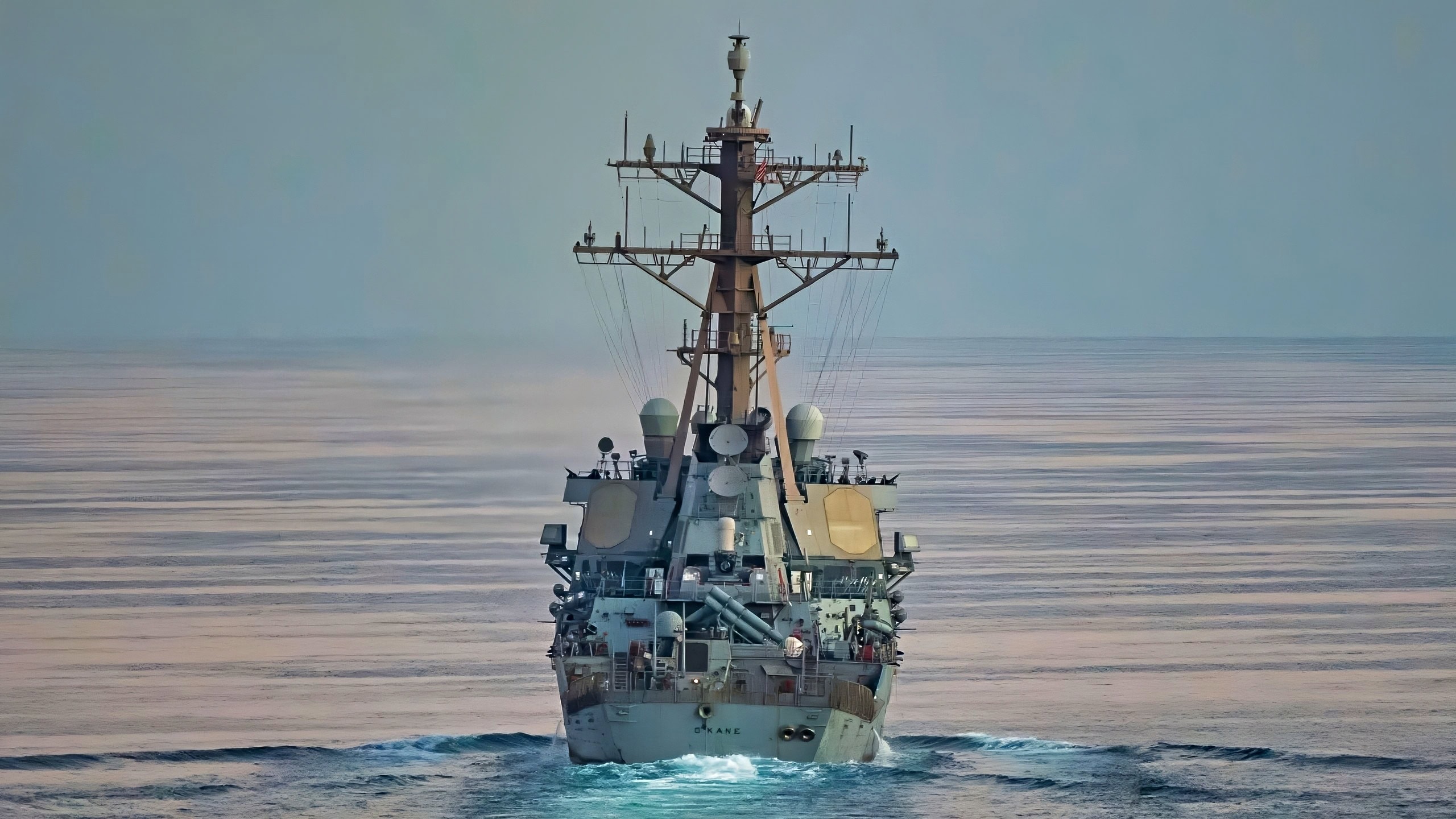
According to Al Jazeera, the International Maritime Organization decided to suspend the evacuation plan after the ship reported being hit by an unknown projectile while attempting to transit near the Omani coast. Just three days prior, the organization announced the start of evacuating more than 11,000 stranded sailors in the strait in coordination with Iran, Oman, coastal states, the United States, and the shipping sector. This was supposed to be the first tangible indicator that the U.S.-Iran memorandum of understanding was moving from paper to sea.
The numbers were seemingly encouraging. On Wednesday, 70 ships transited the strait, more than double the previous day, the highest daily number since March 1, according to ship tracking platforms MarineTraffic and Kpler. Before that, Kpler reported the transit of 36 commercial ships on Monday. However, from a military perspective, traffic density alone is not enough to prove a return to control. In the straits, security is not measured by the number of ships that passed yesterday, but by the system's ability to prevent a single incident from paralyzing commercial behavior tomorrow.
Any officer who has served in the region knows that the strait does not need a complete closure to turn into a global crisis. It is enough for every transit to become a separate security, legal, and political decision.
Iran's Problem is Not Just About Fees
U.S. Secretary of State Marco Rubio said in the UAE that Iran will not be allowed to impose fees on an international strait, and that the countries in the region will agree to this. This is legally correct, but it does not answer the more important question: what happens if Iran does not demand explicit fees, but instead imposes a transit framework, defined corridors, and declared risks on every ship that does not comply? Here, fees transform from a monetary amount to regulatory authority. Tehran does not need a toll gate to prove it is an indispensable party.
Iran's chief negotiator Mohammad Baqer Qalibaf stated that the strait will never return to its pre-war status. This statement is more significant than the details of any official publication. It means that Iran wants practical recognition that the war that began on February 28 changed the rules of maritime movement. Tehran does not only want to stop the bombing or ease sanctions; it wants to establish a new memory among shipping companies, insurance firms, and Gulf states: passage is possible, but it goes through Iranian calculations.
- About a fifth of global oil and liquefied natural gas trade passes through the strait in peacetime.
- Brent rose by up to 4% after the news of the attack and then fell by 1.8%, indicating a worried market rather than a reassuring one.
- The International Maritime Organization spoke of safety guarantees, but a single incident was enough to suspend the plan.
- The Persian Gulf Authority held ships that deviated from its framework responsible for transit.
Naval Defense is Linked to Missile Depletion
The connection between a ship hit near Oman and a meeting in the White House with munitions makers may seem distant. But it is at the heart of the matter. Defense News reported on June 25 that President Donald Trump met with munitions companies to urge them to accelerate production after operations in Iran and other areas depleted sensitive U.S. stockpiles. Proposed agreements include tripling the production of Patriot missiles, quadrupling THAAD production, and expanding Tomahawk and AMRAAM production. This is not the language of absolute power; it is the language of a military that knows deterrence is now linked to production lines, not political statements.
The day before, the White House requested an additional $87.6 billion from Congress, of which $67.15 billion was for the military, and $21 billion for munitions, the industrial base, and critical capabilities. Military Times quoted a CSIS analysis stating that the 38-day bombing campaign on Iran hit over 12,000 targets, used more than 1,000 Tomahawk missiles, and up to 290 THAAD missiles, and that restoring some stockpiles to their previous levels could take until 2029 or 2031. These numbers should be read in Riyadh, Abu Dhabi, and Doha, not just in Washington.
The Gulf has been buying air defense systems for years as if owning the battery means owning the decision. But the recent war showed that air defense in the region is an American network before it is national equipment. If the U.S. stockpile itself needs years to replenish, then Gulf requests for Patriot and THAAD will not just be commercial deals; they will be competition within a long strategic queue, where priority goes to the U.S. military, then Israel, then Europe or the Pacific, and then allies who pay a lot and wait longer.
Oman Between Geography and Security Burden
The occurrence of the incident near the Omani coast gives Muscat a heavier role than it usually wishes to portray. Oman has historically succeeded in selling calm as a foreign policy, but it now faces a situation where a quiet mediator is not enough. If the Omani coast becomes part of the safe passage equation, then Muscat needs more intensive maritime and intelligence coordination with Washington, Tehran, and Gulf states, without appearing to join one axis against another.
Here lies the tragedy of small states around the strait. The UAE needs its ports and alternative routes. Qatar needs a flow of gas. Kuwait, Bahrain, and Saudi Arabia need an American umbrella that does not appear exhausted. Oman needs to ensure that its geographical position does not become a platform for accusation or pressure. Each country has a different interest, but the commercial ship does not see this complexity; it only sees an insurance company raising costs and a captain asking: which route will not kill me or bankrupt my owner?
Testing Triad Capability
In my view, Hormuz today places all parties before the same triad of capability: equipment, training, and institutions. Iran has boats, coastal missiles, drones, mines, and political capacity for ambiguity. The United States has destroyers, defensive systems, and a network of bases, but it suffers from munitions pressure, public opinion, and Congress. Gulf states have money, ports, and some of the best radars and batteries, but they do not yet have a joint regional institution capable of managing a maritime corridor crisis without waiting for a U.S. decision.
Practically, the U.S.-Iran agreement does not need to collapse to fail. It can remain in place in Switzerland while ships fail to return confidently to Hormuz. Politicians can declare that fees are prohibited while Iran creates a more cunning reality: passage without fees, but under its security conditions. As the old military saying goes in our region, the road you cannot protect is not enough to just draw it on the map.
In conclusion, the attack on June 26 did not close the strait, but it closed the illusion that a single memorandum could return the situation to February. Peace in Hormuz will not be measured by the number of handshakes, but by the number of days ships transit without an unknown projectile, without an Iranian statement defining the route, and without a new American meeting with munitions makers because stockpiles emptied faster than Washington anticipated. This is the knot that the Gulf does not want to acknowledge: reliance on America is necessary, but it is no longer sufficient.
An unknown projectile struck a cargo ship near Oman on June 26, 2023, leading the International Maritime Organization to suspend the evacuation of 11,000 sailors. This incident occurred shortly after a U.S.-Iran agreement, raising concerns about maritime security in the Strait of Hormuz. The attack underscores the ongoing tensions and the complexities of safe passage in the region.
- An unknown projectile hit a cargo ship near Oman.
- The International Maritime Organization suspended the evacuation plan for 11,000 sailors.
- The attack occurred shortly after a U.S.-Iran memorandum of understanding.
- Iran asserts control over safe passage in the Strait of Hormuz.
- The incident highlights the fragility of maritime agreements.