

Summary and Key Points: The four Iowa-class battleships, USS Iowa, New Jersey, Missouri, and Wisconsin, were the most powerful the United States ever built, each carrying nine 16-inch guns and capable of 33 knots. They were designed for a decisive gun duel against an enemy battle line, but by the time they entered service in 1943 and 1944, the aircraft carrier had already displaced the battleship as the deciding weapon at sea. For the next fifty years, the ships served instead as fast carrier escorts and shore-bombardment platforms, their enormous guns aimed almost entirely at targets on land. The battle they were built to win never came.
Introduction:
The four Iowa-class battleships were the most powerful the United States ever built, designed for a climactic duel against an enemy battle line. By the time they reached the fleet in 1943, the aircraft carrier had already made that kind of battle obsolete, and they never fought it. Instead, over five decades and five wars, they served as carrier escorts and coastal bombardment ships, firing their enormous guns almost exclusively at land targets. And in their final combat action, the very weapon that had rendered them obsolete, the anti-ship missile, nearly sank the last one.
The Iowa-Class Never Fought the Battle She Was Designed For
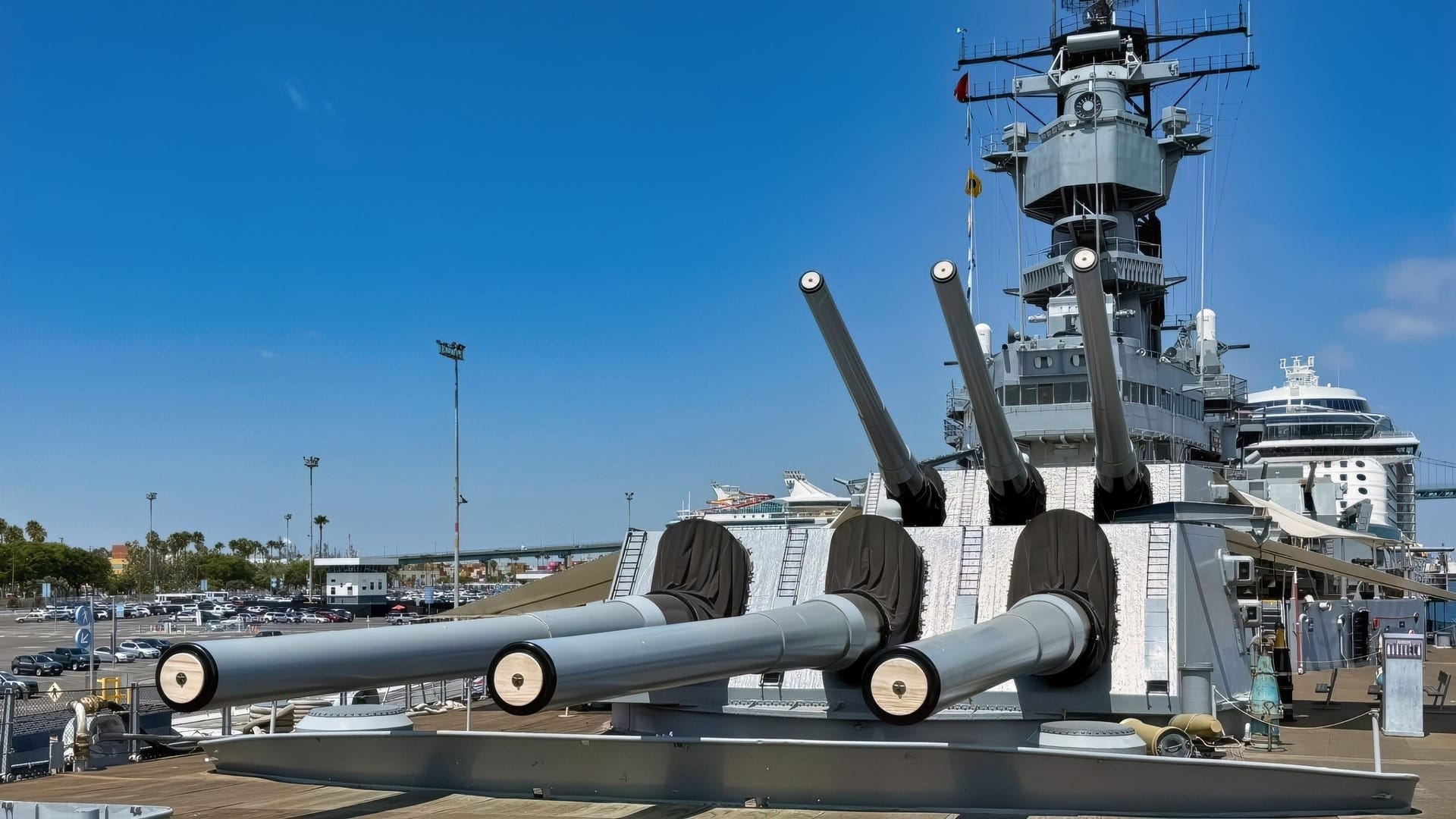
USS Iowa Battleship Guns 19FortyFive.com Image
The USS Iowa and her three sisters, New Jersey, Missouri, and Wisconsin, are among the most beloved warships in American history, and they carried the largest guns the U.S. Navy ever put to sea, nine 16-inch rifles apiece, each capable of hurling a shell weighing up to 2,700 pounds, as much as a small car, more than twenty miles.
They were built to be the ultimate expression of the battleship, the fast, armored capital ship that would win command of the ocean in a decisive gun duel with an enemy fleet. In half a century of service, they never fought that battle, not once.
The story of why is more revealing than any “greatest battleship ever” list.
Built for a Duel That Was Already Dying
The Iowas were ordered in 1939 and 1940 as fast battleships, capable of a remarkable 33 knots so they could run down enemy capital ships and steam as the “fast wing” of the American battle line. To hit that speed, their designers made a revealing trade: they accepted thinner armor than the ships could otherwise have carried, sacrificing protection for the speed to keep pace with the fleet’s fast aircraft carriers.
That decision was more telling than anyone realized at the time, because it meant the last American battleships were built, in part, to escort the very type of ship that was about to make them obsolete.
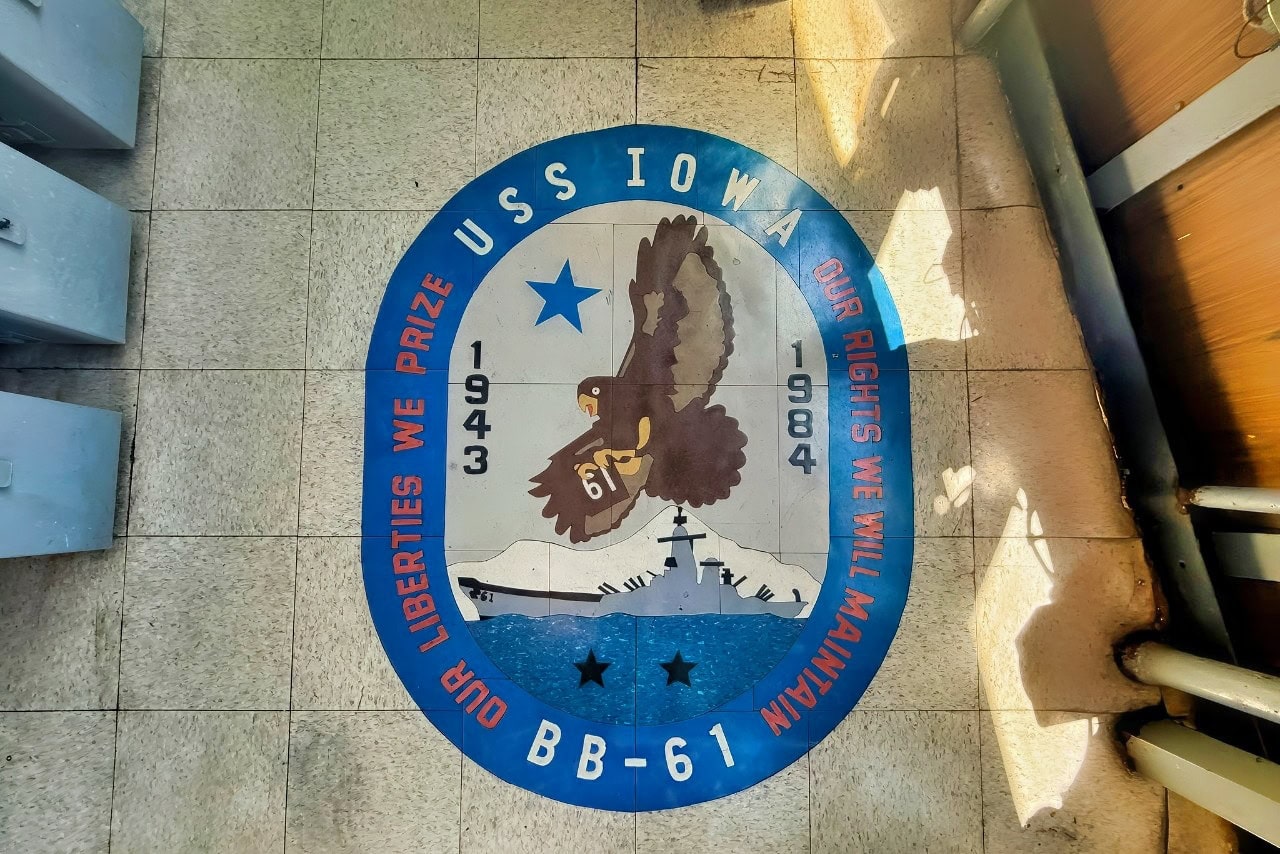
Battleship USS Iowa Logo 19FortyFive Image.
By the time the first Iowas were commissioned in 1943 and 1944, the verdict was already in. Pearl Harbor, Taranto, and Midway had shown that carrier aircraft, striking from beyond the horizon, had displaced the battleship as the decisive weapon at sea.
The Iowas entered a war in which the role they were designed for had already ended.
The Yamato They Never Met
So they were handed a different job. In the Pacific, the Iowas served primarily as fast escorts for the carrier task forces, screening the flattops with their heavy anti-aircraft batteries and, between air strikes, shelling Japanese island garrisons. Their designated arch-rival was the Japanese super-battleship Yamato, the only warship afloat that outgunned them. They never fired a shot at her.
The closest they came was the Battle of Leyte Gulf in October 1944, where Admiral William Halsey took the Iowas north to chase a Japanese decoy carrier force while Yamato and the main enemy surface fleet slipped south, so the two greatest battleships ever built passed in the night and missed each other entirely. The last true battleship-versus-battleship gun duel in history, fought that same night at Surigao Strait, was waged by the old, slow battleships raised from the mud of Pearl Harbor, not by the new Iowas.
The Iowas’ single surface action was almost an afterthought. Off Truk in February 1944, Iowa and New Jersey ran down and sank the fleeing Japanese light cruiser Katori and a destroyer, chasing crippled ships rather than trading broadsides with a battle line. Missouri’s most famous moment came not in combat at all, but when Japan signed its surrender on her deck in Tokyo Bay in September 1945. The most powerful gun platforms America ever built earned their place in history, hosting the end of a war, not winning the battle they were made for.
Fifty Years of Shelling Coastlines
What kept the Iowas relevant for another forty years was that one job they had never been designed to emphasize: pounding targets on land. In Korea, they poured thousands of 16-inch shells into North Korean positions. In 1968, New Jersey was recalled specifically to bombard North Vietnamese logistics and coastal batteries. In the 1980s, she shelled militia positions in the mountains east of Beirut. And when all four were reactivated under Ronald Reagan’s 600-ship Navy, bristling with new Tomahawk and Harpoon missiles, the guns still spoke only to the shore. During Operation Desert Storm in 1991, Missouri and Wisconsin fired their 16-inch batteries at Iraqi troops and bunkers along the Kuwaiti coast, the last time American battleship guns ever fired in anger. In every one of those wars, across every one of those decades, the most powerful guns in the American fleet were aimed at the land, never at an enemy fleet.
The Missile That Nearly Ended It
The last chapter carries the sharpest irony of all. On the night of February 24, 1991, as Missouri shelled Iraqi positions in occupied Kuwait, the Iraqis fired back, not with guns, but with two Chinese-built Silkworm anti-ship missiles.
One tumbled into the sea.
The other bore in on the battleship until it was shot down by a Sea Dart missile from the escorting British destroyer HMS Gloucester, splashing down roughly 700 yards off Missouri’s bow.
It was, fittingly, the last time those guns spoke in war, and in that same fight, the anti-ship missile, the descendant of the airpower revolution that had dethroned the battleship half a century earlier, had come within a few hundred yards of sinking the last one afloat.
Within a year, all four Iowas were retired for good, and today they rest as museum ships in Los Angeles, Camden, Pearl Harbor, and Norfolk.
They were magnificent machines, arguably the finest battleships ever constructed.
But the ocean battle they were built to win had already ceased to exist by the time they first put to sea, and for fifty years they fought, brilliantly, a war other than their own.
About the Author: Harry J. Kazianis
Harry J. Kazianis (@Grecianformula) was the former Senior Director of National Security Affairs at the Center for the National Interest (CFTNI), a foreign policy think tank founded by Richard Nixon based in Washington, DC. Harry has over a decade of experience in think tanks and national security publishing. His ideas have been published in the NY Times, The Washington Post, The Wall Street Journal, CNN, and many other outlets worldwide. He has held positions at CSIS, the Heritage Foundation, the University of Nottingham, and several other institutions related to national security research and studies. He is the former Executive Editor of the National Interest and the Diplomat. He holds a Master’s degree focusing on international affairs from Harvard University.