
The Japan Maritime Self-Defense Force Submarine Sinks USS Juneau with Torpedoes, Demonstrating Denial Capability of the First Island Chain
 Tanaka Takashi
Japan's Maritime Self-Defense Force Submarine Sinks USS Juneau with Torpedo, Demonstrating Denial Capability of the First Island Chain
A column of water engulfed the center of the ship in an instant. On June 27, during the SINKEX of Valiant Shield 2026 in the Philippine Sea, the final blow to the decommissioned U.S. Navy dock landing ship USS Juneau was delivered by a torpedo launched from a Japan Maritime Self-Defense Force submarine. According to Task & Purpose, citing a U.S. military spokesperson, the ship sank after being subjected to a multi-axis attack by U.S. and allied forces in waters over 200 nautical miles off the coast of Guam.
The Significance of a Torpedo, Not a Missile, Delivering the Final Blow
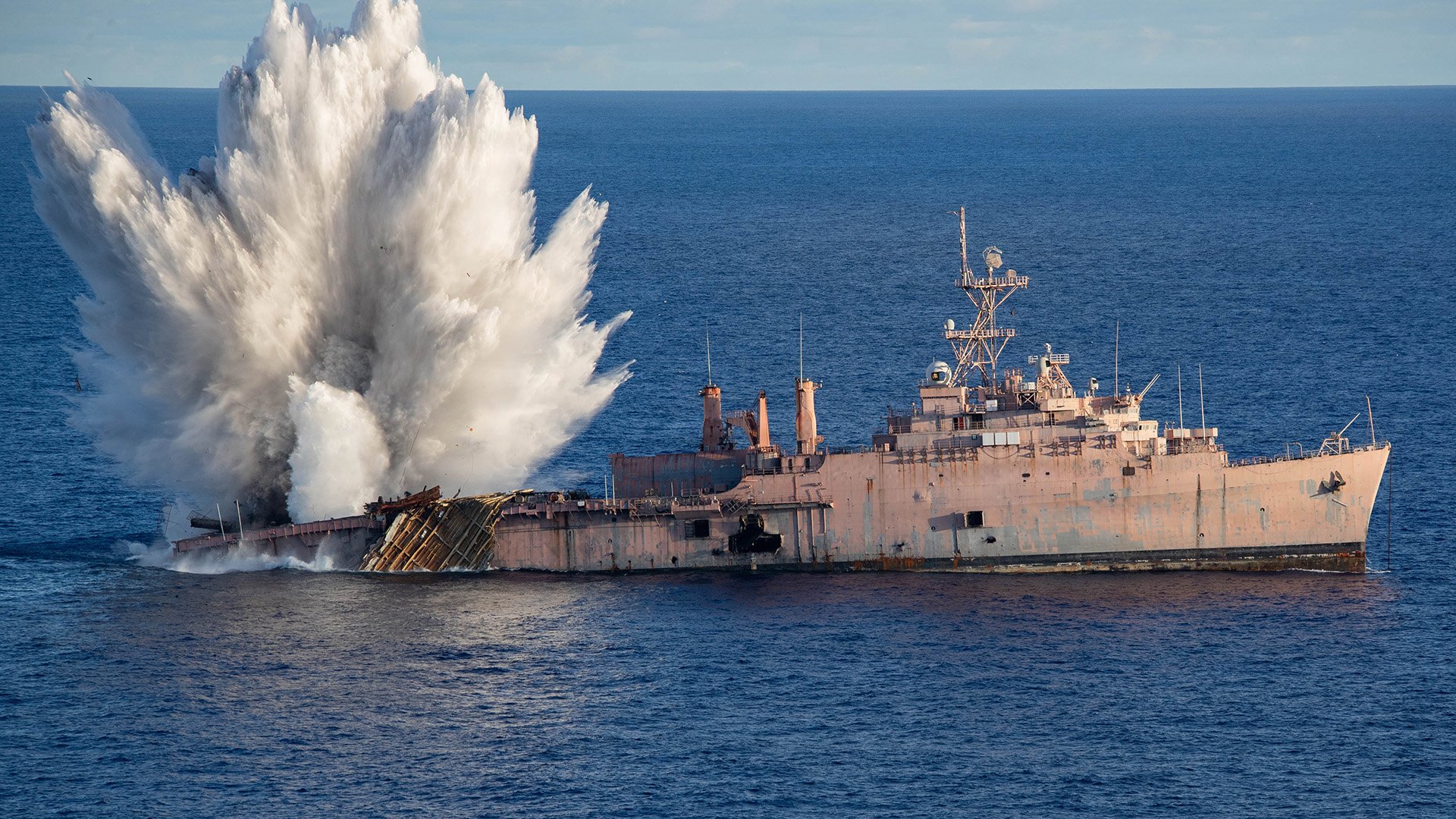
The public photo description from DVIDS states that the SINKEX took place in the Philippine Sea, with air, surface, and underwater forces collaborating to attack a real ship target. According to Task & Purpose, a P-8A Poseidon aircraft launched an AGM-84D Harpoon, and a B-2 bomber deployed an LRASM. After significant damage was inflicted by the U.S. Navy, Air Force, Army, and special operations forces, the JMSDF torpedo delivered the final strike.
What is noteworthy here is that the final blow was delivered by a heavyweight torpedo rather than an anti-ship missile. Missiles destroy the superstructure, sensors, flight deck, and areas around the engine room. In contrast, torpedoes attack the buoyancy and longitudinal strength of the hull below the waterline. The Austin-class Juneau is a real ship with a length of about 570 feet and a displacement of approximately 17,000 tons, featuring complex internal compartments, making it different from a mere target version. The ability to measure the progression of damage, including flooding, bulkheads, engine compartments, and well decks, is valuable.
Estimated JMSDF Submarine and 533mm Heavy Torpedo
Army Recognition has identified the "Jingei" SS-515 of the Taigei class as a potential candidate for the JMSDF submarine that participated in Valiant Shield 2026 based on publicly available information. However, the U.S. military's public caption does not officially specify the name of the launching vessel, and this point should be approached with caution.
The Taigei class is reported to be approximately 84 meters long, about 9.1 meters wide, and has a standard displacement of around 3,000 tons, utilizing lithium-ion batteries as a conventional power submarine. Compared to conventional types, it has more leeway in maintaining high output underwater and charging cycles, allowing for reduced snorkel exposure. This is not merely a performance difference around the First Island Chain; it represents an operational advantage in increasing the time spent in firing positions while remaining hidden from the sensor networks of patrol aircraft, drones, and surface ships.
In terms of armament, the focus is on heavyweight torpedoes launched from 533mm torpedo tubes. The specific type of torpedo used in this instance has not been disclosed, but the Taigei class is noted to have a relationship with the 18-type torpedo, which is the successor to the 89-type. The 89-type is said to have wire guidance, active-passive acoustic guidance, and a warhead weighing approximately 267 kilograms. The 18-type is believed to focus on improvements in detection processing and counter-decoy capabilities, which are significant in shallow waters and noisy environments.
The Kill Chain of the Japan-U.S. Alliance Has Expanded Underwater
The U.S. forces in Japan have recently linked the transformation of the Joint Staff Office of the Self-Defense Forces and the U.S. Forces Japan Command, explaining that it will better connect Japan-U.S. command and control for operational purposes. The sinking of the Juneau can be seen as a case that substantiates this explanation with live-fire evidence at sea. Target detection, identification, weapon assignment, control of air and sea areas, attack order, and battle damage assessment are separate procedures. This was executed against a single target by a B-2, P-8A, surface ships, submarines, and helicopters.
In my view, this is not a simple threat to the large surface fleet of the Chinese Navy. Rather, it is training aimed at simultaneously constraining the opponent's escort ships, anti-submarine aircraft, unmanned sensors, and route selection. As long as there is a strike capability from underwater, surface forces may not be able to withdraw quickly after sustaining damage. This underscores the deterrent weight of the JMSDF submarine fleet.
The Remaining Challenges Are Ammunition and Political Decision-Making
However, one should not be overly optimistic. The series of attacks on a real ship target was conducted in a training area with pre-coordination and safety management in place. In actual combat, enemy electronic warfare, anti-submarine pressure, civilian vessels, weather, and political constraints will all come into play simultaneously. Particularly in Japan's case, in scenarios where submarines are used as part of retaliatory capabilities, the speed of launch orders may become more critical than technical firing capabilities.
The torpedo that sank the Juneau demonstrated the capabilities of the JMSDF submarine. However, the real focus is not on whether the torpedo hits, but on when the political decision is made to fire that torpedo.
On June 27, 2026, a Japan Maritime Self-Defense Force submarine sank the USS Juneau using a torpedo during the Valiant Shield 2026 exercise in the Philippine Sea. The USS Juneau, a retired amphibious transport dock, was targeted after sustaining damage from U.S. military forces. This event highlights the operational capabilities of the Japanese submarine fleet in a multi-domain military exercise.
- The Japan Maritime Self-Defense Force submarine sank the USS Juneau using a torpedo.
- The sinking occurred during the Valiant Shield 2026 exercise in the Philippine Sea.
- The USS Juneau was attacked by multiple U.S. military forces before being sunk by a torpedo.
- The submarine involved is speculated to be the 'Jingei' SS-515.
- The exercise demonstrated the capabilities of the Japan Maritime Self-Defense Force in a multi-domain operation.