
The Japan Maritime Self-Defense Force's Chōkai Conducts First Tomahawk Launch; 2026 Counterattack Capability in Implementation Stage
 Tanaka Takashi
JS Chokai Conducts First Tomahawk Launch; 2026 Counterattack Capability Moves to Implementation Stage
In the Pacific Ocean off the coast of the U.S. mainland, the Japan Maritime Self-Defense Force's Aegis destroyer "Chokai" (DDG-176) launched a Tomahawk cruise missile. The Ministry of Defense revealed on July 30 that this launch was not merely a test firing. It serves as a significant signal indicating that the "counterattack capability" specified in the 2022 National Security Strategy has moved from procurement documents to the combat command center of the destroyer.
According to Naval News, the launch took place on July 29, Japan time, with support from the U.S. Navy. The "Chokai," which has been undergoing modifications and training in the U.S., successfully met its intended objectives regarding crew procedures, ship systems, and missile flight, as explained by ATLA (Acquisition, Technology & Logistics Agency). However, details about the test area, target, flight distance, guidance procedures, and whether the missile used was Block IV or Block V have not been disclosed. This lack of public information suggests that the nature of this test is closer to actual combat operations.
What the "First Launch" Indicates
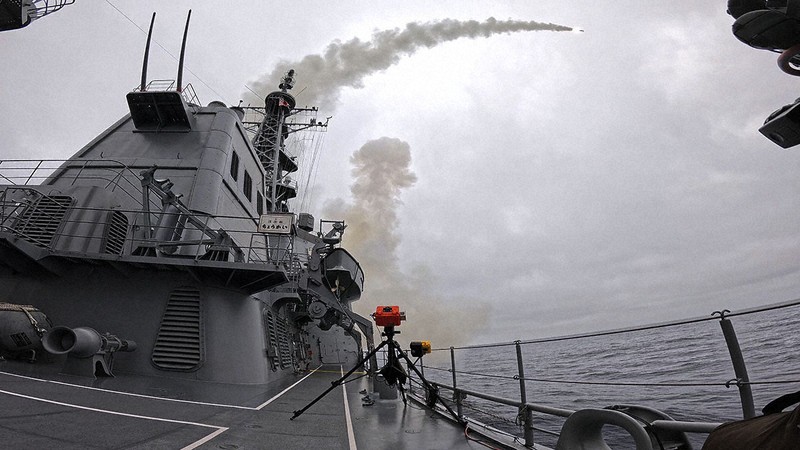
The English version of Mainichi Shimbun reported that the launch occurred on July 28 local time in the Pacific Ocean off the U.S. coast. Considering the time difference, this does not contradict the Ministry of Defense's announcement of July 29 Japan time. From the photos, it is evident that the missile was launched vertically from the Mk 41 VLS, indicating an integration that utilizes the existing launch system of the destroyer.
Japan has joined the ranks of Tomahawk-launching countries, following the U.K., Australia, and the Netherlands, becoming the only country besides the U.S. to do so. While the U.K. operates Tomahawks from submarines, the JMSDF's position is similar to that of Australia and the Netherlands in terms of surface ship launches. However, Japan's geographical significance is greater, as the Korean Peninsula, the East China Sea, the area around Taiwan, and the southwestern islands are all directly linked to Japan's SLOC (Sea Lines of Communication) and homeland air defense.
Realities of Modifying Five Ships and Procuring 400 Missiles
According to the Ministry of Defense's established plan, approximately 113.6 billion yen will be invested by fiscal year 2026 to equip the five ships "Chokai," "Kirishima," "Haguro," "Myoko," and "Atago" with Tomahawk launch capabilities. Naval News reports that the remaining three Aegis destroyers will be considered for budget allocation after fiscal year 2027. Meanwhile, Mainichi Shimbun, citing Ministry of Defense information, reported that ultimately all eight ships will be equipped with Tomahawks.
Regarding the missiles themselves, a maximum of 400 units are planned to be acquired through U.S. FMS, totaling approximately 169.4 billion yen. This includes a maximum of 200 Block IV missiles from fiscal year 2025 to 2027 and a maximum of 200 Block V missiles from fiscal year 2026 to 2027. Deliveries are said to have begun in fiscal year 2025, but the number delivered and the pace of deployment have not been disclosed. There remain questions about whether this number is sufficient as a "munitions depot" for attacking enemy bases.
Changing Division of Responsibilities in the Japan-U.S. Alliance
Until now, Japan's primary missions have been BMD (Ballistic Missile Defense), anti-submarine warfare, and surveillance of surrounding waters. The addition of Tomahawk capabilities will alter this division of roles. It is no longer a simple structure where the U.S. military handles attacks while the Self-Defense Forces provide defense; rather, it creates room for the JMSDF's Aegis destroyers to take part in long-range precision strikes.
However, this cannot be simply viewed as "Japan becoming more aggressive." In my view, what is more important is whether it can shorten the time to wait for U.S. firepower in the early stages of a crisis. How Japan will utilize information, political judgments, and timing against North Korea's mobile launchers, China's coastal missile units, or forward bases around the southwestern islands is crucial. If this remains unorganized, merely extending range will not complete deterrence.
Operational Burden on the Fleet
The "Chokai" is said to have left Japan in September 2025, undergoing modifications and training in the San Diego area, and acquired launch capabilities in March 2026. The additional months required until this live firing indicates that equipment integration cannot be accomplished solely through software updates. Including launch procedures, communications, target information, test control with the U.S. Navy, and ensuring safety in surrounding air and sea areas, the capability enhancement of a single ship requires considerable time and personnel.
This point is often overlooked. The JMSDF has already been heavily utilized for BMD missions with Aegis destroyers. If Tomahawk missions are added, the same ships will have to bear the responsibilities of air defense, missile defense, anti-submarine warfare, and long-range strikes. While modifying five ships may provide a sense of security in numbers, considering maintenance cycles and crew training, the number of ships available for constant use will naturally be lower.
It is natural for the Ministry of Defense to keep the launch distance and target confidential. However, what is truly being concealed is not the performance of the missiles, but rather the political procedures by which the government can decide to launch at various stages of crisis.
Bridging to Domestic Missiles
ATLA has stated that there are no plans for additional acquisitions of more than 400 Tomahawks. The future mainstay is expected to shift to domestically produced stand-off capabilities, such as the Type 12 surface-to-ship guided missile enhanced version. In other words, the Tomahawk serves as a bridge until domestic long-range missiles are operational, and at the same time, it is a teaching tool for the JMSDF to learn the operational culture of long-range strikes.
This launch has shifted Japan's counterattack capability from "concept" to "procedure." However, simply having procedures in place does not complete a strategy. During the Cold War, the JMSDF found its purpose in defending sea lines of communication supporting the U.S. 7th Fleet. In 2026, the JMSDF has begun to take on the role of not only supporting U.S. forces in the same waters but also applying pressure on the enemy's operational base. The true challenge lies not in the range of the Tomahawk, but in whether Tokyo and Washington can operate on the same operational timeline before firing a single missile.
Source: Reports from Naval News, Mainichi Shimbun English version, and Defence Industry Europe from July 30 to 31, 2026.
The Japan Maritime Self-Defense Force launched a Tomahawk cruise missile from the Aegis destroyer Chokai in the Pacific Ocean on July 29, 2026. This marks Japan's first operational use of Tomahawk missiles from surface ships, indicating a significant enhancement of its military capabilities. Japan plans to equip five Aegis destroyers with Tomahawk capabilities by 2026 and acquire up to 400 missiles through U.S. Foreign Military Sales.
- The Japan Maritime Self-Defense Force launched a Tomahawk missile from the Aegis destroyer Chokai.
- The launch occurred on July 29, 2026, in the Pacific Ocean off the coast of the United States.
- This event marks Japan's first operational use of Tomahawk missiles from surface ships.
- Japan plans to equip five Aegis destroyers with Tomahawk capabilities by 2026.
- The acquisition of up to 400 Tomahawk missiles is planned through U.S. Foreign Military Sales.