
The JNIM Targets 44 Mines in the Sahel by 2026 — Gold Becomes a Battlefield
 Marie Dubois
The JNIM Targets 44 Mines in the Sahel by 2026 — Gold Becomes a Theater of Operations
On July 22, ACLED published a report that should be read as a staff map, not as an economic note. By studying the violence related to 44 mines in Mali, Burkina Faso, and Niger, the NGO shows that Sahelian gold is no longer just a source of funding for the Group for Support of Islam and Muslims (JNIM) and the Islamic State in the Sahel. It has become a complete theater of operations, with its roads, markets, informants, fuel stocks, and explosives.
This detail matters. On the ground, one does not control a mine by merely holding the hole in the ground. One controls the path leading to it, the market where miners buy rice, the water point, the motorcycle workshop, the neighboring administrative post. ACLED emphasizes that nearly 90% of conflicts related to mining occur outside the concessions themselves, often within a radius of about ten kilometers. This is exactly where the war in central Sahel is played out.
The Ten Kilometers That Matter
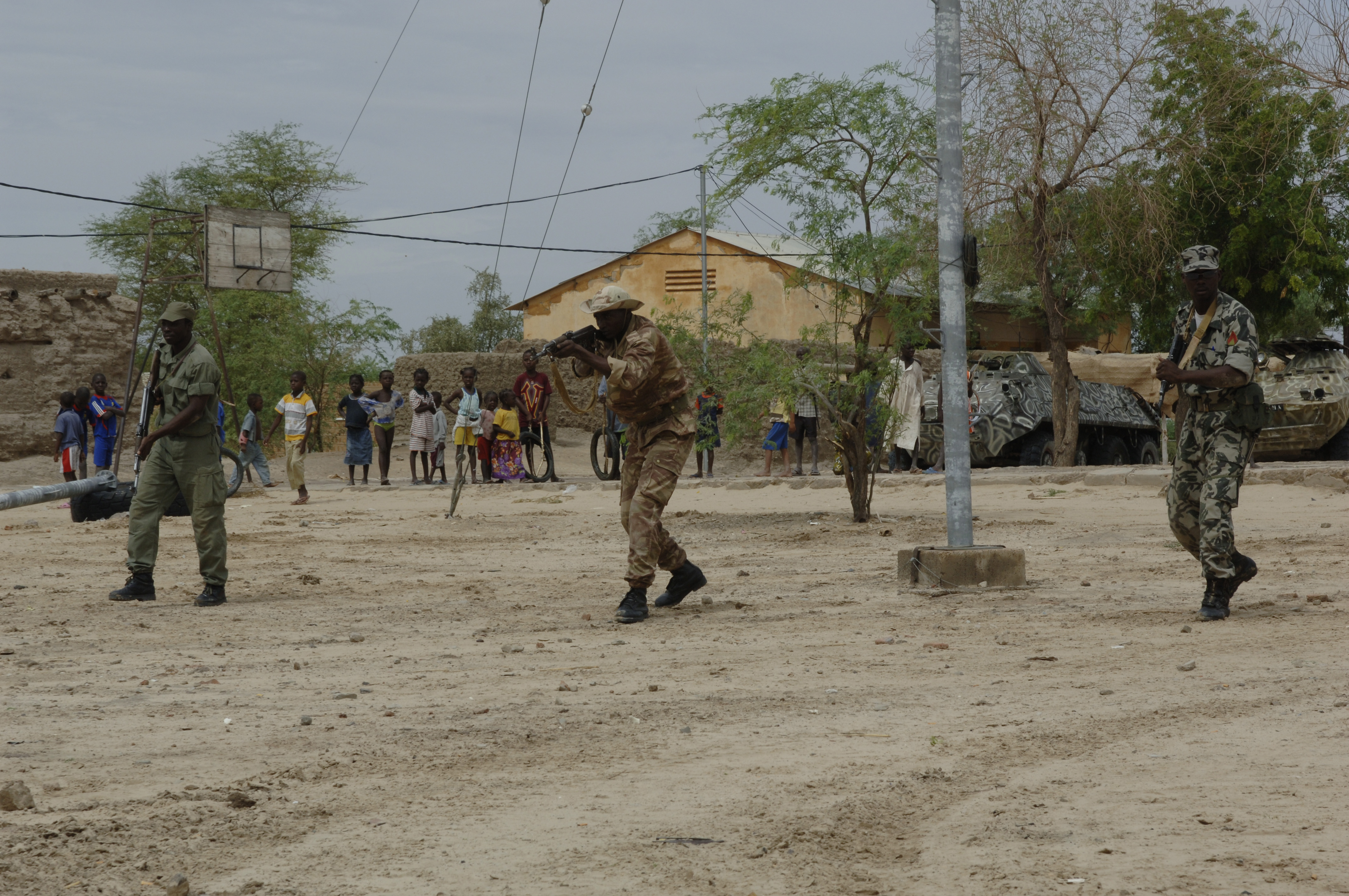
In Burkina Faso, the names mentioned in the report outline a geography familiar to the units that have patrolled the north and east of the country: Inata, Boungou, Solhan, then the corridor of National Road N3. In Mali, ACLED mentions Talhandak, Tinzaouatène, and Intahaka in the North, but also the mining areas that stretch from Kayes to Sikasso in the South. In Niger, Samira, Komabangou, and M'Banga appear in the same pattern.
These places do not form a classic front line. They are points of friction. An armed group may not permanently occupy an industrial concession, but it can make access costly, unpredictable, and sometimes impossible. An ambush on a fuel convoy, the kidnapping of Chinese engineers, a tax levied on gold panners, a threat against transporters: the sum of these actions creates authority.
This is the difference between harassing the state and replacing it in certain areas. The JNIM understood this earlier than many Sahelian staff officers.
The JNIM Taxes, Blocks, and Governs
The report describes an evolution that goes beyond direct funding. Gold pays for weapons, of course. But the mining ecosystem also offers shelter, recruits, intelligence, and daily logistics. In some regions, according to ACLED cited by RFI, the JNIM transforms artisanal sites into semi-permanent bases where fighters alternate between civilian life and military activity. They blend in among the miners, store equipment, and reduce the risk of detection.
This statement is more important than it seems. A semi-permanent base does not need a black flag. It needs complicity, fear, and routine. A pickup truck arriving in the evening no longer raises suspicion. Bags of ammonium nitrate, commercial detonators, motorcycle parts, and fuel do not always look like an arsenal. In a gold panning area, all of this can have a civilian explanation.
Regular armies, on the other hand, often enter these areas with a raid logic. They strike, search, and leave. The problem is that the economy remains. If the administration does not return with credible agents, if the roads are not held, if the inhabitants have only the choice between paying the jihadists or losing their income, the military operation merely shifts the problem a few kilometers away.
A Double Pressure on Mining Companies
Mining companies find themselves caught between two jaws. On one side, armed groups threaten transport, kidnap foreign personnel, and impose informal levies. On the other, Sahelian juntas seek to regain control through law: nationalizations in Burkina Faso, contract renegotiations, and revisions of the mining code in Mali. The stated goal is sovereignist. The operational effect, however, is more ambiguous.
A state has the right to better capture the revenues from its resources. But a decree does not secure the RN3, does not repair a track after the rainy season, and does not protect a village chief threatened after the departure of a column. If mining reforms advance faster than actual security, they increase the political value of the sites without reducing their vulnerability.
The presence of the Russian Africa Corps does not solve this equation. RFI recalled on July 20 that an ambush south of Anéfis, on the road to Gao, reportedly killed at least fifty Malian soldiers, with Russians present in the attacked convoy. The exact figures remain difficult to confirm, as often in this theater. But the message is clear: Russian partners can harden certain operations, they cannot hold the space between the garrisons alone.
From Central Sahel to Coastal States
The United Nations' alert this week goes in the same direction. Before the Security Council, the head of UNOWAS described a threat now targeting the coastal states of the Gulf of Guinea, while modernizing its means: drones, sophisticated communications, links with criminal economies. This expansion is not only military. It follows trade routes, smuggling zones, and peripheries where the state arrives late.
ACLED anticipates the spread of the same patterns beyond central Sahel. This is plausible. Artisanal mines, border markets, and transport networks also exist in northern Benin, Togo, Ghana, and Côte d'Ivoire. The JNIM does not need to conquer capitals there. It is enough for it to impose a price for passage, then to make it understood that this price is less risky than obedience to the state.
There is a lesson here that Paris learned poorly during Barkhane, and that Bamako, Ouagadougou, and Niamey risk relearning at their expense. An anti-terrorist operation that only sees the fighter often misses the tax collector, the motorcycle repairman, the gold trader, and the intimidated local chief. They are the ones who make the jihadist presence sustainable.
What to Watch Now
The next signals may not be spectacular. One should look at kidnappings around Kayes and Sikasso, blockages of tracks near Boungou and Inata, attacks on gold panning markets in western Niger, and new restrictions imposed on transporters. An attack on an industrial mine will make headlines. A series of discreet taxes on ten villages will cause more long-term damage.
The battle for gold in the Sahel will not be won with a single airstrike or a new mining code. It will be won, or lost, in the ten kilometers around the sites: where the pickups slow down, where the miners sleep, where armed groups decide who can pass. It is a small distance on a map. In the Sahel of 2026, it is sometimes the entire battlefield.
Main sources: RFI, ACLED report "Extraction Under Fire," UN News / UNOWAS, July 20-22, 2026.
JNIM targets 44 mines in the Sahel, utilizing gold mining as a strategic operational base. The group controls local economies through taxation and logistical support, while conflicts related to mining occur predominantly outside the concessions. JNIM's tactics include transforming mining sites into semi-permanent bases, complicating military operations by regular forces. The situation is exacerbated by the presence of Russian forces, which do not effectively secure the area.
- JNIM is targeting 44 mines in the Sahel by 2026.
- Gold mining has become a complete operational theater for JNIM.
- 90% of mining-related conflicts occur outside the concessions themselves.
- JNIM transforms artisanal mining sites into semi-permanent bases.
- The presence of Russian forces does not resolve the security issues in the region.