
The Lebanon-Israel Agreement 2026 Grants a Yellow Line to Israel and Puts the Lebanese Army to the Test of Disarming Hezbollah
 Ahmed Al-Rashid
The Lebanon-Israel Agreement 2026 Grants a Yellow Line to Israel and Puts the Lebanese Army to the Test of Disarming Hezbollah
On June 4, 2026, the real news was not that Washington brought Israelis and Lebanese together around a new ceasefire formula, but that the formula itself revealed where the war had reached after three months of open conflict linked to Iran. The agreement, as presented by Western and Arab reports, speaks of a complete ceasefire conditional on steps from Hezbollah, a withdrawal north of the Litani, and a greater role for the Lebanese Army. However, from a military perspective, it is not enough to write the word ceasefire on paper for the shelling to stop; what matters is who has the right to interpret the threat and who has the weapons to implement that interpretation.
The Agreement Starts from the Weakness of the State, Not from the Strength of the Document
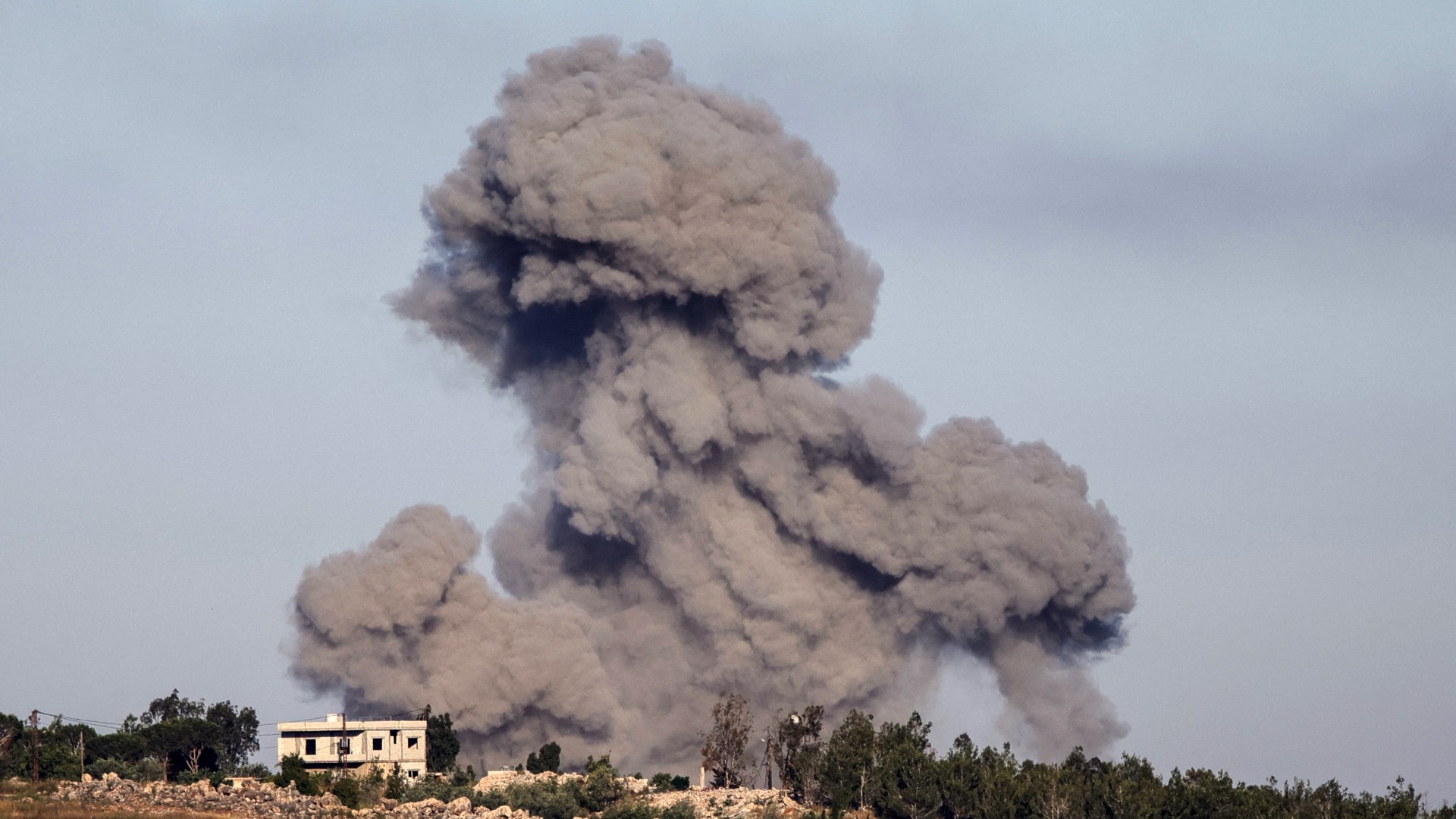
According to reports from Axios and international agencies, Lebanon and Israel agreed on a framework to solidify the ceasefire, while the implementation remained contingent on Hezbollah's steps and Israel's behavior south of what Tel Aviv describes as the yellow line. This expression is important because it is not a geographical detail. Any officer who has served in this area knows that temporary lines, if placed under fire, quickly turn into operational boundaries, and then into a political reality. Israel claims it will retain the freedom to act against threats. Lebanon asserts that the army must deploy and prevent any fire from the south. Between these two statements lies a gap called capability.
The Lebanese Army lacks not only the will but also a complete system of aerial reconnaissance, secure communications, maneuverability, and limited fire support that would allow it to impose a political decision on land where an irregular armed force has lived for decades. Therefore, Beirut's demand to control the south resembles assigning a lone police officer to manage a wide front with drones, short-range missiles, reconnaissance units, and destroyed villages. The state here is called upon when others need a legitimate address, not when tools of power are built for it.
Israeli Freedom of Action is an Unwritten Clause
The most notable aspect of the agreement is not what is written, but what is left open. The Israeli Defense Minister threatened to strike the southern suburbs if northern Israel were attacked, and Reuters reported on intercepting missiles launched by Hezbollah and Israeli strikes targeting vehicles near Beirut, Tyre, and the south. This means that the ceasefire has not entered a phase of calm but rather a phase of testing the rules of engagement. When Israel retains the right to immediate response, and when Hezbollah retains the right to symbolic deterrence, the agreement becomes closer to a military diary than a security settlement.
Practically, Israel does not want to return to the situation before March 2026. Its control over the Shuqif Castle and the surrounding hills just days ago was not merely a historical image; it was a message that Tel Aviv wants a fire and surveillance depth that prevents Hezbollah from rebuilding its launch network near the border. The problem is that this depth requires patrols, drones, precise fire, and American political cover. Therefore, any agreement that leaves Israel with operational space south of the yellow line grants it what it was seeking in the war without requiring it to declare a full occupation.
Hezbollah Between the Missile and Lebanese Legitimacy
Hezbollah is also not in a comfortable position. Launching a limited missile barrage after the announcement of the understanding was enough to show that it had not turned into a passive observer, but it was not enough to change the balance of operations. This is the dilemma known to anyone who has followed the organization's wars since 2006. The party needs to fire to prove that its weapon still has meaning, but it is pushing all of Lebanon into a cost that the Lebanese cannot afford. If the Iranians link the Lebanon file to their negotiations with Washington, the party becomes part of a negotiation paper larger than its local capacity.
An irregular military force can prevent its adversary from declaring a clean victory, but it cannot easily manage a bankrupt state open to airstrikes. This is why the party today seems trapped in three circles: Israeli field pressure, American diplomatic pressure, and Lebanese social pressure wanting to stop the bleeding. In my estimation, the most dangerous thing facing Hezbollah is not the loss of a position or a hill, but the loss of the ability to claim that its weapon protects Lebanon when the weapon becomes a direct cause of continued strikes.
Equipment Alone Does Not Build Security Authority
It will be said that the solution is to arm the Lebanese Army. This is partially true, but it is an incomplete answer. The army needs short and medium-range ground radars, reconnaissance drones, encrypted communication systems, light armored vehicles, limited precision artillery, and logistical capability to remain in the south for months, not days. But it first needs a unified Lebanese political decision, stable funding, and rules of engagement that do not change whenever the balance of negotiations between Washington and Tehran shifts. In the triangle of capability that I always refer to, equipment is just one side; training and institution are the two sides that determine whether the rifle will serve the state or remain a decoration in the military parade.
Therefore, I do not expect this formula to quickly transform into an actual disarmament of Hezbollah. The most that can happen in the near term is a redeployment, concealing platforms, reducing public fire, and increasing the role of the Lebanese Army as a political barrier between Israel and the party. This may reduce the shelling, but it does not resolve the issue of sovereignty. The difference between reducing fire and building sovereignty is like the difference between bandaging a wound and building a hospital.
The Gulf Watches the Lebanese Lesson
Why does this matter to the Gulf states? Because the Lebanese war has become a mirror of what Gulf capitals fear after Iran's strikes on Kuwait, Bahrain, and the UAE. Everyone is buying air defense, but the crisis in Lebanon reminds us that defense does not start only with a Patriot or THAAD missile, but with the state's ability to monopolize the decision of war. The Gulf has equipment many times more than Lebanon, but it faces the same question in another form: Can the state prevent its adversaries from dragging it into a battle it does not choose the timing of?
In Riyadh, Abu Dhabi, and Doha, planners will read this agreement as a signal that Washington now prefers to manage escalation rather than end it. The United States pressures Netanyahu not to bomb Beirut, but it does not prevent Israel from acting southward. It pressures Lebanon to control Hezbollah, but it does not provide the Lebanese Army with sufficient capability to enforce that quickly. This is neither American betrayal nor diplomatic genius; it is crisis management with tools smaller than the size of the crisis.
Military Summary
The Lebanon-Israel agreement in June 2026 does not open the door to peace as much as it organizes a low-intensity war. Israel has gained operational space, Hezbollah has retained some right to respond, and the Lebanese Army has been given a mission greater than its resources. Here lies the crux: each party emerged with a statement it can sell to its audience, but the ground does not recognize beautiful phrases. The ground recognizes who monitors, who responds, and who remains after the last shell.
In military culture, we say that a plan based on the goodwill of the adversary is not a plan but a wish. This agreement relies on the goodwill of three adversaries at the same time: Israel, Hezbollah, and Iran. Therefore, the ceasefire will remain in place as long as it is beneficial for negotiations, not as long as it is fair to Lebanon. As for the Lebanese state, it is once again required to prove its sovereignty with tools it has historically not been allowed to possess fully. This is the paradox that no statement from Washington can resolve.
Sources
- Reuters via Investing.com, June 3, 2026, regarding Hezbollah's missile launches and Israeli strikes near Beirut and Tyre.
- Axios, June 3 and 4, 2026, regarding the ceasefire agreement and Washington's pressure on Benjamin Netanyahu.
- Associated Press, June 3, 2026, regarding the United Nations' options after ending the UNIFIL mission and post-peacekeeping arrangements in Lebanon.
- Le Monde and Washington Post, June 4, 2026, regarding the nature of the agreement and the limits of Israeli freedom of action.
Lebanon and Israel reached a conditional ceasefire agreement on June 4, 2026, which requires Hezbollah to take specific actions for full implementation. Israel maintains the right to respond to threats, while the Lebanese Army is tasked with preventing fire from the south. Tensions remain high as Hezbollah launched limited rocket fire following the agreement, highlighting the ongoing military challenges in the region.
- Lebanon and Israel agreed on a conditional ceasefire framework on June 4, 2026.
- The agreement requires steps from Hezbollah for full implementation.
- Israel retains the right to respond to threats, while Lebanon's army is tasked with preventing fire from the south.
- Hezbollah launched limited rocket fire after the agreement, indicating ongoing tensions.
- The Lebanese Army lacks sufficient resources to enforce the agreement effectively.