
The Load of Southwest Air Defense in 2026 Demonstrated by the Simultaneous Flight of China's TB-001 Drone and Y-9
 Tanaka Takashi
China's TB-001 Drone and Y-9 Flight on the Same Day Indicate the Burden of Southwest Air Defense in 2026
On the afternoon of June 12, a flight path diagram released by the Joint Staff Office does not depict a flashy aerial battle. What it shows are two lines extending from the East China Sea to the south of the Daito Islands in Nagasaki Prefecture and off the coast of Okinawa. However, these two lines vividly illustrate the reality that the southwest air defense will face in 2026.
Flight Paths of Y-9 and TB-001 on the Same Afternoon
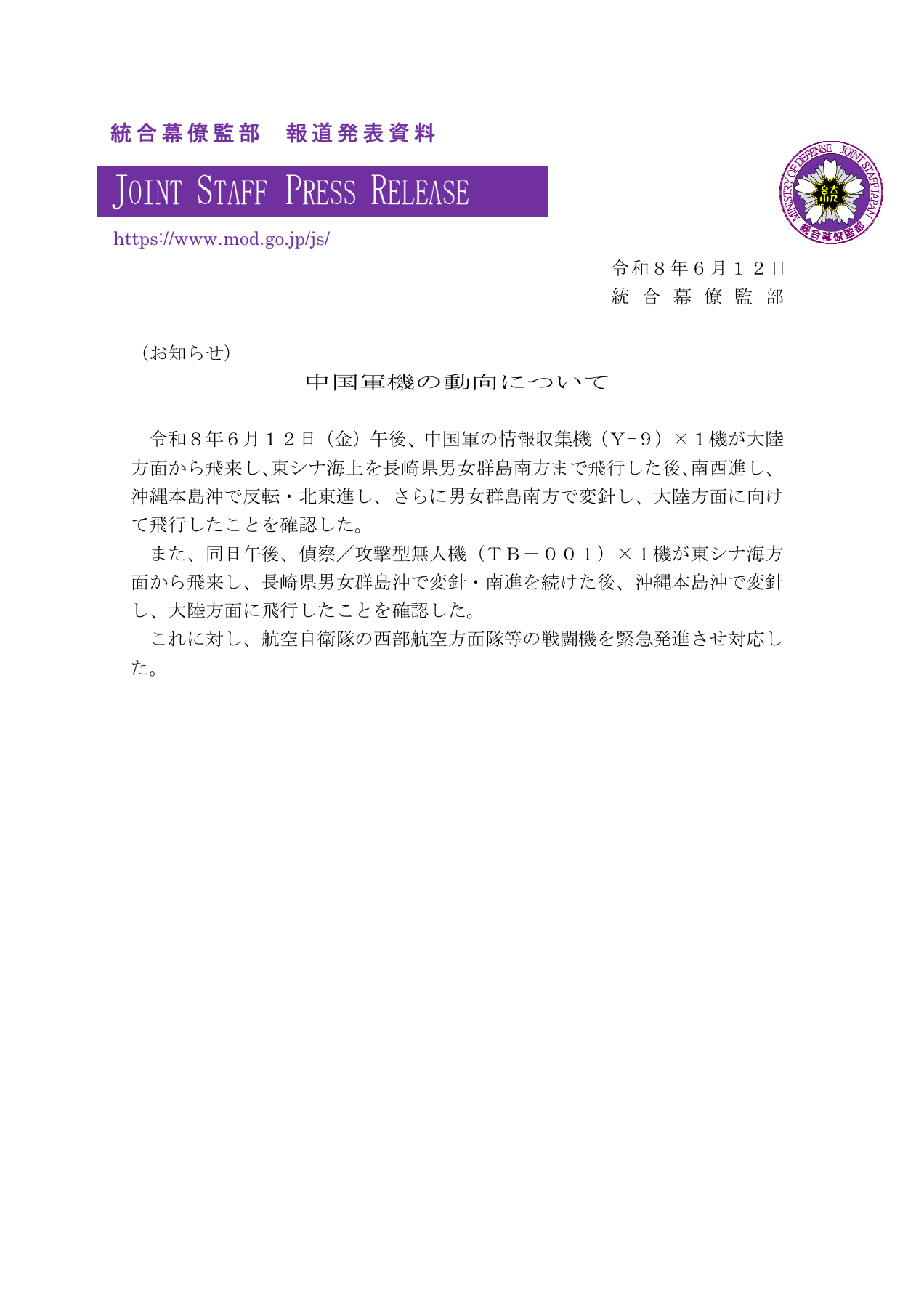
According to the Joint Staff announcement, a single Y-9 reconnaissance aircraft of the Chinese military flew from the mainland, traversed the East China Sea to the south of the Daito Islands, then proceeded southwest, turned northeast off the coast of Okinawa, and once again changed direction to return to the mainland south of the Daito Islands. On the same afternoon, a TB-001 reconnaissance and attack drone also flew from the East China Sea, continued south off the Daito Islands, and turned back toward the mainland off the coast of Okinawa. The Japan Air Self-Defense Force scrambled fighter jets from the Western Air Defense Force to respond.
It is noteworthy that the Y-9 and TB-001 did not take exactly the same trajectory in the same airspace. The Y-9, as a manned reconnaissance aircraft, traced a relatively complex round-trip path, while the TB-001 took a simpler southward and turning route. This suggests an intention to observe separately the response procedures of the Air Self-Defense Force, radar coverage, and command and communication reaction times by combining manned and unmanned aircraft.
The Number of 59 Scrambles
The monthly scramble status for May, released on the same day, also indicates why this flight should not be viewed as an isolated incident. In the fiscal year 2026, there were 55 scrambles in April and 59 in May, totaling 114. By area, the Southwest Air Defense Force accounted for 35 scrambles in April and 40 in May, totaling 75. By country/region, responses to Chinese aircraft were 43 in April, 49 in May, totaling 92.
In other words, the burden on the southwest region is manifesting not only as a "prelude to an emergency" but also as a sustained wear and tear during peacetime. Each time F-15s or F-2s are scrambled, maintenance, fuel, crew standby time, and the tension of ground control personnel accumulate. In terms familiar from the era of the Maritime Self-Defense Force, this is similar to long-term vigilance and monitoring of naval vessels. Even if the enemy does not fire a single shot, it gradually erodes our operational system.
TB-001 is Not Just a Reconnaissance Aircraft
To view the TB-001 merely as a "Chinese-made drone" would be a misjudgment. Existing analyses from NIDS point out the possibility that the aircraft was involved in confirming ballistic missile impact during exercises around Taiwan in 2022. According to publicly available information, the TB-001 is a medium-altitude long-endurance UAV, approximately 10.5 meters in length, with a wingspan of about 20 meters, a maximum range of about 7,200 kilometers, and a maximum endurance of around 36 hours. The Mitchell Institute's analysis also indicates that the TB-001 can be used for reconnaissance and attack missions, with the potential to carry ground attack munitions and C-702K anti-ship weapons.
Therefore, the recent flight of the TB-001 should not be seen as merely "coming to take pictures." It should be viewed as a collection of electronic information, imagery, the Air Self-Defense Force's interception responses, and, potentially, environmental data necessary for future missile operations. The Y-9 supplements manned reconnaissance capabilities, while the TB-001 undertakes long-duration, low-risk monitoring. This combination is cost-effective for the Chinese side.
The Weaknesses of Southwest Defense Are Not Just About Interception Capability
The Japanese Ministry of Defense's materials on Chinese military activities indicate that since 2021, unmanned aircraft have frequently passed between Okinawa and Miyako Islands, and since 2023, they have also been confirmed between Yonaguni Island and Taiwan. Furthermore, there is recognition that the types and routes of aircraft passing between Okinawa and Miyako have diversified. The Y-9 and TB-001 on June 12 are part of this ongoing trend.
This is where the role of the Japan-U.S. alliance comes into play. The U.S. military's ISR (Intelligence, Surveillance, and Reconnaissance) capabilities, the air power in Okinawa including Kadena, and the patrol capabilities of the JMSDF P-1 and U.S. P-8A enhance the surveillance network in the southwest region. However, the decisions regarding scramble judgments, warnings during airspace violations, and measures against unmanned aircraft involve political and legal judgments on the Japanese side. Even if U.S. sensors are quick, if the Japanese decision-making is slow, the deterrent effect will be limited.
The Real Issue is Normalization
In the author's view, the most concerning aspect of this incident is not the performance of the TB-001 itself, but rather that such flights are becoming normalized. If it becomes just one incident among 59 monthly scrambles, public interest will wane. However, the Chinese side can take advantage of that dulling.
The challenges of southwest air defense are not solely about having higher-performance interceptors. It is about how sustainable the system design is that continues to scramble manned fighter jets against unmanned aircraft in the same manner each time. What the Chinese side seems to be testing is not the capabilities of the Air Self-Defense Force, but rather Japan's willingness and mechanisms to maintain peacetime responses over the long term.
Sources
- Japan Joint Staff, Chinese aircraft movements, June 12 2026
- Japan Joint Staff, monthly scramble status through May 2026
- Japan Ministry of Defense, China activities in East China Sea, Pacific Ocean, and Sea of Japan
- NIDS Commentary No.239 on TB-001 UAV operations
- Mitchell Institute, TB-001 technical data
On June 12, 2026, a Chinese Y-9 reconnaissance aircraft and a TB-001 UAV conducted simultaneous flights in the East China Sea, prompting Japan's Air Self-Defense Force to scramble fighters. This incident reflects an ongoing trend of increased Chinese military activity in the region, with a total of 59 emergency scrambles reported in May 2026 alone. The TB-001 UAV is noted for its reconnaissance capabilities and potential involvement in missile operations.
- Chinese Y-9 and TB-001 conducted simultaneous flights on June 12, 2026.
- The Y-9 flew from the mainland to the East China Sea and back, while the TB-001 conducted a simpler flight path.
- Japan's Air Self-Defense Force scrambled fighters in response to these flights.
- The report indicates a rising trend in emergency scrambles due to Chinese aircraft activity in the region.
- The TB-001 UAV is capable of reconnaissance and potentially missile operations.