

Summary and Key Points: Sixty-two years after its first flight and 27 after its last, the Lockheed SR-71 Blackbird is still the fastest air-breathing aircraft ever built, Mach 3.32 on the official record and 3.56 unofficially. The Air Force began retiring it in 1989 anyway.
The Lockheed SR-71 Blackbird Wouldn’t Stay Retired
The Lockheed “Skunk Works” SR-71 Blackbird is *still* the world’s fastest air-breathing aircraft ever built, a whopping 62 years after its maiden flight and 27 years after its retirement…or more accurately, its second retirement.
Indeed, we at 19FortyFive have run multiple stories discussing the prospect of NASA not only resurrecting the iconic Cold War classic supersonic spy plane reborn but indeed kicking it up to even greater speeds, as in Mach 4.0, or 2,660 mph.
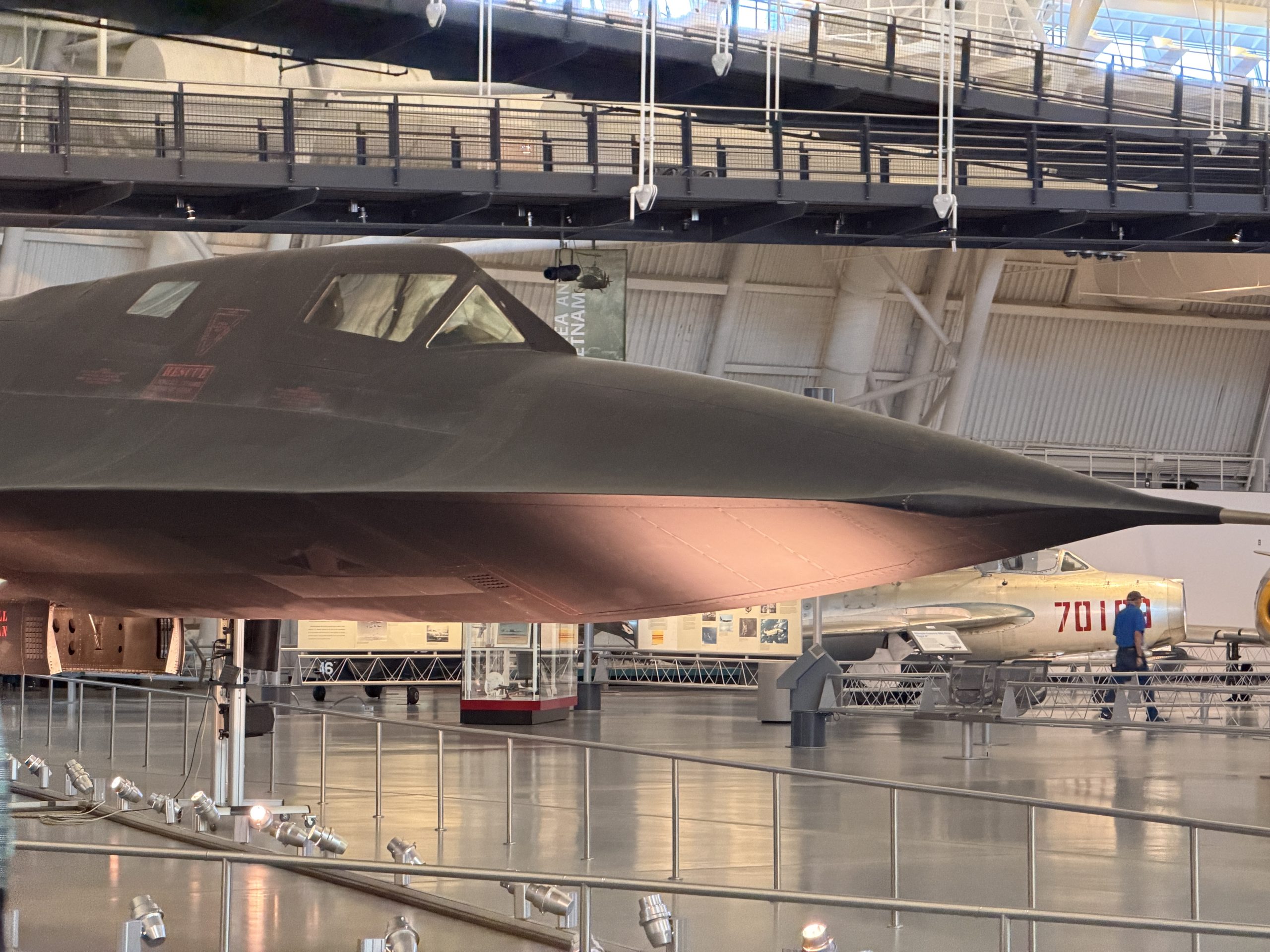
SR-71 Blackbird at Steven F. Udvar-Hazy Center Taken on 10/23/2026.
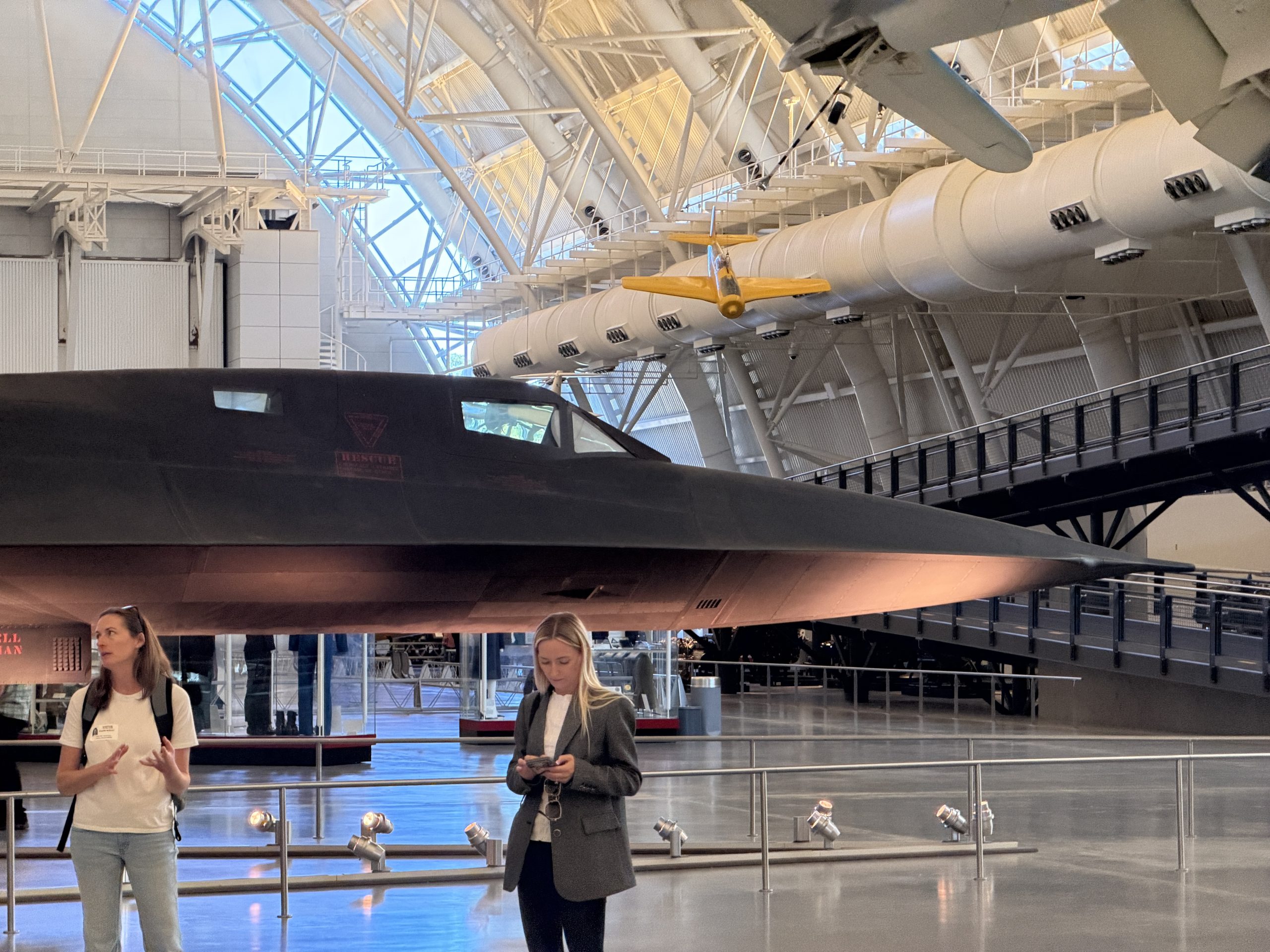
SR-71 Blackbird at Steven F. Udvar-Hazy Center Taken on 10/23/2026.
Which begs the question: Why was the Blackbird retired in the first place, then brought out of retirement, and then retired a second time…all before the 20th century even ended?
Blackbird Retirement #
The *official* record airspeed attained by that spy plane was Mach 3.32, whilst unofficially it was Mach 3.56.
Those records still stand today.
Yet, despite those records, the SR-71 was given its first partial retirement by the United States Air Force in 1989.
As noted by Aaron Spray of Simple Flying, “While this was before the collapse of the USSR (1992), it was also a period when relations were thawing, and it was clear the Soviet Union was in dire straits…Many advanced programs were built explicitly to counter the Soviet Union. Competition with the Soviets drove the enormous US defense spending (including the Reagan-era defense buildup). These programs were expensive, and the US government had to make hard choices over where it could allocate funding.”
Just how expensive in terms of absolute dollars and opportunity cost alike? Then-Secretary of the Air Force (SECAF) Edward C. Aldridge Jr. noted that the $200–$300 million per annum spent on the fleet of supersonic speed demons could instead operate two tactical fighter wings; the Blackbird’s special JP-7 fuel alone cost an estimated $18,000 per hour.
Thus, the SR-71 became a casualty of the post-Cold War military budget cuts—or, as CDR (USN. Ret.) Richard “Demo Dick” Marcinko, founding commander of SEAL Team 6, called it, “the LFM (Let’s F*** the Military) policy”—along with, among other things, the Iowa-class battleships that had kicked butt in World War II and multiple “hot wars” of the Cold War alike.
Mr. Spray adds that “Perhaps the biggest nail in the SR-71’s coffin was the development of alternative systems able to absorb many of its missions.” These alternatives included satellites and UAVs that were far cheaper and didn’t risk human pilots’ lives or diplomatic incidents, e.g., the Francis Gary Powers U-2 fiasco of 1960.
The USAF permanently retired the Blackbird in 1998.
Blackbird Un-Retirement
However, even though the Air Force no longer saw a sufficient degree of military necessity to justify the Blackbird’s high costs, it found a new lease on life for peacetime purposes—part of the so-called “peace dividend” of the first few years of the post-Cold War era—thanks to the National Aeronautics and Space Administration (NASA).
More specifically, NASA’s Dryden Flight Research Center (now known as the Armstrong Flight Research Center) acquired two of the planes to carry out aeronautical research at extreme speeds and altitudes.
The first of the duo, an SR-71A bearing AF Serial No. 61-7980 and NASA Serial No. NASA 844, arrived at Dryden on 15 February 1990, whilst 61-7956/NASA 831, an SR-71B, arrived on-scene on 25 July 1991.
As noted by the official NASA info page on its Blackbird program, “The first of a series of flights using the SR-71 as a science camera platform for NASA’s Jet Propulsion Laboratory [JPL], Pasadena, Calif., was flown in March 1993.
From the nose bay of the aircraft, an upward-facing ultraviolet video camera recorded data on celestial objects in wavelengths blocked to ground-based astronomers by Earth’s atmosphere.”
Other noteworthy NASA Blackbird projects of the 1990s:
-New Year’s Day 1997: The plane was used in a program to study ways of reducing sonic booms or overpressures that are heard on the ground when an aircraft breaks the sound barrier.
-Halloween Day 1997: The Linear Aerospike SR-71 Experiment (LASRE), which helped Lockheed Martin maximize its design for a future potential reusable launch vehicle, giving the company an understanding of the performance of the X-33 lifting body and linear aerospike engine combination.
-1 November 1997: From “LASRE” to “laser,” as in a laser air-data sensor, which used laser light instead of air pressure to generate airspeed and attitude data such as angle of attack and side
SR-71 Blackbird. Smithsonian Display Photo Taken by 19FortyFive on 9/30/2026.
slip, data normally obtained with small tubes and vanes extending into the airstream or from tubes with flush openings on an aircraft’s outer skin.
Blackbird Retirement #2
NASA 831 remained in service until October 1997, whilst NASA 844 had her swan song on 9 October 1999, flown by NASA’s Rogers Smith and Robert Meyer Jr. Once again, high operational costs buried the Blackbird.
Whether NASA will now resurrect the plane remains to be seen. Stay tuned, dear readers.
About the Author: Christian D. Orr
Christian D. Orr is a Senior Defense Editor. He is a former Air Force Security Forces officer, Federal law enforcement officer, and private military contractor (with assignments worked in Iraq, the United Arab Emirates, Kosovo, Japan, Germany, and the Pentagon). Chris holds a B.A. in International Relations from the University of Southern California (USC) and an M.A. in Intelligence Studies (with a concentration in Terrorism Studies) from American Military University (AMU). He is also the author of “Five Decades of a Fabulous Firearm: Celebrating the 50th Anniversary of the Beretta 92 Pistol Series,” the second edition of which was recently published.