

Winston Churchill, who knew a thing or two about naval warfare, once wisecracked that “capital ships” of his day were—contrary to the commonplace analogy of heavily armored knights battering each other with swords to little effect—eggshells smiting one another with hammers. Offensive firepower reigned supreme over armor and other passive defenses that encased battleships, battlecruisers, and kindred ships of war. The doughty Churchill, who served as first lord of the British Admiralty—the equivalent of our secretary of the U.S. Navy—was not wrong. History attests to it. During the Battle of Jutland in 1916, for example, Admiral David Beatty, commander of the Royal Navy’s battlecruiser squadron, exclaimed that “there seems to be something wrong with our bloody ships today” after watching battlecruisers get pounded to smithereens by gunfire from Germany’s High Seas Fleet.
Nor was naval-architecture fragility peculiar to Churchill’s Royal Navy. The offense-defense mismatch went into overdrive during World War II, as aviation technology superempowered combat aircraft to pummel warships. There was Pearl Harbor, of course, although the U.S. Pacific Fleet battle line dangled a static target for Japanese carrier aviators while resting at its moorings off Ford Island. But battleships proved vulnerable to aerial assault even while in motion and on full alert. History’s bulkiest dreadnoughts, the Imperial Japanese Navy’s Yamato and Musashi, descended to Davy Jones’ locker during the World War II endgame, succumbing to relentless bombardment from above.
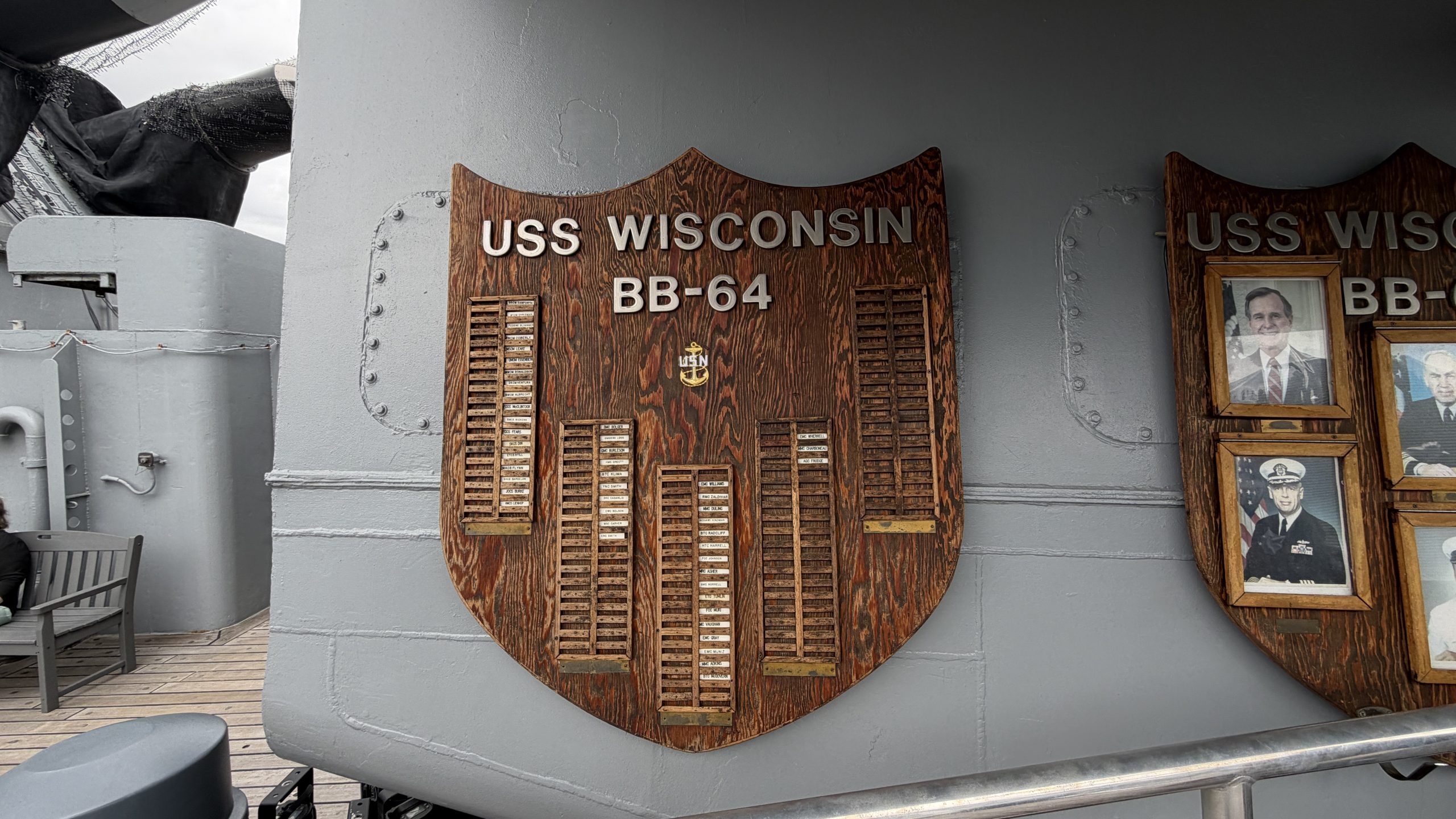
USS Wisconsin Iowa-Class Battleship Tour. Photo by 19FortyFive Reporter Christian D. Orr.
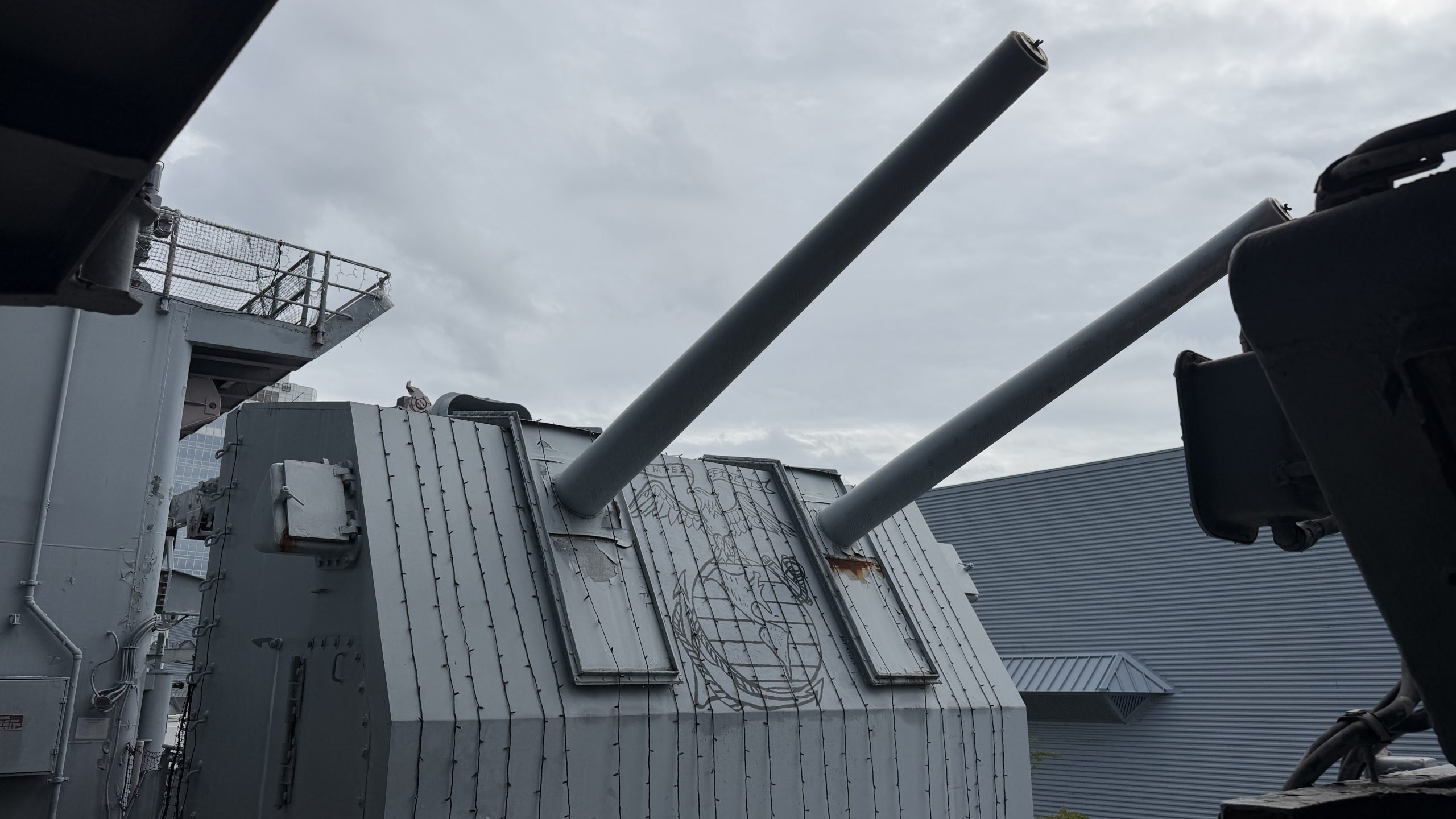
USS Wisconsin Iowa-Class Battleship Tour. Photo by 19FortyFive Reporter Christian D. Orr.
So the giants of naval theory and practice have ample grounds to embrace an offensive cast of mind. A ship that doesn’t get in the first shot may be lost. At the dawn of the twentieth century, W. S. Sims, then a junior officer on the U.S. Navy’s Asiatic station, learned the technique of “continuous aim” firing from a British Royal Navy comrade. Regearing the guns’ elevation mechanisms while adding telescopic sights for spotting helped gun crews keep naval cannons constantly trained on an enemy vessel as the two ships maneuvered, pitched, and rolled. Continuous aim bolstered the odds of landing the first punch, and thus of prevailing in action. (Sims had to go to extravagant lengths to get the Navy leadership to adopt continuous aim; the leadership denied such a thing was possible, even though it was already in place and serving Royal Navy gunnery well. Sims wrote to President Theodore Roosevelt, bypassing the chain of command, and was made director of target practice for the fleet. Sims earned the moniker of “the man who taught us how to shoot.”) In a similar vein, the late Captain Wayne Hughes, long the dean of U.S. Navy missile-age fleet tactics (and one of my favorite penpals), deemed fire effectively first the zenith of tactical skill.
And yet being at a material disadvantage is no excuse. Offsets are possible. Certain principles of battleship design are worth rediscovering and incorporating into contemporary warship design to the maximum extent possible. It is possible to harden Churchill’s eggshell—making it more resilient when struck hammer blows. And indeed, doing so was essential for Captain Alfred Thayer Mahan, history’s foremost maritime strategist and a contemporary of W. S. Sims. Mahan defined a capital ship simply: “the backbone and real power of any navy are the vessels which, by due proportion of defensive and offensive powers, are capable of taking and giving hard knocks” in combat against a peer battle fleet. A worthy capital ship, that is, could stand in the battle line and dish out and withstand punishment from rival capital ships—burnishing the fleet’s prospects for victory at sea.
Of course, Mahan was writing in a different age, before military aviation came into its own and long before the advent of guided missiles. Active defenses such as autocannons and surface-to-air missiles did not exist in surface fleets. There was no real prospect of shooting down incoming enemy gun projectiles, so for America’s maritime “evangelist,” defensive powers meant passive defenses. In other words, the ship itself needed to be ruggedly built in order to withstand battle damage and fight on. Naval architects had to proceed from the assumption that battleships would take hits—and fortify them against damage as best they could.
Here’s how shipwrights animated by that dour—but accurate—precept constructed their handiwork:
Thick Armor
Fleet designers projected the angles from which enemy gunfire was likely to come and arranged armor at vulnerable hull zones to absorb hits from it. The Iowa class—Iowa, New Jersey, Missouri, Wisconsin—featured armor up to seventeen inches thick along the hull, around the massive gun turrets, and surrounding that vital command space, the bridge.
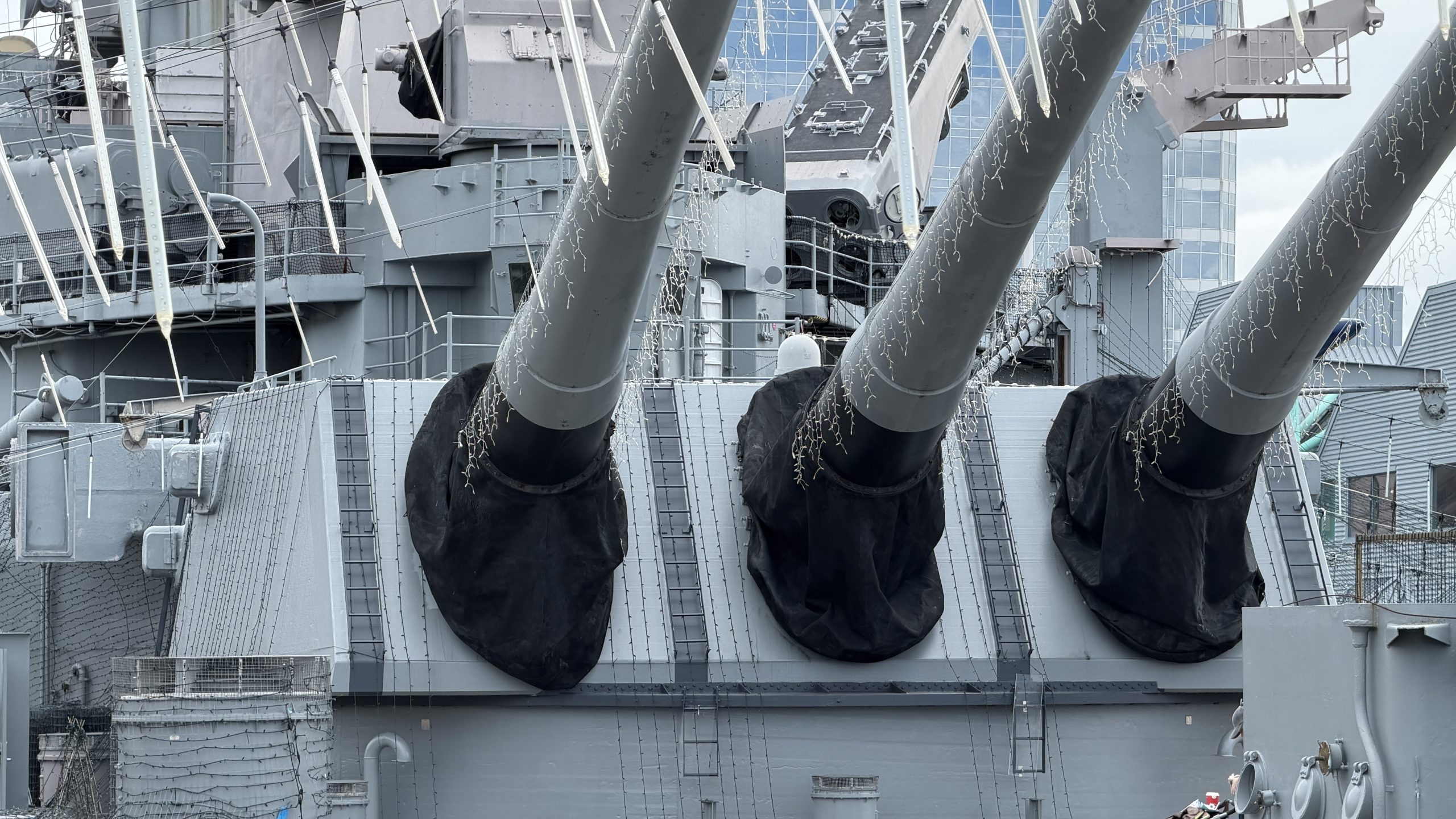
USS Wisconsin Iowa-Class Battleship Tour. Photo by 19FortyFive Reporter Christian D. Orr.
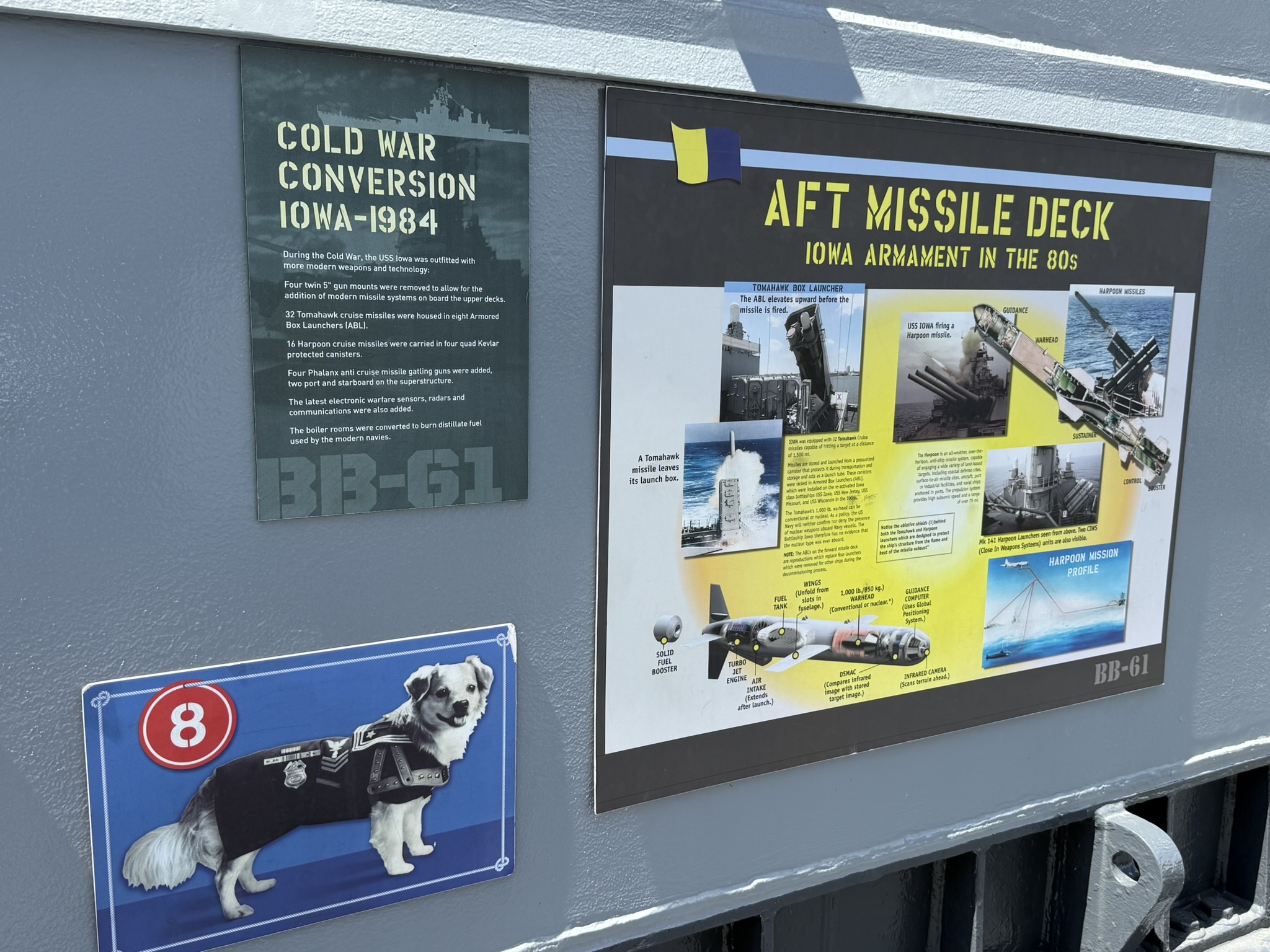
USS Iowa Battleship tour taken by 19FortyFive in August 2025.
Visit one of these museum ships and your tour director will doubtless show you the door to the “citadel” enclosing the bridge. It’s basically a bank-vault door weighing several tons permitting access to a large, equally armored tube within which the bridge crew could stand to pilot, navigate, and fight the ship. Shipwrights likewise sheathed the steam propulsion plant in an “armored box” deep in the ship, furnishing the plant an extra layer of protection. After all, a ship accomplishes little without mechanical and electrical power. Armor shields vital functions.
Redundancy
In life it’s always wise to have a spare of everything so there is no single point of failure. Battleships had as many spares of everything as shipbuilders could outfit them with. When I say “the” engineering plant, that’s a misnomer. In fact, the Iowa class sported four engineering plants, all housed within the armored box, arranged one after another in line from fore to aft.
Four shafts and propellers, or “screws,” drove the hull through the water, and each was geared to a complete, self-contained propulsion plant—boiler, main engine, auxiliary services providing fuel, clean water, air, and the like.
But the beauty of battleship engineering design (I was an engineer in Wisconsin before moving on to gunnery) lay in its excess.
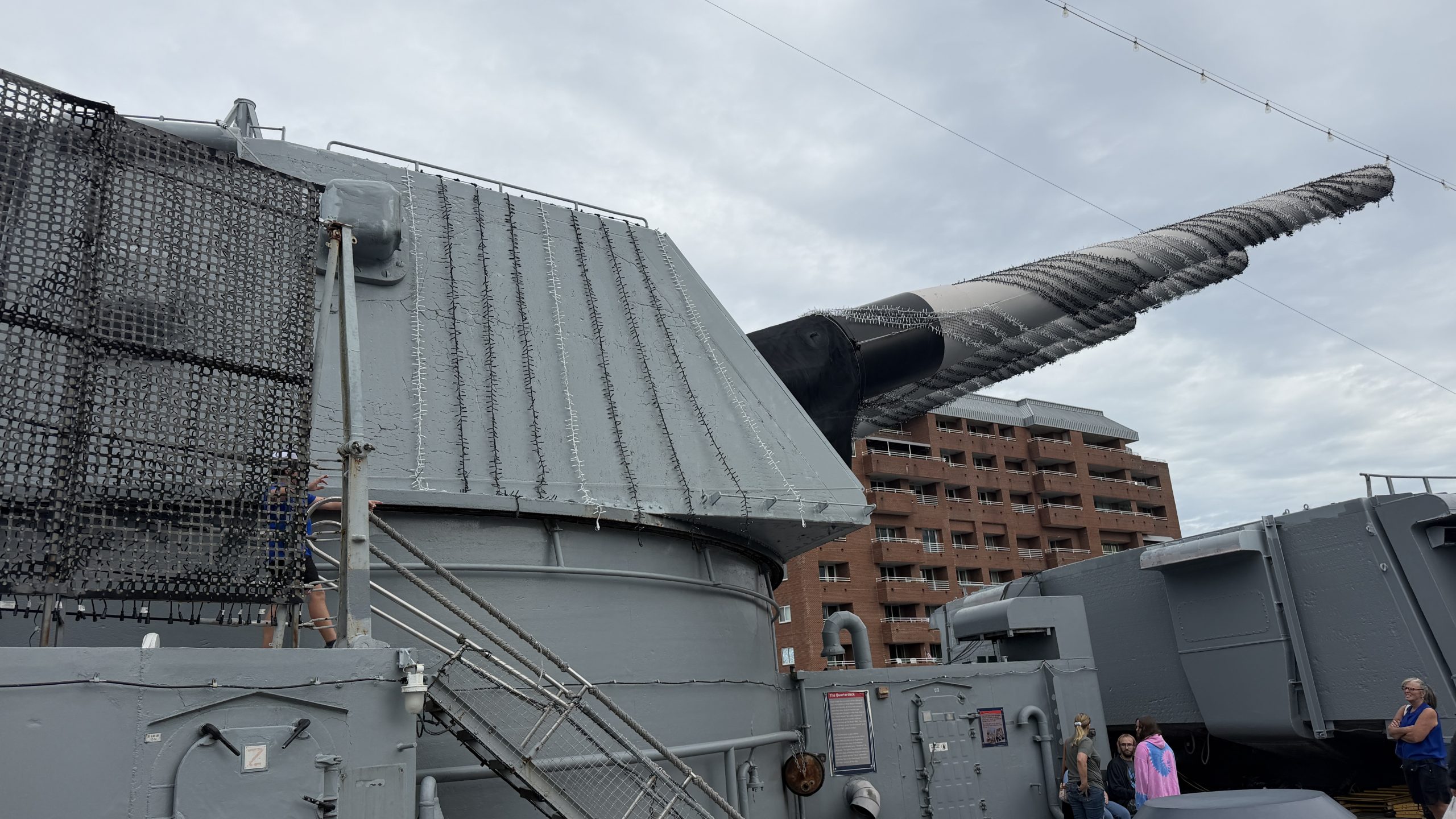
USS Wisconsin Iowa-Class Battleship Tour. Photo by 19FortyFive Reporter Christian D. Orr.
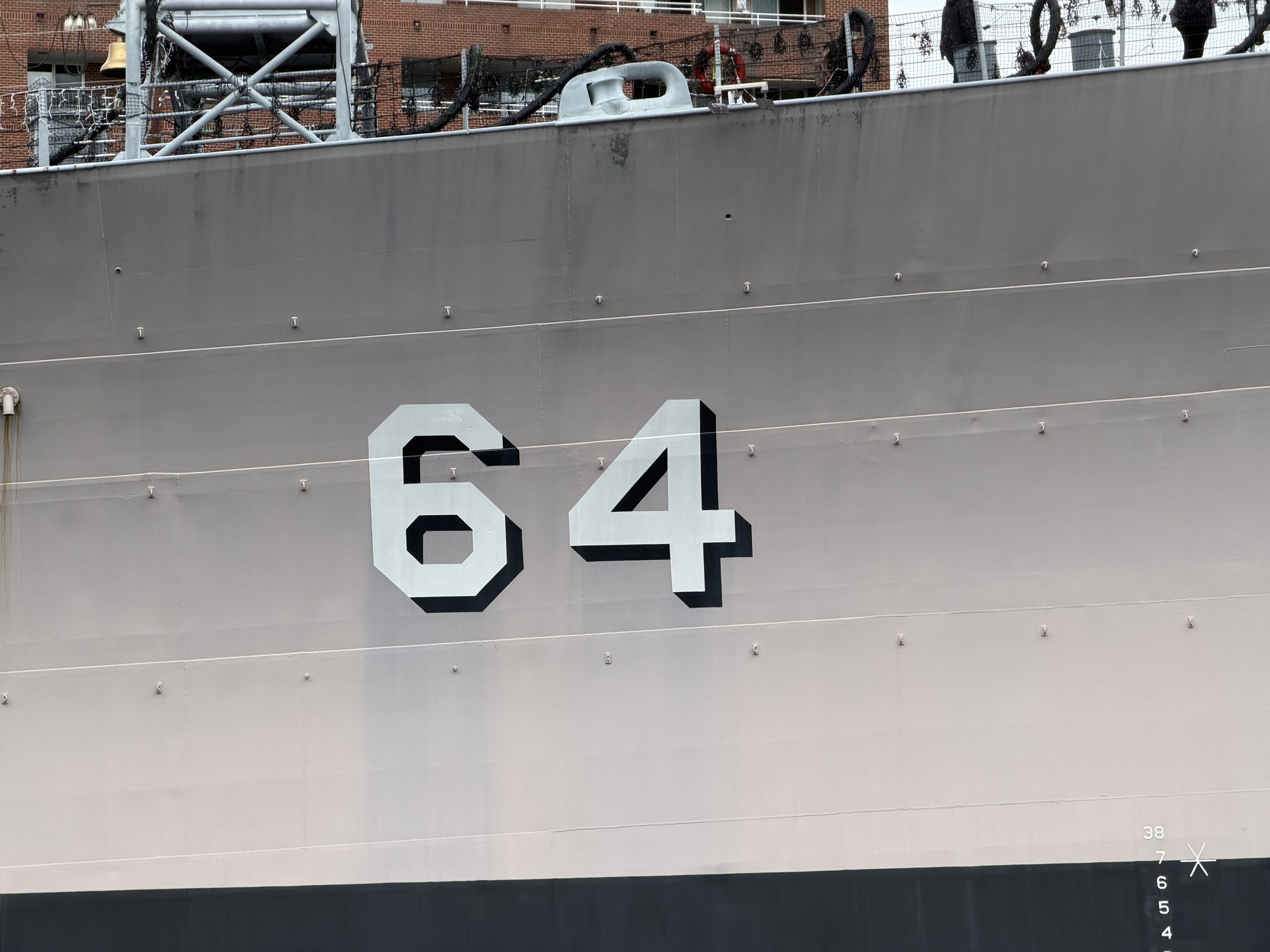
USS Wisconsin Iowa-Class Battleship Tour. Photo by 19FortyFive Reporter Christian D. Orr.
If you suffered engineering troubles in one plant, you had three others to turn to. Or if you wanted to conserve fuel and speed was not at a premium, you could idle a couple of engines and keep the ship moving, albeit more slowly. Redundancy provides options—and thus peace of mind for the vessel’s leadership.
Compartmentation
To continue with that theme, ingenuity went into fashioning an Iowa-class battleship’s innards. Subdividing a ship into many watertight compartments—hence compartmentation—boosts resilience. “Watertight integrity” limits the amount of space within the hull that can be flooded or consumed by fire in battle or some other mishap. The ship may lose some of its capability when it suffers damage, but it stays afloat and fights on—which is the point of naval warfare, after all. Buoyancy is good.
Each of the four propulsion plants described above was divided into two mammoth spaces within the armored box, a “fire room” housing the boilers and affiliated auxiliary systems to generate steam, and an “engine room” housing the main engines, electrical turbine generators, and their affiliated auxiliaries that ran off steam’s motive power.
The genius of battleship engineering design was that the watch team could “cross-connect” between the plants, rerouting steam and other vital resources to keep the screws turning and the electricity buzzing even amid battle damage. For example, the engineering team could funnel steam from a fire room in one plant to power the main engine in another plant.
Such flexibility is priceless in times of duress. The eggshell might be fragile, but it could endure after being whacked.
Firepower
The more firepower a warship carries, the better. In their 1980s-1990s lives, the Iowa class packed nine 16-inch, 50-caliber guns able to loft projectiles weighing over a ton over twenty miles. (The barrels were about 67 feet long.) Complementing that “main battery” was a “secondary battery” comprised of six 5-inch 38 gun mounts. (A modern surface combatant carries one or at most two 5-inch guns.)
Beyond brute gunnery, battleships also carried some of the heaviest loadouts of Harpoon anti-ship missiles and Tomahawk land-attack missiles of the day.
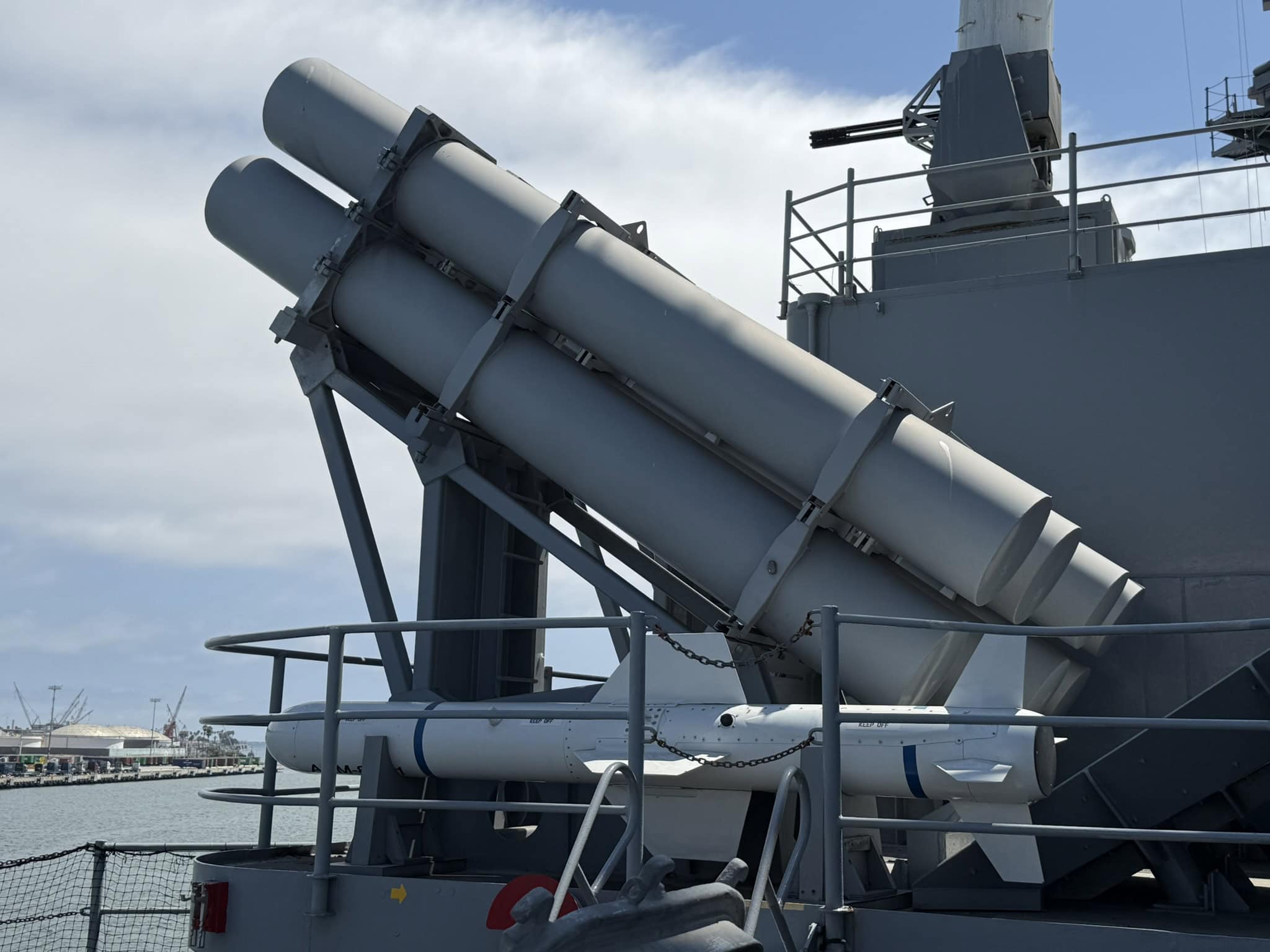
USS Iowa Harpoon Missiles. Photo Credit: 19FortyFive
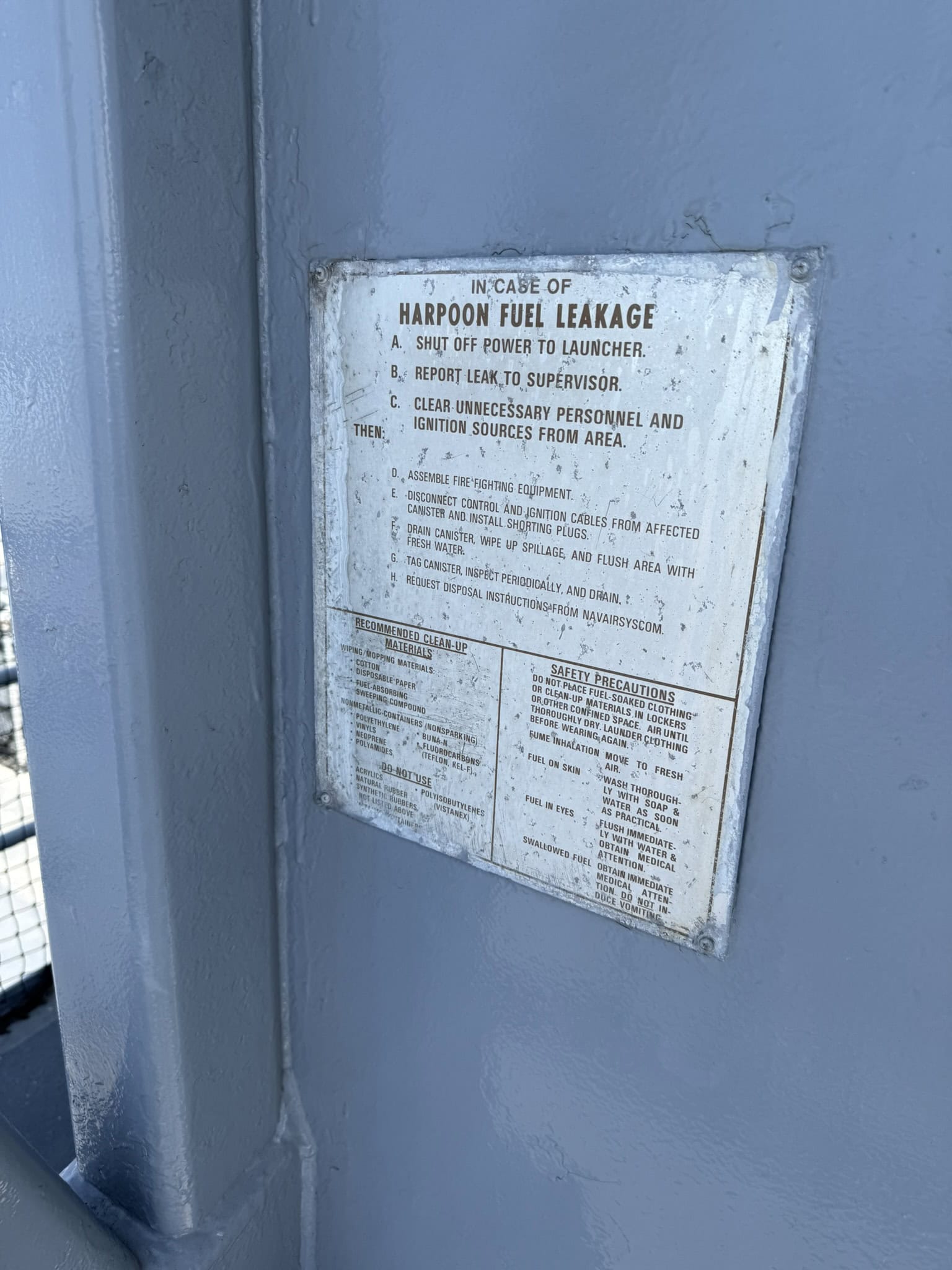
Harpoon Missile Equipment Aboard USS Iowa. Image Credit: 19FortyFive
Needless to say, modern ships will not carry a similar array of armament. Big guns are things of the past unless railguns prove their mettle. Yet the Iowa-class example implores us to pack as much weaponry as possible into every U.S. Navy combatant. To do otherwise is waste.
What To Make Of All of This
Let’s not take this critique of contemporary fleet design too far. The U.S. Navy’s contingent of nuclear-powered aircraft carriers—latter-day capital ships boasting a main battery called the air wing—is sturdily built.
This has been true since conventionally powered supercarriers debuted in the 1950s. In 2005 the Navy leadership decided to sink the retired, inert USS America to divine what lessons the service could learn about carriers’ battleworthiness as it embarked on design and construction of the then-forthcoming Ford-class nuclear-powered aircraft carriers. It took forever to sink America—nearly four weeks of pounding—and cost untold amounts of ordnance.
This was heartening. But no navy can afford a fleet made up entirely of capital ships, as Mahan’s contemporary Sir Julian Corbett points out. They’re too big, too complex, too manpower-intensive, too expensive. Lesser craft, affordable in bulk and thus resembling eggshells, have to fill out the fleet inventory. This is reality.
Nonetheless, the example of the battleships is worth bearing in mind when designing surface combatants that are not as sturdily built as carriers. This is what concerns me most. If capital ships are eggshells, as Churchill quipped over a century ago, today’s surface combatants take his jest to extremes. Think about Arleigh Burke-class guided-missile destroyers (DDGs), arguably the prime surface combatants on the planet. U.S. Navy DDGs are an odd hybrid. They brandish capital-ship armament coupled with impressive active defenses against surface, subsurface, and air attack, as the campaigns against Iran and the Houthis have shown (despite some uncomfortable close calls).
But there is a reason destroyers are known colloquially as “tin cans.” They are lightly built, with little hull armor and thus few innate defenses against battle damage from enemy weapons that get past their self-defense missiles, gunnery, and electronic-warfare systems. I started my commentary career by pointing this out.
And some ships will incur damage during a face-off against China’s People’s Liberation Army, which poses dangers an order of magnitude more forbidding than the Islamic Revolutionary Guard Corps or Houthi militants. Tin-can construction for surface combatants may be unavoidable considering the mandate for economies in any defense budget, including our own.
Still, ship designers and shipwrights should look to the past—to armor, redundancy, compartmentation, firepower—for inspiration as they craft future warship classes.
America’s maritime destiny could depend on it.
NOTE: This piece includes many of our originally sourced photos from various visits to the Iowa-class battleships USS Iowa in 2025 and USS Wisconsin a few months ago.
About the Author: Dr. James Holmes, US Naval War College.
Dr. James Holmes is J. C. Wylie Chair of Maritime Strategy at the Naval War College and a Distinguished Fellow at the Brute Krulak Center for Innovation & Future Warfare, Marine Corps University. A former U.S. Navy surface-warfare officer, he was the last gunnery officer in history to fire a battleship’s big guns in anger, during the first Gulf War in 1991. The views voiced here are his alone.