
The May 17 Training of Kuma and Te Mana Demonstrates South Pacific SLOC Defense
 Tanaka Takashi
Defense of South Pacific SLOC as Demonstrated by the Training of JS Kumano and HMNZS Te Mana on May 17
A photograph taken in the waters west of New Zealand showed the Japan Maritime Self-Defense Force destroyer "Kumano" alongside the New Zealand Navy frigate "Te Mana." On May 18, the Maritime Staff Office announced that both ships conducted a joint training exercise on the 17th, which included tactical maneuvers, communication training, and PHOTOEX. At first glance, the content appears to be a small-scale goodwill exercise. However, the fact that it took place west of New Zealand should not be overlooked.
FFM Operating in the South Pacific
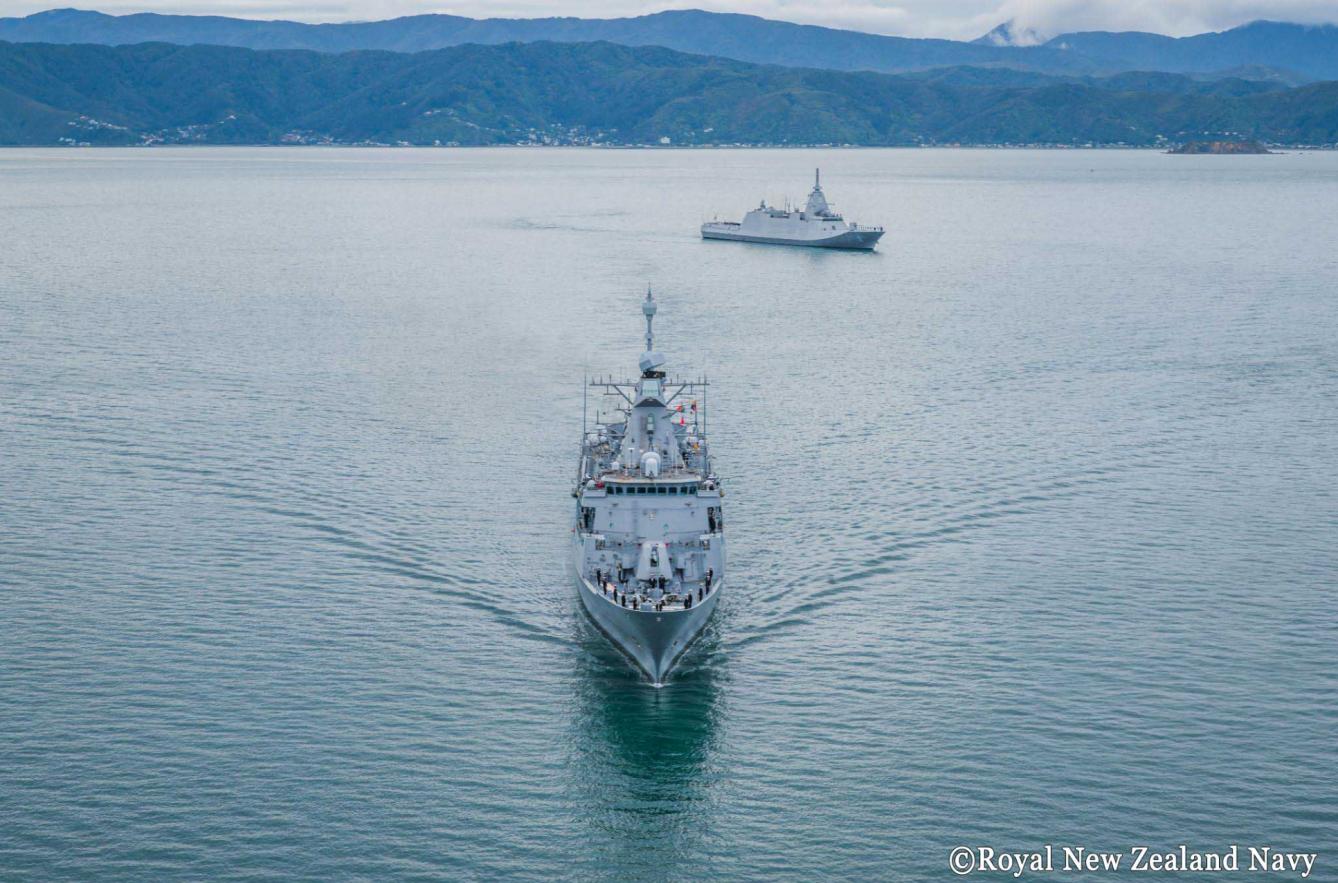
"Kumano" is the second ship of the Mogami-class FFM, a new generation destroyer with significantly reduced crew size. According to public specifications, it has a length of approximately 133 meters, a speed of 30 knots, a 127mm gun, mine warfare capabilities, and helicopter operation capabilities. It may appear smaller than conventional multi-role destroyers, but the aim is to perform peacetime surveillance, mine warfare, low-intensity maritime interdiction, and joint training with allies using the same hull.
This training should be viewed as a follow-up to participation in the Australia-hosted ASWEX 2026 from April 1 to May 5. According to the JMSDF announcement, "Kumano" conducted training that included anti-submarine warfare, surface gunnery, and underway replenishment in the waters around Sydney and the Bass Strait. The subsequent communication training with "Te Mana" west of New Zealand is not merely a diplomatic port call but is closer to an experiment in the continued operation of FFM in the South Pacific.
Te Mana Reflects the Reality of Small Navy States
According to official documents from the New Zealand Defence Force, "Te Mana" is an ANZAC-class frigate with a displacement of 3,660 tons, a length of 118 meters, a speed exceeding 27 knots, and a range of 6,000 nautical miles at 18 knots. It operates Sea Ceptor air defense missiles, Phalanx CIWS, Mk46 lightweight torpedoes, and SH-2G(I) helicopters. It is reported that during the 2021-22 refurbishment, its combat management system, radar, electronic detection, and bow sonar were updated.
It is noteworthy that the New Zealand Navy does not possess a large fleet. This is why a single frigate can serve multiple roles, including SLOC (Sea Lines of Communication) protection, surveillance in the Southern Ocean, training with allies, and United Nations missions. Japan faces a similar issue. If it expands its involvement not only in the Nansei Islands, the Korean Peninsula, the Sea of Japan, and the East China Sea but also towards Australia and New Zealand, the constraints will not be the number of destroyers but rather the operational rate and logistics design.
Connecting Beyond the Japan-U.S. Alliance
According to Tanaka, the significance of this training goes beyond the dimension of "Japan and New Zealand becoming closer." It lies in the fact that the JMSDF is aligning its communication procedures and tactical maneuvers with a maritime network that includes Australia, New Zealand, and potentially Canada and the UK, while centering on the Japan-U.S. alliance. While PHOTOEX provides visually appealing photographs, communication training is practical. If encrypted lines, reporting formats, safe distances during approach, and communication protocols with aircraft and supply ships do not align, multilateral actions in times of crisis will be merely superficial.
Even if the Chinese Navy has not yet reached the stage of having a permanent base in the South Pacific, analyzing only the number of warships while overlooking survey ships, intelligence-gathering vessels, port access, and police/coast guard cooperation will lead to delays. Japan's resource and energy transport relies not only on the Taiwan Strait but also on the waters around Australia. A single day of training in the South Pacific is a sign that Japan's defense plans are extending southward on the map.
Remaining Constraints
The JMSDF announcement stated that it aims to realize a "free and open Indo-Pacific" and strengthen cooperation. While this is a correct expression, the practical challenges are more detailed than those words suggest.
While the FFM is a convenient ship with reduced crew size, there is not much leeway if damage, malfunction, or ammunition depletion occurs in distant waters. Although New Zealand's "Te Mana" has been refurbished, the number of main vessels in the New Zealand Navy is limited. In other words, while political cooperation in the South Pacific may easily expand, military operations are constrained by the number of vessels and their operational days.
The training conducted on May 17 demonstrated not a glamorous multilateral framework but rather a test of how far and how long the JMSDF can connect small, crew-reduced ships like "Kumano" with allied nations. The true risk lies not in the mere appearance of Chinese vessels but in whether Japan can extend its supply and maintenance lines at the same pace as the mission lines it has stretched southward.
Main Sources
- Maritime Staff Office "About the Japan-New Zealand Joint Training" May 18, 2026
- Maritime Staff Office "Participation in the Australia Navy-hosted Multinational Joint Training ASWEX 2026" May 7, 2026
- New Zealand Defence Force, HMNZS Te Mana official specifications
The Japan Maritime Self-Defense Force's frigate Kumano and the Royal New Zealand Navy's frigate Te Mana conducted a joint training exercise in the South Pacific on May 17, 2026. The training involved tactical maneuvers and communication drills, highlighting military cooperation between Japan and New Zealand. This exercise follows Kumano's participation in the ASWEX 2026 exercise in Australia, indicating a strategic focus on regional security.
- The Japan Maritime Self-Defense Force's frigate Kumano and the Royal New Zealand Navy's frigate Te Mana conducted joint training on May 17, 2026.
- The training included tactical maneuvers, communication training, and a photo exercise.
- Kumano is a new generation frigate designed for various operations including low-intensity maritime interdiction.
- Te Mana is an ANZAC-class frigate equipped with modern combat systems and capabilities.
- The exercise reflects Japan's expanding defense engagement in the South Pacific.