
The participation of elite equipment showcases high strategic mutual trust: Experts interpret the highlights of the China-Russia "Maritime Joint" exercise.
【Global Times Report by Reporter Guo Yuandan】On the morning of the 6th, the China-Russia "Maritime Joint-2026" joint exercise opened at a military port in Qingdao, Shandong. The "Maritime Joint" series of joint exercises between China and Russia is a mechanized cooperation project between the two countries' navies, successfully held 11 times since 2012, and has become an important platform for practical cooperation between the two militaries. According to a message released by the WeChat public account "North Sea Fleet," this exercise has established a joint directing department and a joint command department, with a mixed formation of the navies of China and Russia. After the opening ceremony, the two navies jointly carried out command simulations and tactical coordination, with the joint command conducting in-depth discussions on key exercise subjects during the maritime drill phase to finalize coordination points. Experts interviewed by the Global Times stated that in the "Maritime Joint-2026" joint exercise, the navies of China and Russia are still showcasing their elite forces, reflecting the high level of strategic mutual trust between the two militaries.
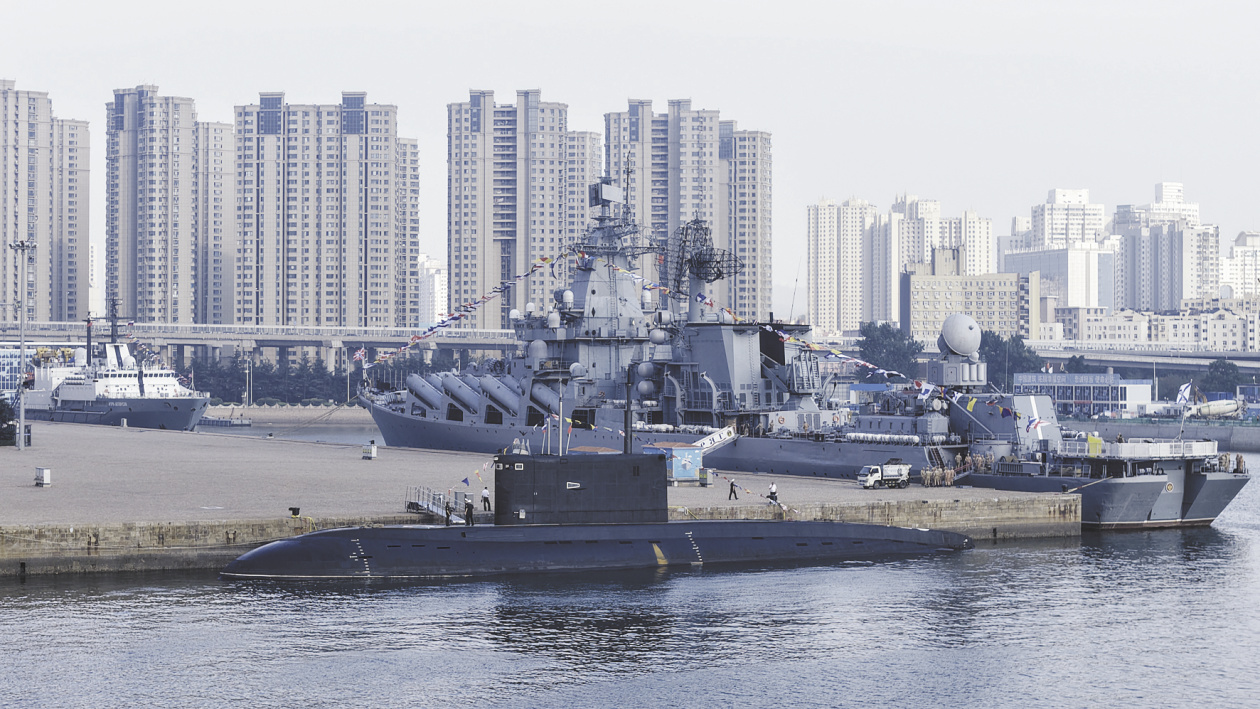
Russian missile cruiser participates again
According to official information released, the Russian participating forces in this exercise include the "Varyag" missile cruiser, the "Razor" frigate, the "Ufa" large submarine, and the "Igor Belousov" rescue ship. The Chinese participating forces mainly consist of the missile destroyer Kaifeng, the Anshan, the missile frigate Wuhu, the comprehensive supply ship Kekexili Lake, the submarine rescue ship Yangcheng Lake, and one submarine. Both China and Russia also dispatched shipborne helicopters, marines, and other forces to participate.
A military expert stated to the Global Times reporter on the 6th that in the "Maritime Joint-2026" joint exercise, the navies of China and Russia are still showcasing their elite forces. "From the configuration of the participating forces, this exercise can execute multiple drill contents such as fleet air defense, joint anti-submarine operations, and maritime firepower strikes."
Military expert Zhang Junsha stated, "As the most representative main battle ship of the Russian Pacific Fleet, the 'Varyag' missile cruiser has participated in the 'Maritime Joint' series of exercises multiple times, each time demonstrating the depth of military mutual trust between China and Russia. This ship is equipped with long-range supersonic anti-ship missiles and is known as a 'carrier killer.' Especially after undergoing real combat training, its combat capability should not be underestimated."
Moreover, it has been noted that the "Varyag" missile cruiser has undergone some subtle changes, such as the addition of two heavy machine guns at the bow.
Experts believe that "this modification reflects the current Russian Navy's approach to strengthening close-range defensive firepower. When facing high-speed moving targets or low-flying targets at sea, manually operated multiple heavy machine guns can serve as the last line of defense, which, although seemingly simple, is a practical and effective combat defense measure."
The Chinese participating forces are also noteworthy, including the "10,000-ton large destroyer" 055-class missile destroyer Anshan, the 052DL-class missile destroyer Kaifeng, and the 054A-class missile frigate Wuhu.
"The 055-class is the fourth generation of missile destroyers currently in service with the Chinese Navy and is the core main force of the aircraft carrier formation," Zhang Junsha introduced, stating that this type of ship is equipped with new air defense, anti-missile, anti-ship, anti-submarine, and land strike weapons, possessing strong information perception, air defense, anti-missile, and maritime and land strike capabilities.
Military experts believe that compared to the Russian side, the Chinese participating forces have stronger regional air defense capabilities and a more diversified firepower configuration, allowing them to play an important role in the joint exercise.
China-Russia "Surface + Underwater" Three-Dimensional Combat Becomes Normalized
Most notably, both China and Russia dispatched submarines to participate, as they are the most core and classified equipment of their respective navies. Their participation not only reflects the strategic mutual trust between the two militaries but also indicates that naval cooperation between the two countries is transitioning from surface operations to a normalized three-dimensional combat of "surface + underwater."
According to Zhang Junsha, the "Ufa" large submarine is an improved version of the Russian Navy's "Kilo" class conventional submarine, which entered service in 2022. After technical upgrades, it is equipped with the latest inertial navigation system and automated information management system, has lower underwater noise, and is equipped with six 533mm torpedo launch tubes, capable of carrying "Kalibr" cruise missiles and various torpedoes and mines.
"In anti-submarine exercises, this submarine can act as an imaginary enemy, allowing both sides' surface ships to conduct searches, thus completing the entire process of anti-submarine combat training," the expert stated.
During the exercise, both sides organized joint reconnaissance and early warning, air defense, anti-missile, and other drill subjects, and conducted actual weapon training. "When practicing these subjects, various radars, sonars, electro-optical, communication, and other electronic devices on both sides' ships and aircraft must be turned on and used, thus showcasing the tactical characteristics, technical performance, and data of each other's weaponry. This can only be achieved when both militaries have a high level of strategic mutual trust. Therefore, the joint exercise fully reflects the high level of the comprehensive strategic cooperative partnership between China and Russia in the new era and the strategic mutual trust between the two militaries," Zhang Junsha said.
Rehearsing "Joint Response to Maritime Security Threats" Again
The North Sea Fleet released news indicating that the exercise is themed "Joint Response to Maritime Security Threats," during which both sides will conduct joint reconnaissance, air defense, anti-missile, and maritime strike drills.
The Global Times reporter found that this is the second time since 2024 that the China-Russia "Maritime Joint" series of exercises has been themed "Joint Response to Maritime Security Threats." What is the reason for this?
In this regard, Zhang Junsha believes that this indicates that the maritime security threats currently faced by both sides are more severe compared to 2024, requiring both sides to pay high attention and focus, and to enhance their ability to jointly respond to maritime security threats through real troop exercises, ensuring the security of both countries and regional peace and stability.
China and Russia to Hold Sixth Joint Maritime Patrol
The Ministry of Defense announced that after the joint exercise, some of the forces from both sides will organize a joint maritime patrol in relevant sea areas of the Pacific.
Public information shows that this joint patrol is the sixth consecutive joint maritime patrol organized by China and Russia since 2021. Military experts stated that during this exercise, the navies of China and Russia will form a joint formation to conduct joint patrols in important sea areas of the western Pacific, demonstrating the capability of both navies to maintain regional peace and stability. Experts analyze that "during the joint training and patrol, especially when passing through the first island chain, if they encounter tracking, harassment, or interference from external aircraft or ships, the China-Russia joint formation will enter a high-intensity combat readiness state and respond to various external interference factors based on established plans and contingencies."
According to reports, during the China-Russia "Maritime Joint-2025" joint exercise, aircraft and ships from some countries continuously appeared around the exercise forces. The spokesperson for the Ministry of Defense responded at the time, stating that China and Russia always adhere to the principles of not forming alliances, not confronting, and not targeting third parties in developing their bilateral military relations, playing an important role in maintaining international and regional peace and stability. "We hope that relevant parties will view the normal defense cooperation between China and Russia objectively and rationally, and stop subjective speculation and smear campaigns."
Zhang Junsha stated that both China and Russia are major powers in the Asia-Pacific region and permanent members of the United Nations Security Council, jointly bearing the important responsibility of maintaining regional security and stability. The navies of China and Russia, through the "Maritime Joint" series of exercises as a normalized and mechanized cooperation form and platform, learn from each other, continuously deepen mutual understanding, traditional friendship, and strategic mutual trust, laying a solid foundation for further friendly and pragmatic cooperation.
The Chinese and Russian navies commenced the 'Maritime Cooperation-2026' joint exercise on October 6, 2026, in Qingdao, Shandong. This exercise features numerous naval vessels, including the Varyag missile cruiser and Ufa submarine, focusing on tactical coordination and joint operational capabilities. The event underscores the strategic trust and military cooperation between China and Russia, with activities including joint reconnaissance and air defense drills.
- The 'Maritime Cooperation-2026' exercise commenced on October 6, 2026, in Qingdao, Shandong.
- Both Chinese and Russian navies participated with a variety of naval vessels and submarines.
- The exercise aims to enhance joint operational capabilities and strategic trust between the two nations.
- The Varyag missile cruiser and other advanced vessels were highlighted as key participants in the exercise.
- The exercise includes joint reconnaissance, air defense, and anti-submarine operations.