
The Philippines' 2026 MQ-9A Detachment Cannot Close the South China Sea Gap
 Marcus Chen
The Philippines' 2026 MQ-9A Detachment Cannot Close the South China Sea Gap
A U.S. Marine Corps MQ-9A detachment is now operating from Antonio Bautista Air Base on Palawan, facing the South China Sea. USNI News reported on October 28 that Marine Unmanned Aerial Vehicle Squadron 1 is using the Philippine airfield, citing a logistics document and commercial satellite imagery showing an expeditionary hangar. That is a useful operational move. It is not persistent surveillance of the South China Sea.
The Aircraft Brings Range, Not Mass
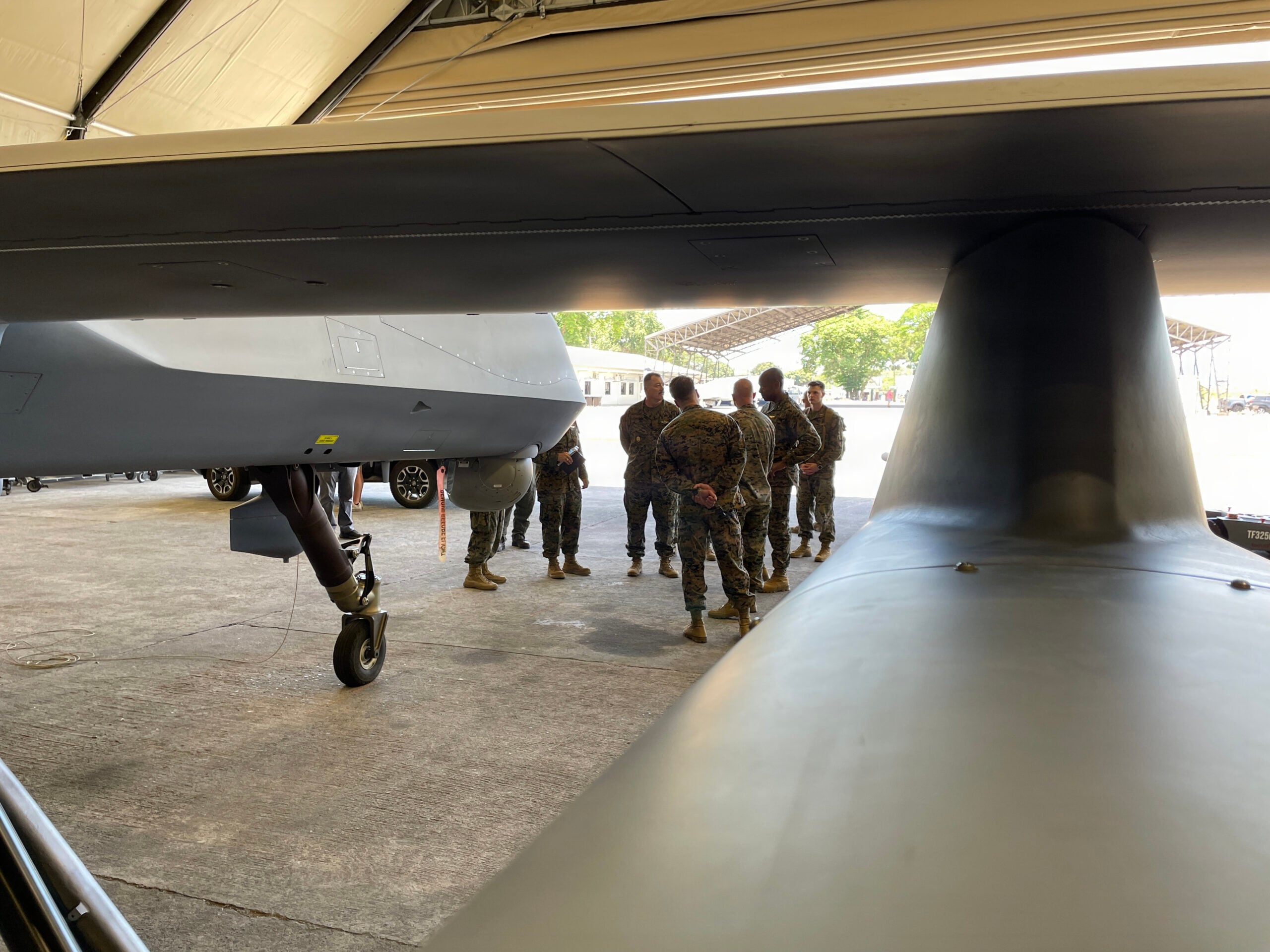
The MQ-9A Reaper is a serious intelligence, surveillance and reconnaissance platform. General Atomics lists more than 27 hours of endurance, a 240-knot cruise speed, an operating ceiling of 50,000 feet and a 3,850-pound payload. Its sensor options include electro-optical and infrared cameras, maritime radar and electronic-support measures. In the right conditions, one aircraft can watch a large maritime box and pass targeting-quality information to ships, aircraft or Philippine forces.
Palawan improves the geometry. A detachment operating from Luzon or Guam spends more of its sortie reaching the patrol area. From Antonio Bautista, the aircraft is closer to the Spratly Islands and can respond faster to a Philippine coast guard or navy report. The base also places American sensors near the routes where Chinese coast guard, maritime militia and naval vessels regularly contest Manila's claims.
But endurance is not the same as coverage. A 27-hour brochure figure does not equal 27 hours on station. Crews need launch and recovery windows, maintenance, fuel, weather margins and communications support. A single aircraft cannot remain overhead every day without a second airframe cycling through maintenance. Two aircraft can produce a useful rotation; a small detachment can create a pattern of observation. Neither automatically creates an unbroken picture.
What the Deployment Actually Changes
The immediate gain is information. The Philippines has long faced a problem of seeing Chinese activity early enough to document it, publicize it and decide whether to respond. An MQ-9A can extend the timeline before a confrontation. It can identify a vessel, record behavior and cue other assets without placing a crewed aircraft directly over the contact.
That matters most in gray-zone operations. Beijing does not need to sink a Philippine ship to change the facts at sea. It can use repeated presence, water-cannon attacks, dangerous maneuvers and blockade-like formations. Persistent-ish airborne surveillance makes those actions harder to deny and easier to attribute. It also gives Manila a better chance of bringing diplomatic pressure before a local incident becomes a crisis.
USNI News described the Palawan operation as potentially supporting more intensive ISR of Chinese forces. The word “potentially” matters. The report did not establish the detachment's aircraft count, sortie rate, weapons load or rules of engagement. Those details determine whether this is a durable operational capability or a high-value experiment.
The Missing Link Is the Kill Chain
An MQ-9A sees. It does not, by itself, control the sea. To turn a sensor track into an operational effect, the United States and the Philippines need a secure communications network, a common operating picture, an authority to share data and a shooter that can act quickly. That shooter might be a Philippine missile battery, a surface combatant, a fighter, or another aircraft. If the data moves slowly through multiple headquarters, the advantage of the drone's long endurance disappears.
The same problem applies in a crisis with China. The MQ-9A is large, relatively slow and not designed to survive inside a dense air-defense environment. Its value is greatest before a conflict, when it can document patterns and support maritime domain awareness. Once the People's Liberation Army begins actively suppressing regional sensors, the drone needs stand-off distance, electronic protection and replacement airframes. Palawan is forward, but forward bases are also observable and vulnerable.
There is a political calculation as well. A U.S. aircraft operating from Philippine territory signals alliance commitment without putting a destroyer or fighter squadron permanently on the ramp. That is deliberately calibrated. Manila gains a stronger watch over waters it claims; Washington gains access and data. Beijing will see the same arrangement as another step toward a distributed U.S.-Philippine network along the first island chain.
Palawan Is a Starting Point, Not a Solution
The deployment should be judged by outputs, not photographs of a new hangar. How many hours per week are actually on station? How quickly can the Philippines receive full-motion video? Can the aircraft hand a track to a Philippine weapon system? Are there enough spare engines, ground crews and satellite links to sustain operations during a month-long crisis? Those are the numbers that matter.
Washington and Manila should build the detachment around redundancy. That means multiple aircraft, dispersed operating locations, hardened communications and a pre-agreed process for releasing evidence after maritime confrontations. It also means training Philippine crews and analysts instead of treating the MQ-9A as an American sensor that happens to be parked on Philippine soil.
Palawan makes the South China Sea more visible. It does not make the area controllable. One MQ-9A detachment can expose coercion, shorten reaction time and improve the alliance's decision-making. It cannot maintain a continuous watch, survive a serious air campaign or replace the ships and missiles needed to impose costs. The deployment is useful precisely because it reveals the next requirement: more sensors, more aircraft and a kill chain that works before the first shot.
Sources
The U.S. Marine Corps MQ-9A detachment operates from Antonio Bautista Air Base in Palawan, enhancing ISR capabilities in the South China Sea. This deployment aims to improve surveillance of Chinese activities and support Philippine maritime operations. However, the report emphasizes that the MQ-9A cannot maintain continuous coverage and requires a secure communications network for effective data utilization.
- The U.S. Marine Corps MQ-9A detachment is operating from Antonio Bautista Air Base in Palawan.
- The MQ-9A Reaper has over 27 hours of endurance and can provide ISR capabilities.
- The deployment aims to enhance surveillance of Chinese activities in the South China Sea.
- The report highlights the need for a secure communications network to utilize the MQ-9A's data effectively.
- The operation is seen as a signal of U.S.-Philippine alliance commitment.