
The PLA Liaoning Aircraft Carrier Participates in Silent Military Exercises, Taiwan's Isolation Capability in the Western Pacific Enters Operational Phase
 Li Minghui
The PLA Liaoning Aircraft Carrier Participates in Silent Military Exercises, Isolation Capability Around Taiwan Enters Practical Phase
On November 10, Taiwan officially referred to China's recent actions in the Western Pacific as "regional denial exercises" for the first time. What is most noteworthy about this operation is not the number of vessels present at sea, but rather that the PLA did not announce the exercises in the traditional manner, while simultaneously deploying forces around Taiwan, the Philippine Sea, the East China Sea, and the South China Sea. For a military prepared to handle high-intensity crises, this sudden activation itself is part of the training content.
A Maritime Coordination Without Announcement
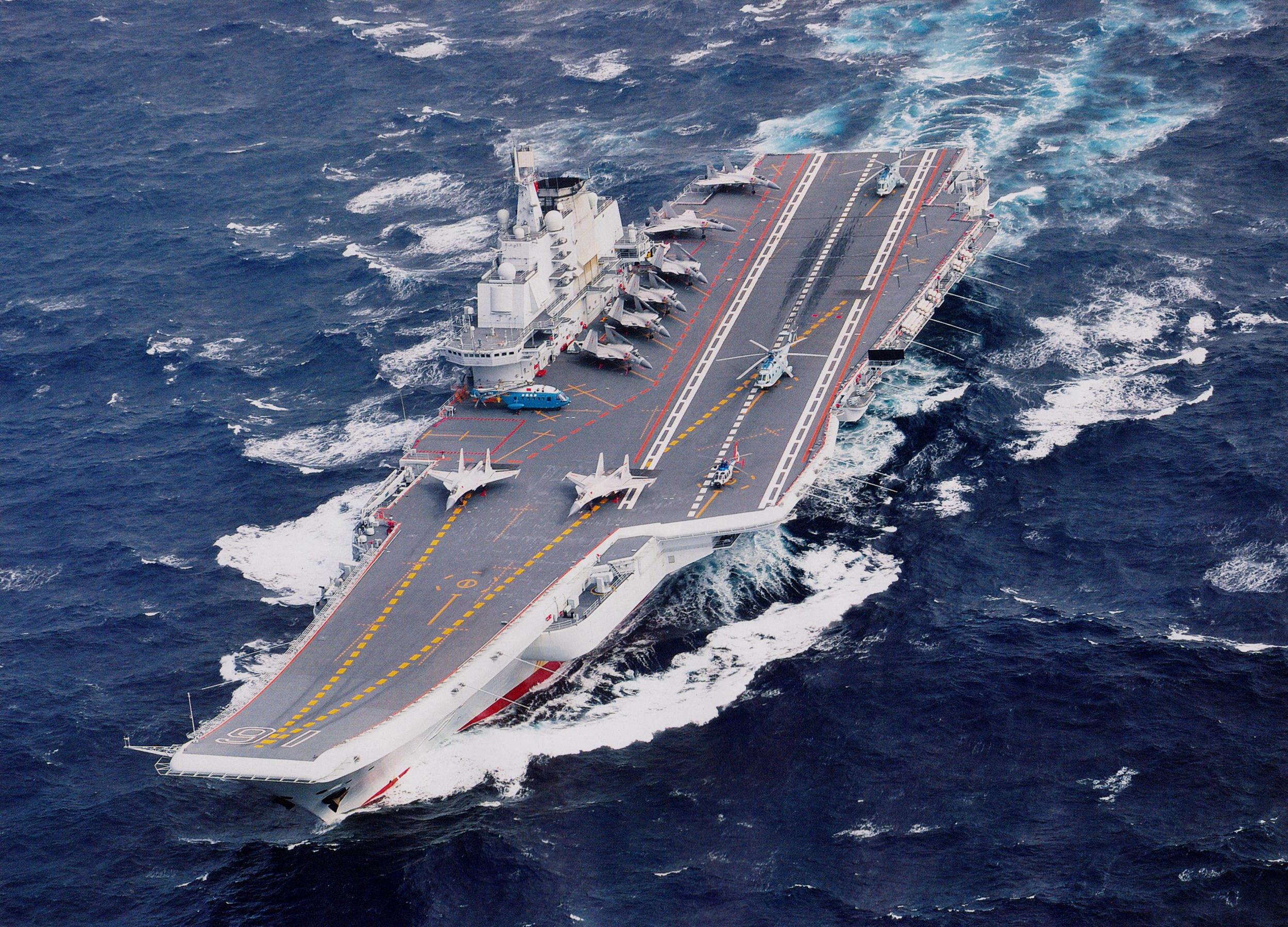
According to Taiwan's security authorities, around November 3, over 100 PLA Navy and China Coast Guard vessels were active in the relevant waters. One group moved towards the Pacific with the Liaoning, while another group exerted near-shore pressure around Taiwan; naval forces from the Eastern, Northern, and Southern Theater Commands were all included in the operation. Reuters subsequently quoted Taiwan's defense department confirming that China conducted regional denial exercises in the Western Pacific.
This differs from past single-direction patrols around the Taiwan island chain. The task focus of the Liaoning carrier group may not be to directly attack Taiwan, but rather to combine aircraft carriers, destroyers, land-based aviation, anti-ship missiles, and coast guard vessels into a multi-layered "entry toll booth," forcing external reinforcements to confront reconnaissance, identification, warning, and strike chains before entering the combat zone.
Isolation and Blockade Are Not the Same Concept
The Maritime Executive cited an assessment from the U.S. Institute for the Study of War, stating that the scope and location of the actions resemble a simulation of isolating Taiwan. A technical distinction needs to be made here: a blockade typically means a sustained severing of ports and shipping routes, carrying a clear wartime attribute; isolation can be achieved through coast guard enforcement, temporary navigation bans, naval escorts, and long-range firepower deterrence, with intensity that can be increased or decreased. If Beijing can normalize the latter, it can continuously raise the transportation costs for Taiwan and external forces without declaring a full blockade.
From an equipment structure perspective, the Liaoning does not independently determine the outcome of the battle. Its value lies in providing early warning in distant seas, fighter patrols, and fleet command nodes; the true support for regional denial comes from land-based anti-ship ballistic missiles, long-range aviation, submarines, early warning aircraft, and sensors distributed along the coast. In simple terms, the aircraft carrier serves as a mobile pivot pushing the denial circle outward, while land-based firepower is the hard foundation behind it.
Strategic Signals Pointing to External Intervention
The Taiwanese side claims the operation aims to undermine peace and stability in the Indo-Pacific, while Chinese military commentator Song Zhongping believes its primary signal targets are the United States and Japan. The author believes this operation resembles a "joint operational process test" rather than a countdown to an imminent blockade. The PLA needs to verify three questions: whether different theaters can coordinate without long-term political forewarning; whether the navy, coast guard, and civilian shipping can maintain unified command; and whether the Liaoning's distant sea operations can share target information with mainland land-based firepower.
Public information still cannot prove that this operation has formed a complete blockade plan, nor can it be inferred that war is imminent. However, if similar actions evolve from a few days into a periodic norm, Taiwan's warning time, external reinforcement routes, and commercial shipping insurance costs will all be affected. What truly deserves questioning is whether the next "silent military exercise" will incorporate amphibious transport, maritime resupply, and communication suppression elements—this will determine whether it is merely a display of deterrence or if it is moving towards an executable isolation combat plan.
Sources
- Reuters, November 10, 2026, Taiwan claims China is conducting regional denial exercises in the Western Pacific.
- The Maritime Executive, November 11, 2026, analysis on China's maritime exercises and preparations for isolating Taiwan.
- Taiwan's Ministry of National Defense, November 10-11, 2026, report on PLA activities around the Taiwan Strait.
The People's Liberation Army Navy conducted silent military exercises involving over 100 naval and coast guard vessels around Taiwan and in the West Pacific on November 3, 2026. This operation, described by Taiwan as a regional denial drill, aims to simulate the isolation of Taiwan and test military coordination among various PLA units. The exercises included the Liaoning aircraft carrier and focused on creating pressure around Taiwan.
- Taiwan identified China's recent actions as regional denial drills.
- Over 100 Chinese naval and coast guard vessels were active in the area.
- The Liaoning aircraft carrier was involved in operations around Taiwan.
- The exercises simulate isolation of Taiwan without declaring a blockade.
- The operations aim to test joint military coordination among different PLA branches.