
The question arises, how much longer can the U.S. military's ammunition stockpile hold out?
The US-Israel-Iran conflict has been prolonged for over a month
US President Trump recently stated
that they have achieved a "decisive victory"
However, assessments from US intelligence agencies show
that Iran still has half of its missile launch systems intact
How much ammunition have the US and Israel consumed?
How has Iran managed to withstand the offensive?
Read on for more ↓
US military losses continue to rise
Ammunition consumption is staggering
On April 1, Eastern Time, Trump delivered a speech, claiming a "rapid, decisive, overwhelming victory" in the conflict with Iran, stating that Iran's ability to launch missiles and drones has been "greatly weakened," and that there are "few weapons factories and rocket launch systems left."
About half an hour after the speech, the Israel Defense Forces issued a statement saying they had detected Iran launching missiles at Israel, and their air defense systems were intercepting them.
According to a report by CNN on April 2, assessments from US intelligence agencies indicate that Iran still has about half of its missile launch systems intact and has preserved thousands of suicide attack drones.
Meanwhile, losses of US military aircraft have been gradually increasing. On April 5, according to Iranian sources, the Iranian military has shot down 12 various US aircraft since April 3, including 1 F-15E fighter jet, 2 C-130 transport planes, 1 A-10 attack aircraft, 4 "Black Hawk" helicopters, 2 "Little Bird" helicopters, and 2 MQ-9 "Reaper" drones.
The rate of missile consumption by the US, Israel, and Gulf countries is also quite staggering. According to a report released by the Royal United Services Institute on March 24, during the first 16 days of Operation "Epic Fury," the US consumed 11,294 precision-guided munitions, with a total cost of about $26 billion; Israel's "Arrow" 2 and "Arrow" 3 missile defense systems consumed over 80% of their interceptors; and the US military's "THAAD" system also consumed about 40% of its stockpile.
Ongoing missile offensive and defensive battles
How has Iran managed to withstand this?
Military expert Wang Mingzhi analyzed that even with sufficient preparation, the US cannot escape the influence of the "fog of war." The two most important weapons for Iran in countering the US and Israel are missiles and drones, and they have three effective strategies in their deployment.
First, relying on concealment and mobile deployment to ensure the survival capability of their equipment. Iran employs dispersion, concealment, camouflage, and protection for its missiles and drones, and uses simple means to create false targets to deceive the US and Israel.
Second, controlling the pace and engaging in a war of attrition. Iran has not launched all its ammunition at once but maintains 6 to 10 waves of strikes daily, continuously depleting US and Israeli interceptors.
Third, relying on the depth of its territory to construct a layered missile strike system. The US and Israel dare not strike all areas of Iranian territory. Iran continues to strike Israeli targets using the missiles it has preserved in the eastern and northeastern regions.
Is the US military planning to engage in ground warfare next?
Experts: It may aim to "control oil"
Although Trump has declared "victory," US land, sea, and air forces and equipment continue to gather in the Middle East. What is the next target for the US military?
Military commentator Wei Dongxu believes:
First, the US decision-makers want to exert greater pressure on Iran to force it to compromise, allowing the US to exit gracefully. However, Iran's underground missile cities continue to retaliate, causing headaches for the US and Israel.
Second, the US has currently adopted a posture for island seizure operations and ground combat. Two amphibious readiness groups of the US Marine Corps, along with part of the 82nd Airborne Division, have a frontline mobile force of about 10,000 troops. However, most of these forces may be for "show of strength" and to tie down Iranian forces, with the real possibility of executing island seizure operations or land deep area raids resting with special forces.
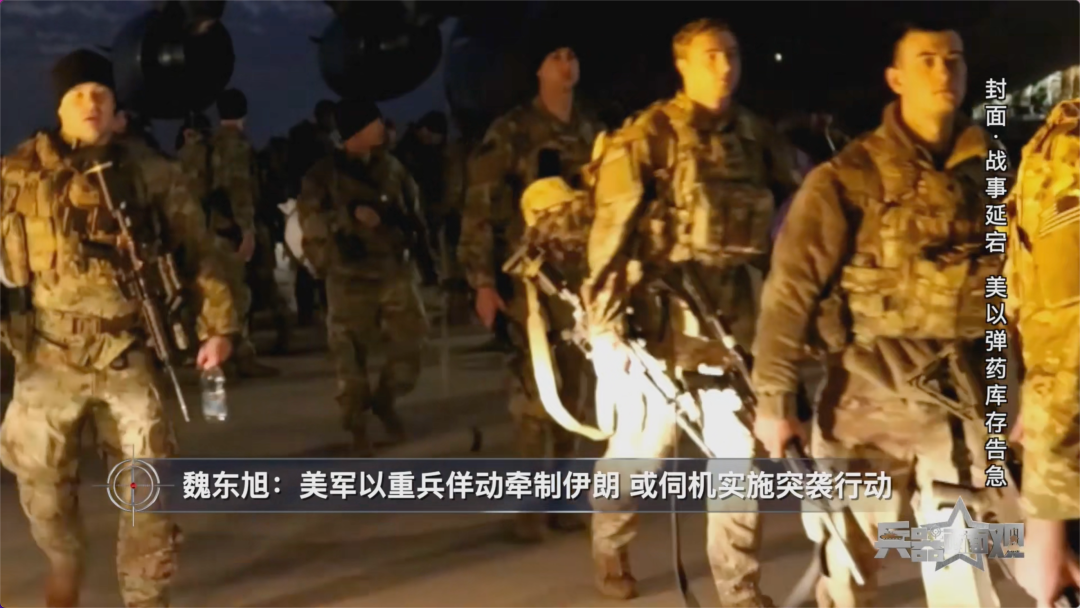
Wei Dongxu predicts that the US military may target Khark Island to control Iran's oil export terminals, executing quick strikes and withdrawals, seizing but not holding. As for fully controlling the Strait of Hormuz, the difficulty is quite high. Whether and when the decision to conduct island seizure or ground operations will be made remains to be seen.
Source: CCTV Military Comprehensive CCTV-7 "Global Military Events"
U.S. and Israeli forces are actively engaged in military operations against Iranian missile and drone capabilities in the Middle East. Between April 1 and April 5, 2023, U.S. forces reported the loss of 12 aircraft due to Iranian defenses. Despite claims of significant Iranian losses, U.S. intelligence indicates that Iran still possesses a substantial number of operational missile launchers and drones. The conflict has seen a rapid depletion of precision-guided munitions by U.S. and Israeli forces.
- U.S. forces have lost 12 aircraft to Iranian defenses since April 3, 2023.
- Iran retains approximately half of its missile launchers and thousands of drones.
- The U.S. has expended over 11,000 precision-guided munitions in the first 16 days of operations.
- Israeli missile defense systems have consumed over 80% of their interceptors during the conflict.