
The Repeated Flights of China's Y-9 and TB-001 Indicate the Endurance Burden of Southwest Air Defense
 Tanaka Takashi
The Repeated Flights of China's Y-9 and TB-001 Indicate the Endurance Burden of Southwest Air Defense
The movements of the Y-9 electronic reconnaissance aircraft and TB-001 drone flying along the line of the Senkaku Islands in the East China Sea are no longer a mere show of force. According to a report by USNI News on August 21, Chinese military aircraft have been making round trips around the Senkaku Islands from west of Okinawa from Tuesday to Wednesday, prompting continuous emergency scrambles by the Japan Air Self-Defense Force's Western Air Defense Force. More significant than the equipment itself is the way this repetition reduces the cycle of Japan's alertness, maintenance, and command decision-making.
June's Pattern Repeated in August
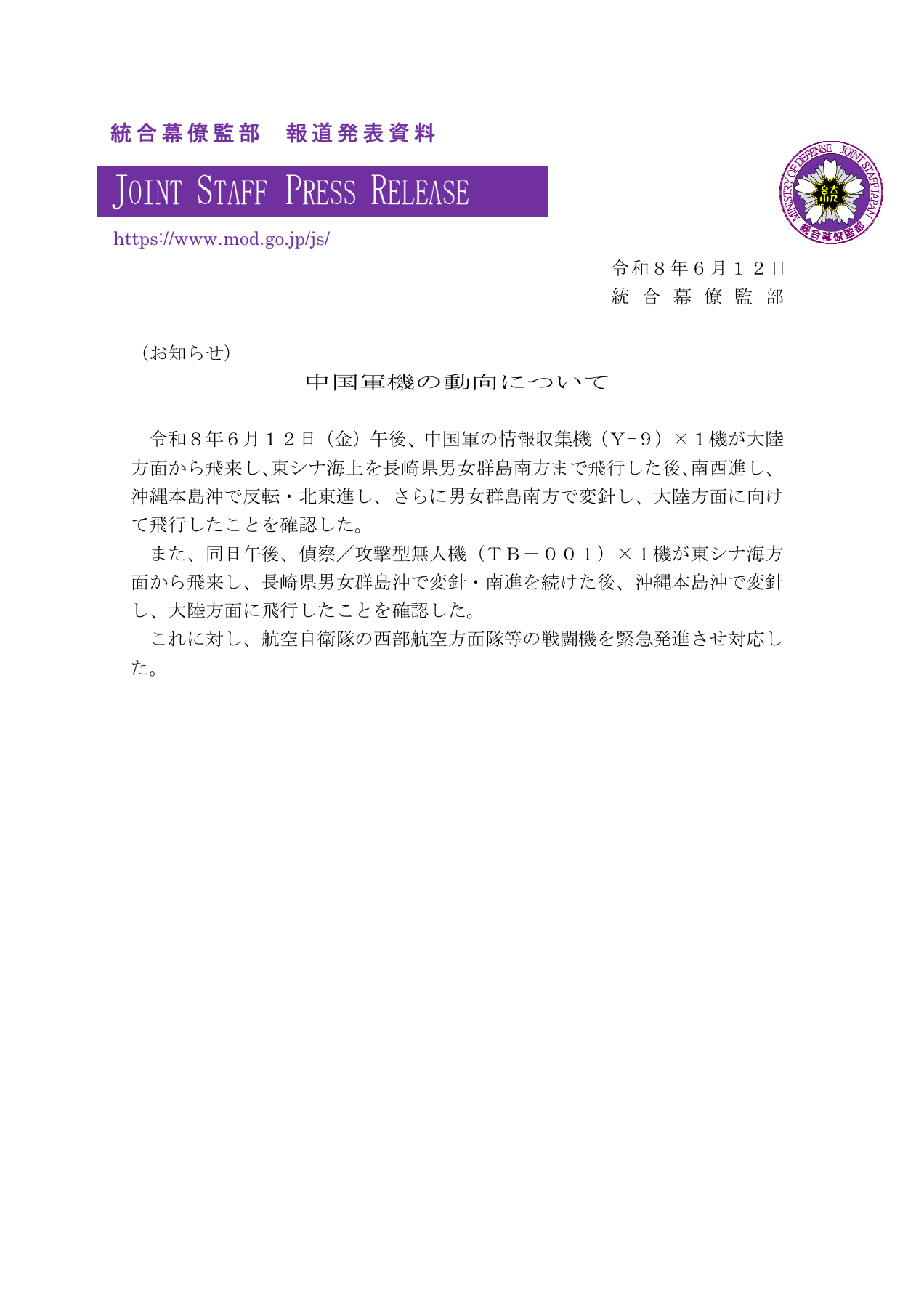
In a report released by the Joint Staff Office on June 12, a similar incident was noted where the Y-9 advanced from the mainland through the East China Sea to the south of the Senkaku Islands, while the TB-001 extended westward toward Okinawa via a different route. The flights in August, as cited by USNI, also utilized the same airspace connecting the Senkaku Islands and west of Okinawa. This should not be seen as an incidental flight path but rather as a repeated pattern intended to measure Japan's radar monitoring, scramble, and fighter aircraft engagement response times.
The Complications of the Y-9 and TB-001 Combination
The Y-9 serves the role of electronic reconnaissance, capable of gathering electromagnetic data from ground radar and the Japan Air Self-Defense Force's launch patterns. On the other hand, the TB-001 is a reconnaissance and attack drone that can remain airborne for extended periods, maintaining pressure at a lower cost than manned aircraft. The combination of observing responses with a manned reconnaissance aircraft and extending flight time with a drone is the most depleting for Japan. In the gray zone of peacetime, where it is difficult to engage in shooting down or intimidation, the burden falls lightly on the side that launches the aircraft while heavily weighing on the side that responds.
The Issue Lies in Turnover Rate Rather Than Airspace Violations
In this incident, an airspace violation was not immediately confirmed. However, in the practicalities of air defense operations, that is not the essence of the matter. In the southwest region, in addition to responding to Chinese aircraft, there is also the monitoring of Russian vessels and patrol aircraft, as well as readiness for emergencies on the Korean Peninsula. If the Y-9 and TB-001 are repeatedly cycled in and out of the same airspace at short intervals, it reduces the waiting cycles for crew members, the turnover of maintenance personnel, and the flexibility for aerial refueling and base operations more than the number of launching aircraft. In my view, what China is testing is not the upper limit of Japan's interception capabilities but rather the threshold of endurance in terms of how many days it takes for decision-making speed to dull.
Overlooked Implications
Specialized media have also been addressing the TB-001 interception incidents in the context of ongoing monitoring from August 24 to 25, indicating that the pressure in this airspace is not transient. The true challenge lies not in how many fighter jets can be deployed from the southwestern islands but in how many weeks the same quality of response can be maintained. Similar to the Japan Maritime Self-Defense Force's SLOC defense, air defense is determined not by momentary maximum output but by sustainability. This type of repeated flight in the East China Sea quietly measures that vulnerability.
USNI News reports that the Japan Air Self-Defense Force's Western Air Defense Force continuously scrambled in response to the August flights, capturing photographs of the Y-9 and TB-001 from their fighter jets.
Chinese Air Force conducted repeated flights of Y-9 electronic reconnaissance aircraft and TB-001 drones around Mannen Island and Okinawa from August 21, 2023. These operations are designed to test the response times of Japanese air defenses and exert pressure on their operational capabilities. The Y-9 collects electronic intelligence while the TB-001 maintains a low-cost, persistent presence in the air.
- Chinese Y-9 and TB-001 conducted repeated flights around Mannen Island and Okinawa.
- The flights are part of a strategy to test Japanese air defense response times.
- The Y-9 is used for electronic reconnaissance, while the TB-001 is a long-endurance drone.
- Japanese Air Self-Defense Force scrambled jets in response to these flights.
- The operations are seen as a test of endurance for Japan's air defense capabilities.