

Summary and Key Points: In October 2010, a new British government decided its Royal Navy Queen Elizabeth-class aircraft carriers would have catapults and arresting wires. In May 2012, the same government decided they would not. The whole argument lasted nineteen months, cost about £100 million, according to the accounting later given to Parliament, and never bent a single piece of steel. Its consequence is the most durable fact about the two largest warships Britain has ever built: HMS Queen Elizabeth and HMS Prince of Wales can operate the F-35B and no other fixed-wing combat aircraft, and they are funded to serve until 2069. Most procurement mistakes fade when the program ends. This one is welded into two 65,000-ton hulls, and it will outlive every official who made it.
What the 2010 Review Decided for the Royal Navy’s Queen Elizabeth-Class Aircraft Carriers
The Strategic Defence and Security Review of October 2010 inherited two carriers under contract and a plan to fly the short takeoff and vertical landing F-35B from their ski-jump decks.
The review changed the aircraft and therefore the ships.
One carrier would be converted to a catapult configuration to fly the F-35C, the US Navy’s carrier variant, while the second would be mothballed or sold.
The logic was genuinely attractive.
As Defence Secretary Philip Hammond later told the Commons, the C model was pursued in 2010 precisely because it carried a lower purchase cost and lower through-life maintenance cost on paper, and it brought longer range, a bigger weapons load, and the ability to operate alongside American and French naval aviation.
The launch system would be the electromagnetic EMALS, then in development for the US Navy’s Ford-class, the natural choice for ships without nuclear reactors to generate steam for catapults.
The Estimate That Was Never Real
The problem was that nobody knew what the conversion cost would be, including the people who ordered it.
The National Audit Office’s report on the episode is one of the most quietly damning documents in modern British procurement.
In October 2010 the Ministry of Defence estimated the EMALS installation at £800 million; no breakdown of that figure was ever produced for the review that relied on it, and the department lacked the technical information on the American equipment to estimate accurately at all.
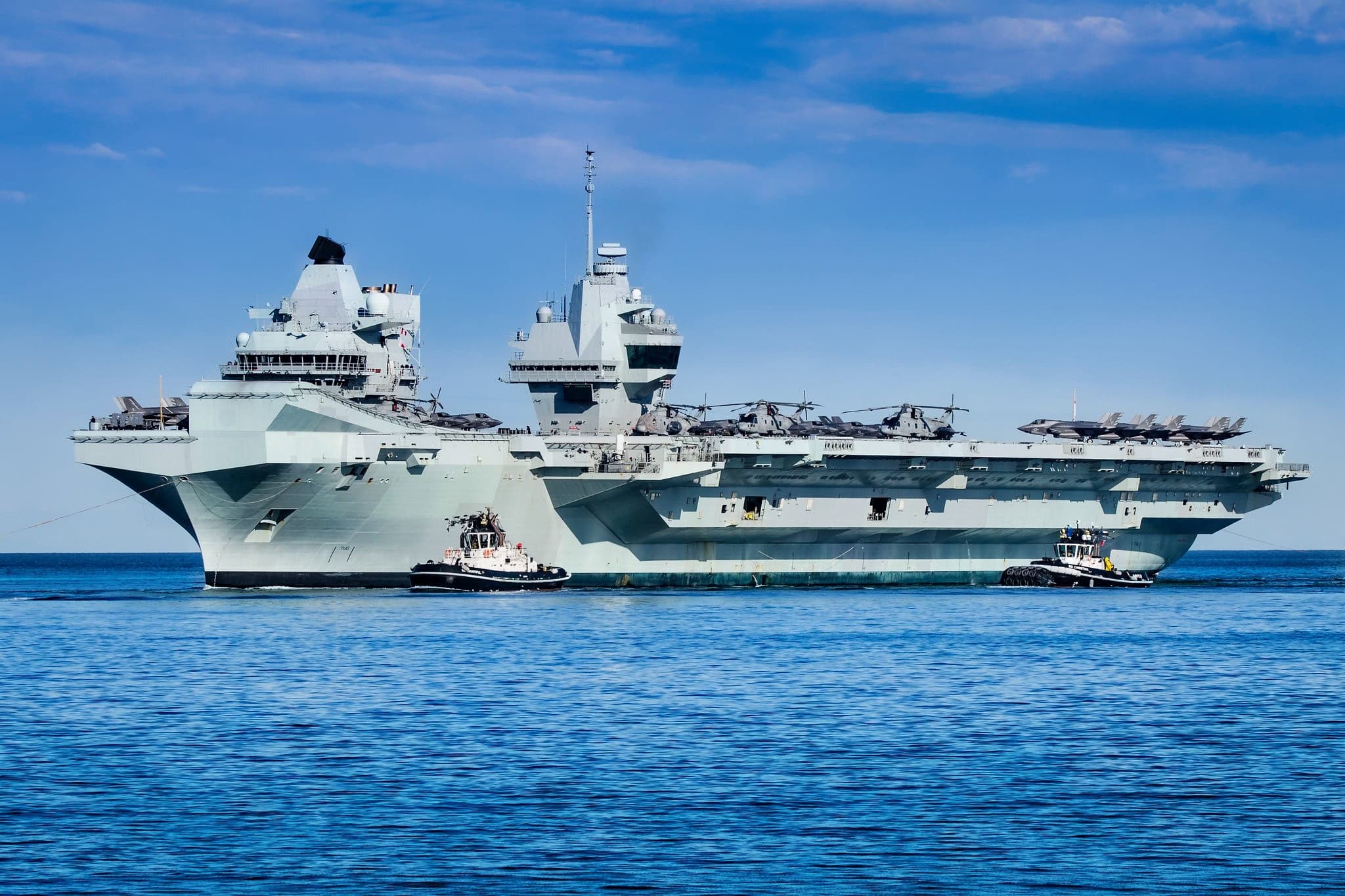
HMS Queen Elizabeth Royal Navy. Image Credit: Creative Commons.
By November 2010 the working figure was £886 million for one ship.
By February 2012, sixteen months into the episode, it stood at £2 billion and rising, with the work adding roughly three years to the build. Conversion also created a strange interim fleet: Queen Elizabeth would have been completed without catapults and left unable to fly fixed-wing aircraft at all until the converted Prince of Wales arrived around 2023, leaving Britain without a usable strike carrier deep into the decade.
On May 10, 2012, Hammond stood in the Commons and reversed course, telling members the catapult installation would cost “in the order of £2 billion and rising” and that a properly discounted thirty-year analysis now favored the jump jet.
Both carriers would be completed in the original STOVL configuration for the F-35B, with flight trials in 2018 and an initial capability in 2020.
The government that had loudly blamed its predecessor for choosing the F-35B had spent about £100 million studying its way back to the F-35B, according to the figure Hammond later gave Parliament.
The U-turn restored the schedule and saved the £2 billion. It also made the ships’ limitation permanent, because the moment both hulls were finished around ski jumps, the conversion cost stopped being £2 billion and became, in effect, infinite.
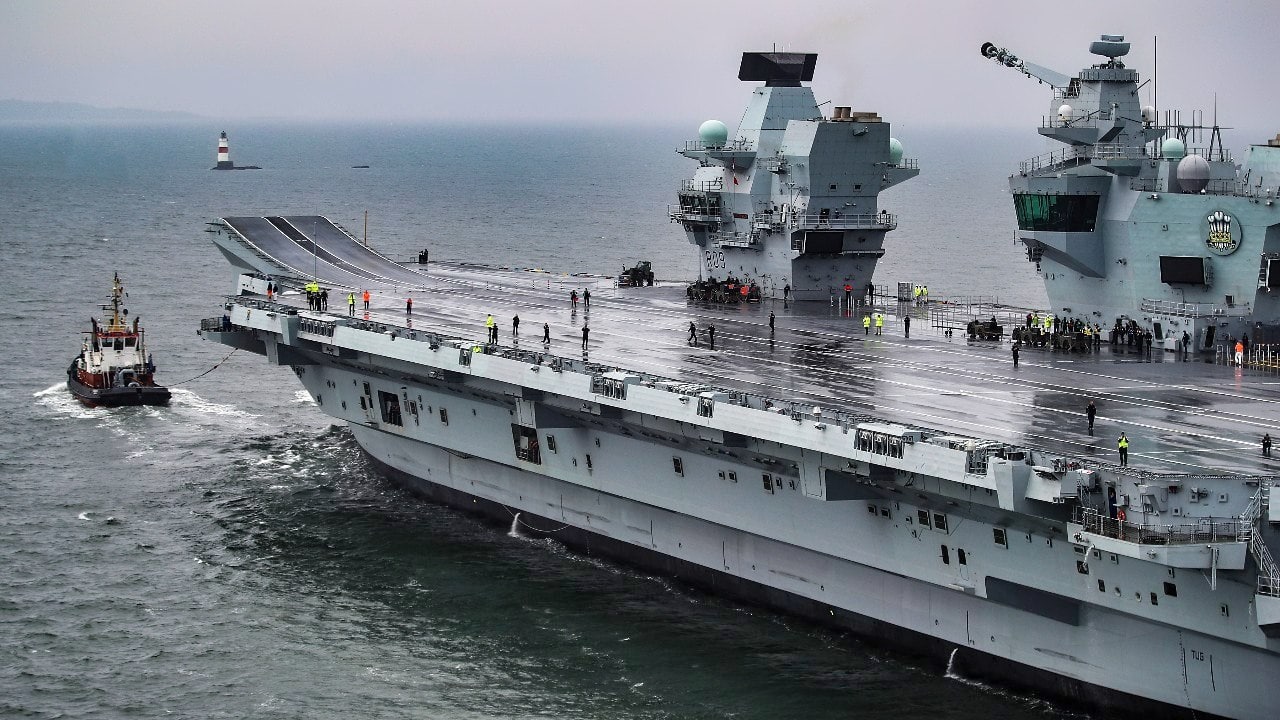
HMS Prince of Wales Aircraft Carrier Queen Elizabeth-Class Aircraft Carrier. Image Credit: Creative Commons.
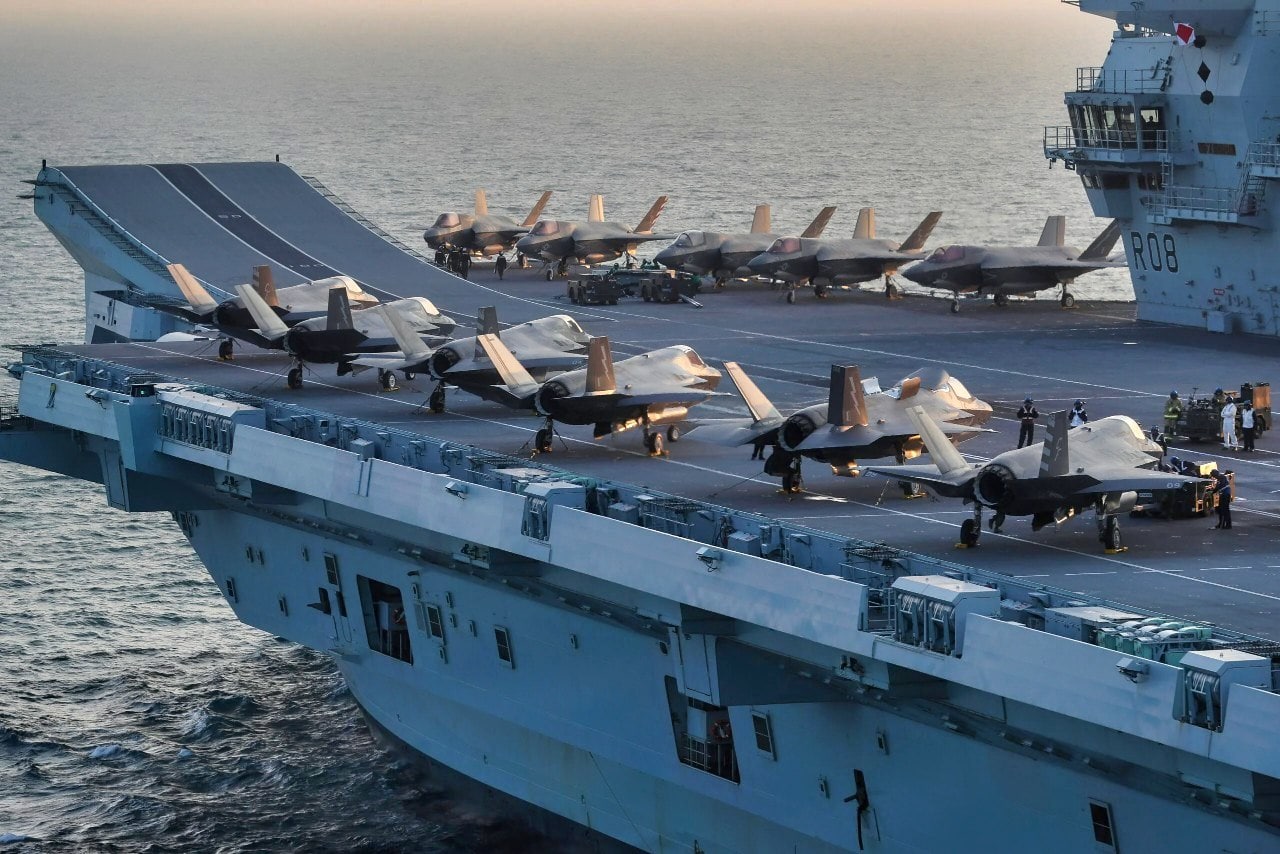
Queen Elizabeth-Class Aircraft Carrier Deck. Image Credit: Creative Commons.
What Reverting Preserved
Reverting kept both carriers in the fleet, and the STOVL configuration has real virtues.
The first F-35Bs landed aboard in 2018, the 2021 maiden strike deployment embarked Britain’s 617 Squadron alongside the US Marine Corps’ VMFA-211, and the Royal Navy says the class can launch two dozen jets in about five minutes off the ramp.
The B model also opened its own club of decks: Marine Corps amphibious ships and British carriers can trade aircraft freely, a cross-decking practiced in the North Sea as early as 2020, and Italy and Japan now fly the same jet from their own flat decks.
Within the STOVL world, the Queen Elizabeth class sits at the center of a genuine alliance network.
The trouble is everything outside that world.
The Doors That Are Welded Shut
An aircraft carrier without catapults and wires cannot recover a conventional carrier aircraft, full stop, and that single sentence rules out most of Western naval aviation.
No F/A-18 Super Hornet.
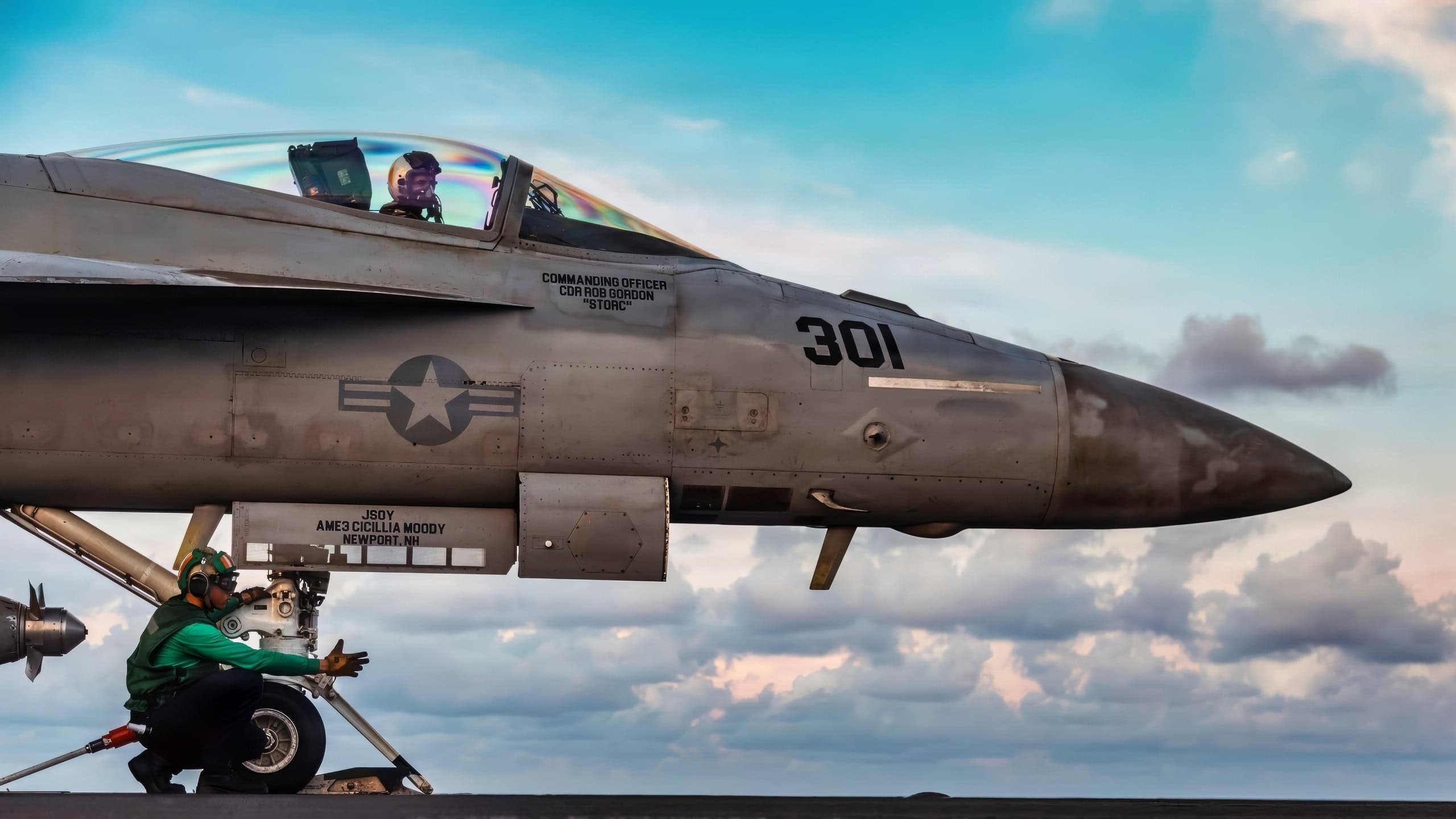
A U.S. Sailor performs a safety scan of the catapult track as an F/A-18E Super Hornet aircraft positions for launch from the flight deck while underway in the Caribbean Sea, Nov. 25, 2025. U.S. military forces are deployed to the Caribbean in support of Operation Southern Spear, the U.S. Southern Command mission, Department of War-directed operations, and the president’s priorities to disrupt illicit drug trafficking and protect the homeland. (U.S. Navy photo)
No EA-18G Growler, which means no dedicated electronic attack.
No F-35C, whose combat radius the Congressional Research Service puts near 600 nautical miles against the B’s 450 nautical miles.
No French Rafale M cross-decking in either direction, on ships whose 2010 conversion was justified partly by interoperability with the French.
And no E-2D Advanced Hawkeye, the flying radar that gives American and French carrier groups their long-range airborne eyes, an aircraft that simply cannot operate from a Queen Elizabeth-class deck.
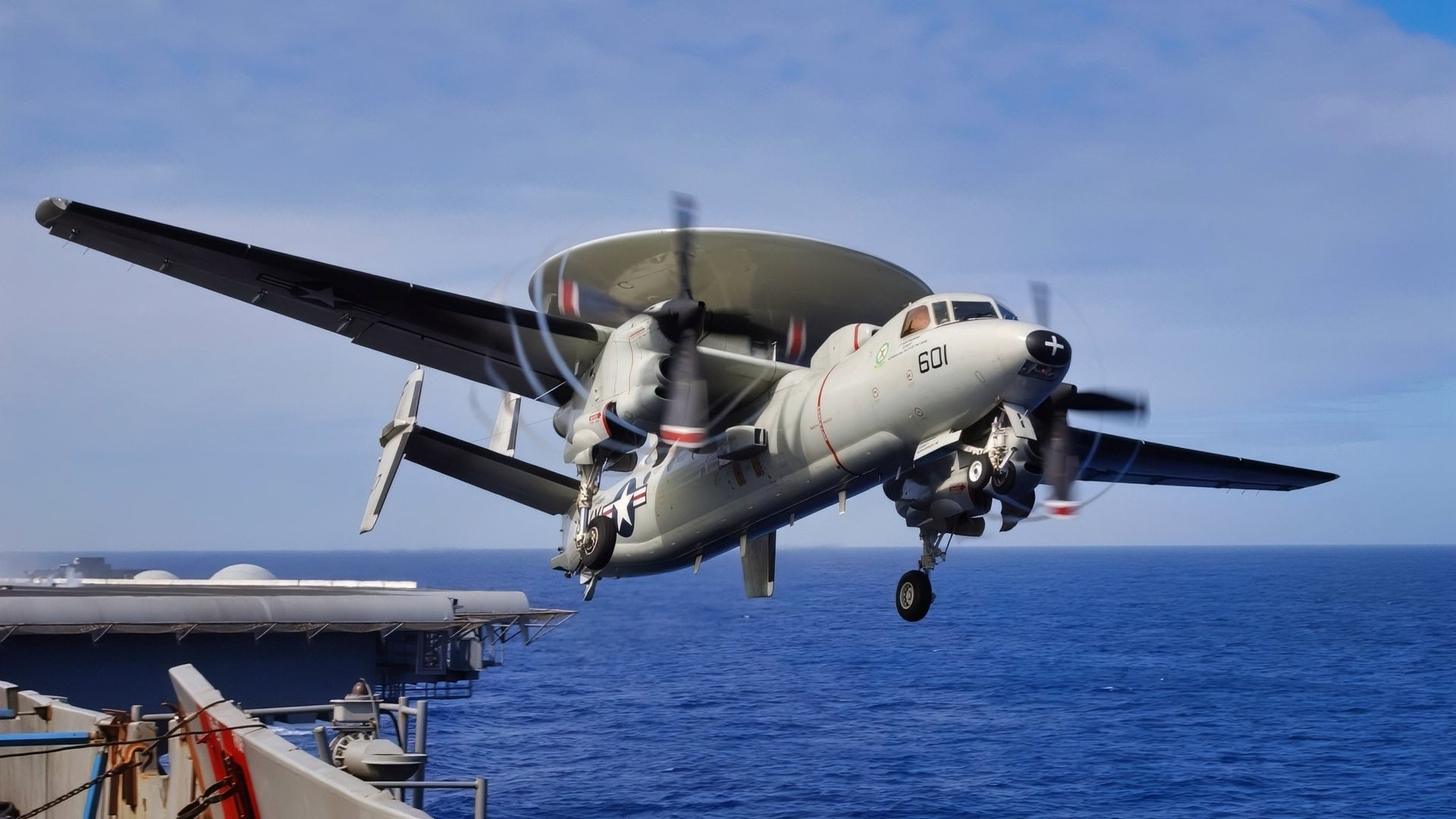
ABOARD USS KITTY HAWK (CV 63) AT SEA (May 22, 2004) — An E-2C Hawkeye assigned to Airborne Early Warning Squadron (VAW) 115 “Liberty Bells” banks after being launched from USS Kitty Hawk (CV 63) following the ship’s annual spring cruise. The E-2C is all weather, carrier-based tactical warning/control system aircraft, providing airborne early warning and control functions for the strike group. Currently under way in the 7th Fleet area of responsibility (AOR), Kitty Hawk demonstrates power projection and sea control as the world’s only permanently forward-deployed aircraft carrier, operating from Yokosuka, Japan.
U.S. Navy photo by Photographer’s Mate 3rd Class Jason T. Poplin
That last exclusion has run the deepest.
In place of the Hawkeye, the Royal Navy fitted a radar to a helicopter: Crowsnest, a mechanically scanned Searchwater derivative bolted to Merlin HM2s.
The program arrived late and troubled, plagued by integration problems and what parliamentary reporting called insufficient ministry oversight, and it deployed on the 2021 carrier group with significant limitations and reliability issues.
The National Audit Office found that the initially contracted capability fell eighteen months behind schedule, and the fixes dragged on long enough that the Navy reviewed its required specifications for the system while it was already at sea.
The dates that follow are the decision’s bill arriving.
Initial operating capability finally came in July 2023, with £425.662 million spent by December 2023, and under current plans the system retires on December 31, 2029. The Navy’s innovation arm had signaled as early as 2021 that the replacement would likely be a large radar on an uncrewed aircraft, and the formal request for information followed in April 2025, because the crewed alternatives all need the wires the ships do not have.
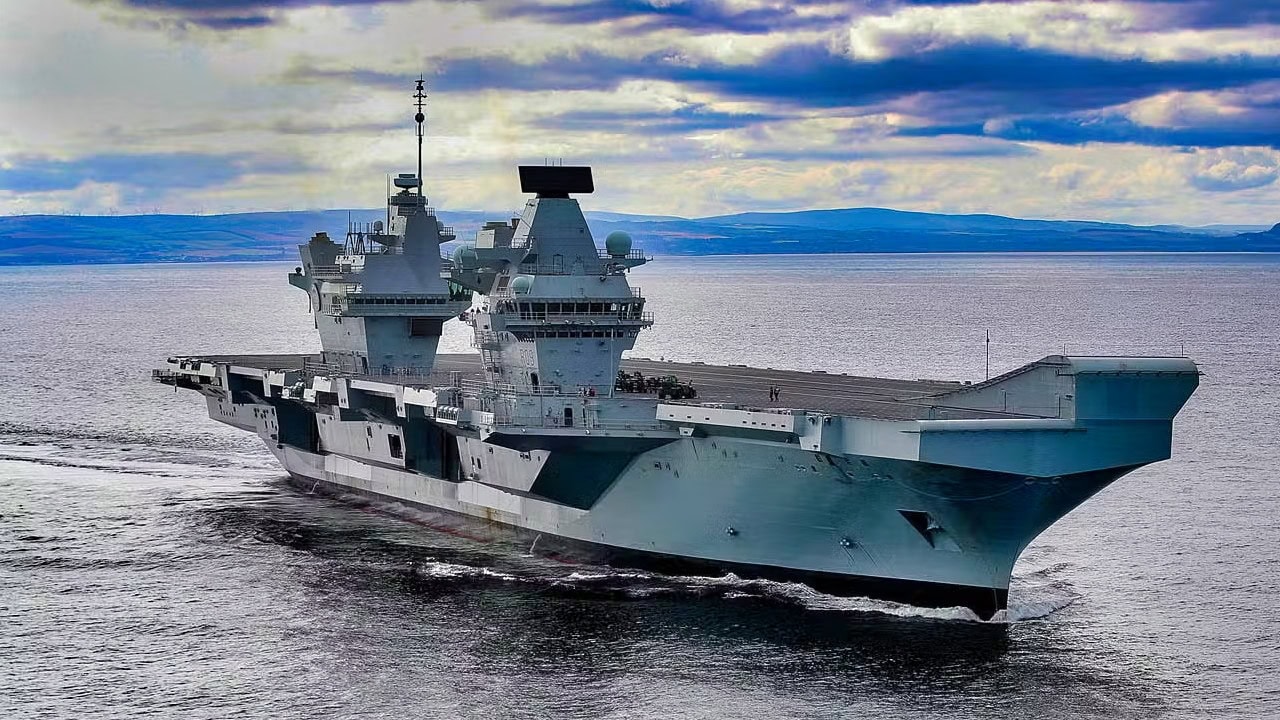
HMS Prince of Wales Aircraft Carrier.
As of this June, the replacement was still on hold awaiting the defense plan, leaving the fleet facing a possible gap in the exact capability the catapult decision foreclosed fifteen years ago.
The Long Road Back to the Catapult
The strangest part of the story is that the Royal Navy is now studying its way back.
The effort is called Project Ark Royal, named for the last British carrier capable of launching and recovering conventional aircraft, and its phased ambition runs from drones to progressively heavier aircraft, with full catapult capability for crewed jets held out as a distant possibility.
The near-term hardware is modest: Banshee target drones fly from a movable deck catapult under Project Vampire, and a future fixed-wing combat drone called Vixen sits on the far horizon.
On November 15, 2023, a General Atomics Mojave took off from and landed back aboard HMS Prince of Wales off Virginia. The Mojave needed no catapult and no wire, landing short and diagonal across the deck, and nothing its size had ever flown from a carrier outside the US Navy: a 1.5-tonne aircraft with a 17-meter wingspan, operated under a £1.25 million demonstration contract.
General Atomics pitched the follow-on as a STOL version of the MQ-9 B, able to provide the strike group with persistent surveillance coverage, which is the polite way of describing a partial, uncrewed substitute for the Hawkeye that the ships can never embark.
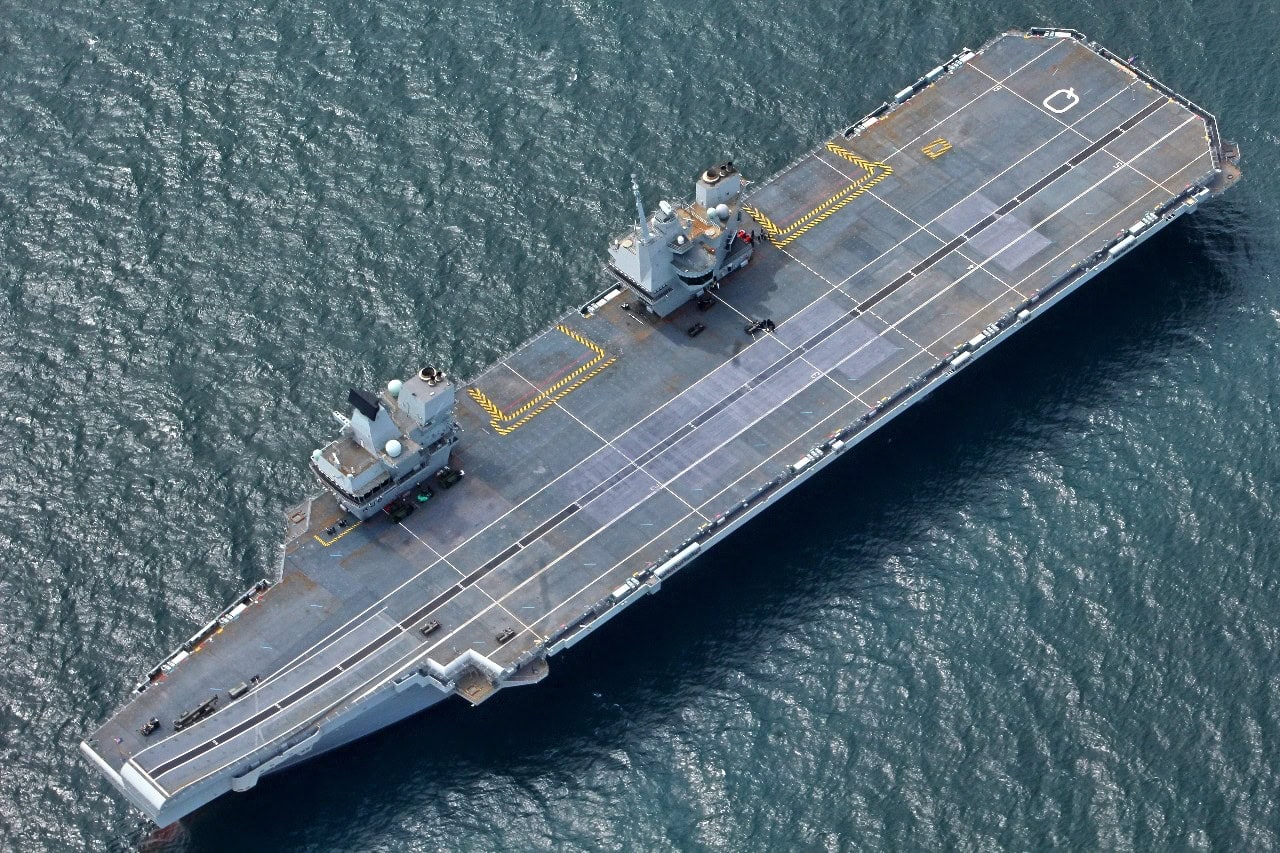
HMS Queen Elizabeth-Class Aircraft Carrier. Creative Commons Photo.
The weight arithmetic explains the modesty: a loaded Mojave comes in at around a tonne and a half, and an F-35C comes in at around 27 tonnes. A catapult for the first is deck furniture. A catapult for the second was £2 billion.
Fifty-Seven Years of One Decision
The Ministry of Defence has confirmed the class is planned to serve until 2069.
Set that against the calendar of the decision itself: chosen in October 2010, unchosen in May 2012, and binding for the fifty-seven years between the reversal and the retirement.
Every future British debate about carrier aviation, sixth-generation naval jets, uncrewed strike, allied integration,and the next airborne radar arrives pre-filtered through a single question no other major carrier navy has to ask: does it hover, land vertically, or land very short?
The ships themselves have given the question added weight, with the pair that cost roughly £7.6 billion to build spending long stretches in repair and the F-35B force growing slowly, and the class has endured its share of embarrassments besides, including an F-35B lost off the deck into the Mediterranean in 2021.
None of that changes with a catapult. What the catapult decision fixed forever is the ceiling.
About the Author: Harry J. Kazianis
Harry J. Kazianis (@Grecianformula) was the former Senior Director of National Security Affairs at the Center for the National Interest (CFTNI), a foreign policy think tank founded by Richard Nixon based in Washington, DC. Harry has over a decade of experience in think tanks and national security publishing. His ideas have been published in the NY Times, The Washington Post, The Wall Street Journal, CNN, and many other outlets worldwide. He has held positions at CSIS, the Heritage Foundation, the University of Nottingham, and several other institutions related to national security research and studies. He is the former Executive Editor of the National Interest and the Diplomat. He holds a Master’s degree focusing on international affairs from Harvard University.