
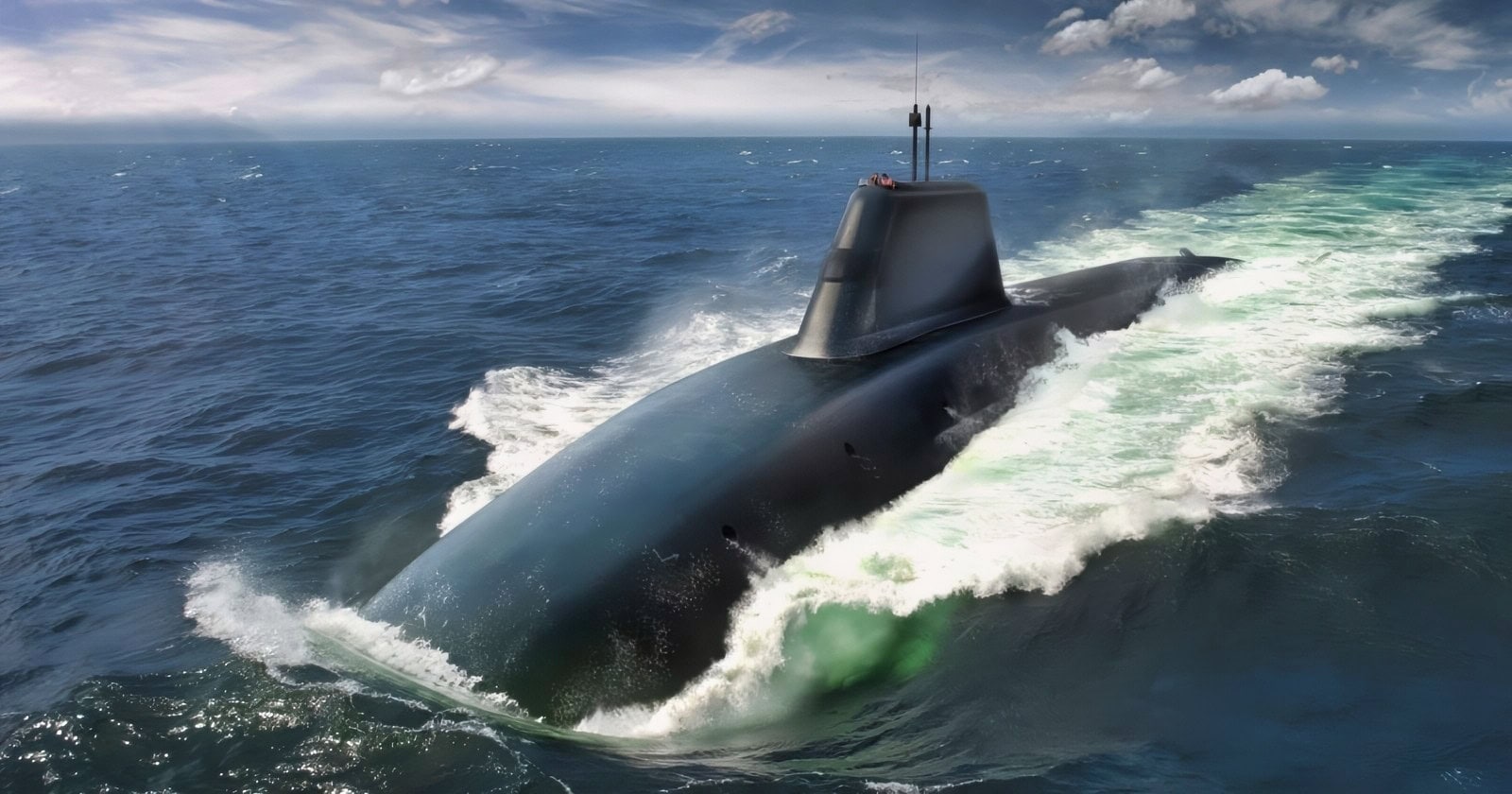
 Dreadnought-Class Submarine Royal Navy
The name HMS Dreadnought is prestigious and time-honored in the annals of Great Britain’s Royal Navy, with the most recent operational example being the United Kingdom’s first nuclear-powered submarine (Pennant No. S101), launched in 1960 and decommissioned in 1980. That metaphorical torch is now being passed to the newest generation of the UK’s submarine fleet: the Dreadnought-class ballistic missile submarines (SSBNs).
Dreadnought-Class Premise and Promise
Built by BAE Systems Maritime UK—headquartered in Barrow-in-Furness, Cumbria, England, and also the manufacturer of the Astute-class nuclear-powered attack submarine (SSN, i.e., Submersible Ship, Nuclear)—the Dreadnought-class submersibles have been tabbed as the successors to the country’s four venerable Vanguard-class SSBNs, which were commissioned between 1993 and 1996 and originally intended for a 25-year service life.
Indeed, the prospective and proverbial new kids on the block were provisionally named “Successor” as a stopgap measure until the Dreadnought designation was announced for both the lead vessel and the class as a whole in 2016.
As the official Royal Navy info page proudly proclaims, “The epitome of naval engineering. With Continuous At Sea Deterrence, they provide unrivaled strength and security.”
A total of four are planned, in an even one-for-one replacement plan for the Vanguards:
-HMS Dreadnought: steel cut in October 2016, laid down in March 2025, launch date TBD, commissioning date expected in the early 2030s
-HMS Valiant: steel cut in September 2019, with keel-laying, launch date, and commissioning dates all TBD
-HMS Warspite: steel cut in February 2023, with keel-laying, launch date, and commissioning dates all TBD
–HMS King George VI, steel cut in September 2025, with keel-laying, launch date, and commissioning dates all TBD
As of this writing, the Pennant Numbers, AKA Pendant Numbers, of all four of these warships are also still TBD.
And given the ongoing efforts of the Russian Navy and Red China’s People’s Liberation Army Navy (PLAN) to expand and modernize their own submarine fleets, the Dreadnoughts couldn’t come soon enough.
Dreadnought-Class in 4 Words: Stacked with Nuclear Weapons
We’re talking a submerged displacement of 17,200 tons, a hull length of 153.6 meters (503. 9 feet), and a crew complement of 130 crew members, including three chefs and one doctor.
To show how far the submarine fleet has come in terms of career opportunities and creature comforts to female seamen, these undersea boats will also feature separate female crew quarters, heads/loos, and washing facilities.
Weaponry-wise, the official site notes that “Like the Vanguard-Class submarines that they will be replacing in the Royal Navy’s service fleet, Dreadnought Class submarines will be capable of launching Trident 2 D5 missiles…
The new submarines will each have three missile compartments, and each compartment will comprise of four missile tubes (known as a ‘Quad Pack’) and five deck levels, for a total of 12 missiles.
Dreadnought-Class submarines will also feature four 533mm torpedo tubes for Spearfish heavyweight medium-range torpedoes.”
NOTE: “Medium-range” as in 30 nautical miles and a max speed of 80 knots; “heavyweight” as in an overall mass of 4,080 lb., with a warhead weight of 480 lbs. worth of aluminized PBX (polymer-bonded, AKA plastic-bonded) explosive.
The powerplant is a Rolls-Royce Pressurized Water Reactor 3 (PWR3) that will enable the boats to attain a top speed of at least 20 knots and leverage technology to deliver key benefits such as simplified operations, a longer service life, and reduced maintenance costs over the lifetimes of the boats.
And whilst the aforementioned Astute-class SSNs are already highly stealthy—quiet as a baby dolphin,” as some observers claim, or, to quote that RN info page again, “the quietest submarines ever constructed”—the Dreadnoughts will take that a step even further, as they’ll be “the first British submarines to feature X-rudders…
These new rudders will sit in front of the very latest Pumpjet propulsor.
These are designed to reduce submarine noise, particularly at high speeds.
And the Pumpjet used in the Dreadnought Class of submarines is the quietest yet.” In other words, an X-shape that will replace the longstanding “cross-shape” design, whilst the Pumpjet replaces old-school propellers.
HMS Dreadnought: What’s In a Name?
Going back to what we said at the beginning about HMS Dreadnought being such a prestigious name in British maritime military history, the moniker has also been bestowed upon ten Royal Navy surface warships; the most famous example is the battleship commissioned in 1906 whose design was so revolutionary for her time that an entire generation of battleships was named after her.
That, in turn, helps explain why two of the remaining three soon-to-be Dreadnought-class SSBNs will bear the names of WWII battlewagons, with HMS Valiant (1914) and Warspite (Pennant No. 03) both having impressive wartime records.
And appropriately enough, HMS Vanguard also has a significant battleship naming nexus, as Pennant No. 23 was the last battleship ever built, thus signifying the end of an era in naval power projection, laid down in 1941, launched in 1944, commissioned in 1946, and decommissioned & scrapped in 1960.
What goes around comes around.
About the Author: Christian D. Orr
Christian D. Orr is a Senior Defense Editor. He is a former Air Force Security Forces officer, Federal law enforcement officer, and private military contractor (with assignments worked in Iraq, the United Arab Emirates, Kosovo, Japan, Germany, and the Pentagon). Chris holds a B.A. in International Relations from the University of Southern California (USC) and an M.A. in Intelligence Studies (with a concentration in Terrorism Studies) from American Military University (AMU). He is also the author of the book “Five Decades of a Fabulous Firearm: Celebrating the 50th Anniversary of the Beretta 92 Pistol Series,” the second edition of which was recently published.