

On November 6, 2025, HMS Prince of Wales carried 24 F-35Bs into the Mediterranean for Italy’s Falcon Strike exercise, the largest sovereign F-35B air wing the Royal Navy has yet assembled. The ship is rated to carry up to 36. Even at that peak, the carrier’s substantial aviation capacity remained largely unused.
Critics have treated this gap between what the Queen Elizabeth-class carriers can accommodate and what Britain actually puts them aboard as evidence the ships were overbuilt.
Britain bought enormous flight decks and hangars, the argument goes, without an air wing large enough to use them.
Now there is another possibility.
On June 4, the UK Ministry of Defence told Parliament that Vanquish, a jet-powered drone being developed to fly from a Queen Elizabeth-class deck without a catapult, is in trials alongside the F-35B force.
The Navy is still using those trials to work out exactly what it wants the aircraft to do.
Vanquish is therefore testing more than a drone.
It is testing whether some of the capacity that has looked excessive for a decade may prove useful after all.
What the Ships Were Built For
Neither the Queen Elizabeth nor the Prince of Wales has a catapult. The Royal Navy settled on that configuration in 2012, after reversing an earlier decision to fit both ships with launchers.
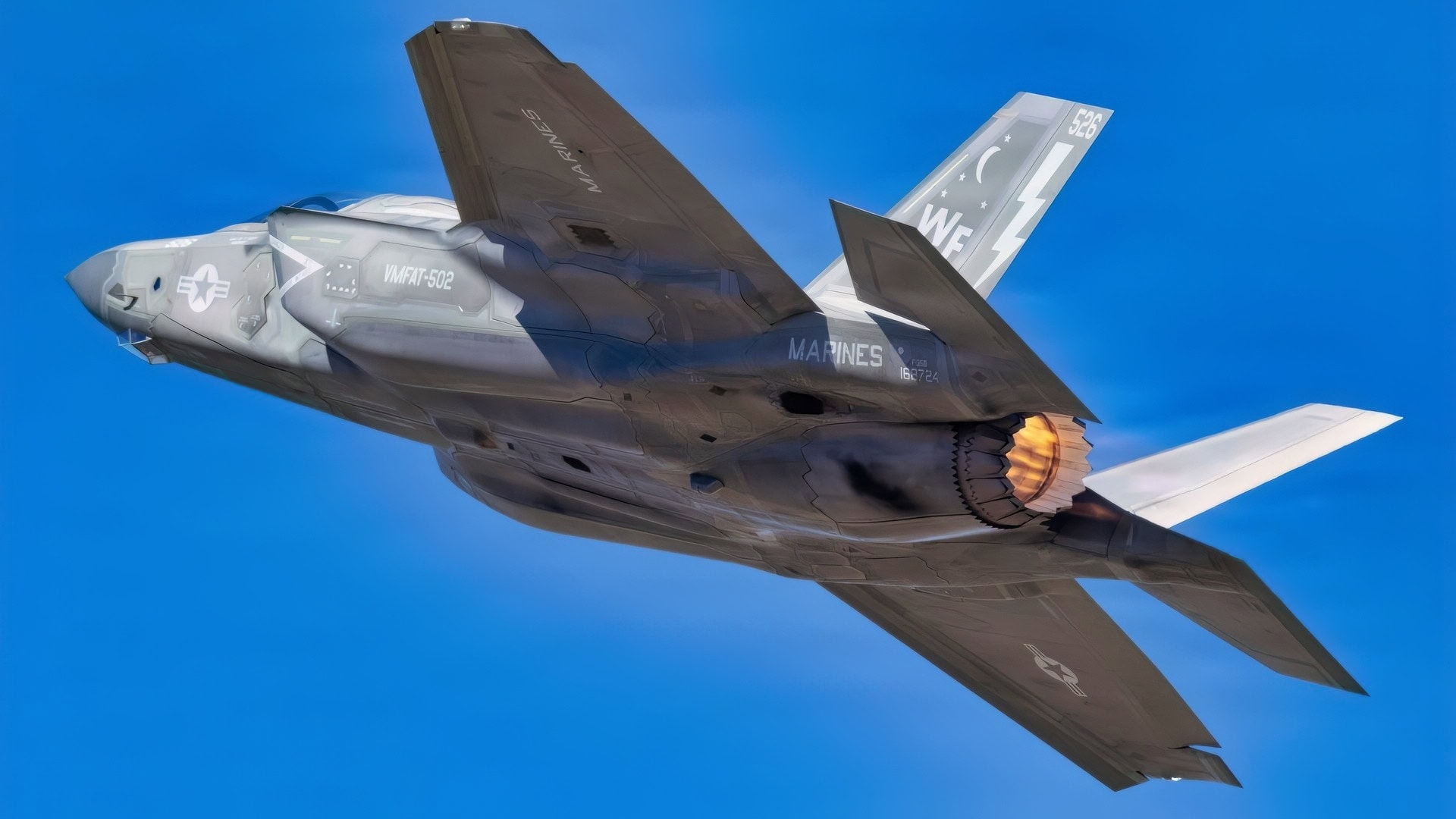
A U.S. Marine Corps F-35B Lightning II lights its afterburner and climbs during the Luke Days 2026 airshow, Saturday, March 21, 2026, at Luke Air Force Base, Arizona. The Marine Corps F-35B Lightning II demonstration showcases the maneuverability and advanced technology of a fifth-generation fighter. Demonstrations like this reflect the cutting-edge capabilities that allow the joint force to maintain air superiority in modern combat operations. (U.S. Air National Guard Photo by Tech. Sgt. Hampton Stramler)
Instead, they got a ski-jump ramp, a hangar 155 meters long and 34 meters wide, and two aircraft lifts that can move four F-35s from hangar to flight deck in 60 seconds.
Each Queen Elizabeth-class carrier can carry up to 72 aircraft.
Up to 36 of them can be F-35Bs. The Royal Navy says the ships can also generate 72 fast-jet sorties in a day, and more than that for short periods.
Britain built the hulls around that capacity. It did not build a jet inventory to match it.
The Royal Navy has taken delivery of all 48 F-35Bs ordered in its first procurement tranche; 47 are still flying after one was lost in 2021.
Forty-seven sounds like plenty against a 36-jet ceiling.
But those 47 aircraft have to cover two carriers, a training pipeline, and squadrons based ashore. Generating 36 combat-ready F-35Bs on one deck, on one day, was never realistic with that inventory.
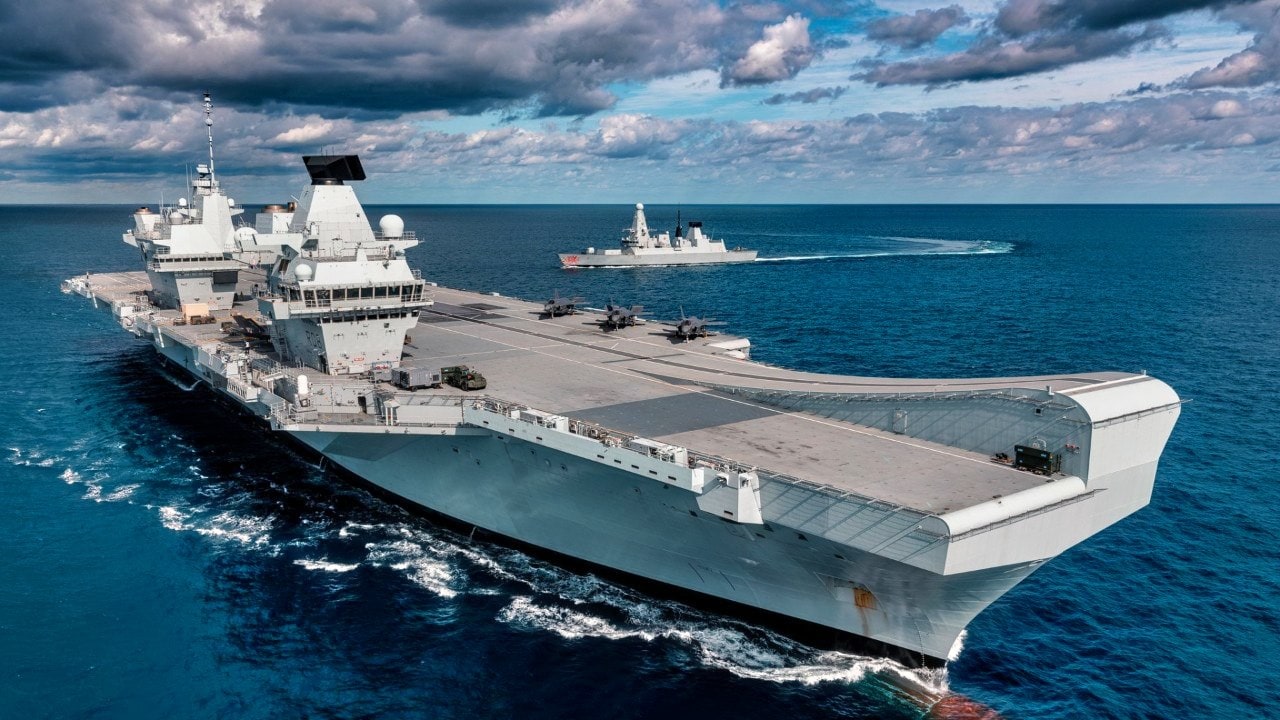
Queen Elizabeth-Class Royal Navy Aircraft Carrier. Image Credit: Creative Commons.
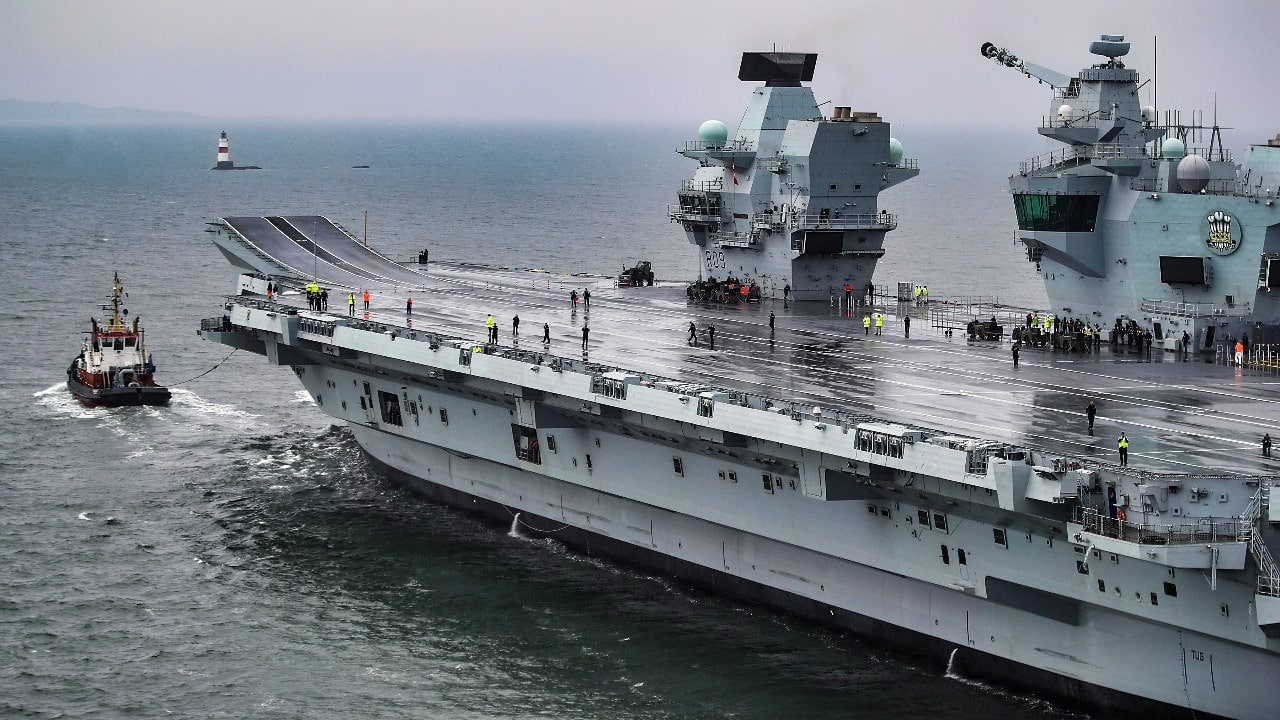
HMS Prince of Wales Aircraft Carrier Queen Elizabeth-Class Aircraft Carrier. Image Credit: Creative Commons.
The real constraint was concentration: getting enough jets onto one deck, on one day, at the same time.
The UK’s 2025 Strategic Defence Review did not try to close that gap with more F-35 orders. It ordered something else instead.
What Britain Is Actually Building
That shift is now taking shape through three separate uncrewed-aircraft programs.
Proteus is the rotary-wing program.
Leonardo built the autonomous helicopter at its Yeovil works under a 60 million pound contract.
It first flew on January 16 from an airfield in Cornwall.
It is still a demonstrator, land-based for now rather than a shipboard aircraft.
Storm Fighter is the larger fixed-wing program. Backed by 300 million pounds and aimed mainly at the Royal Air Force, it draws in part on technology developed for the Global Combat Air Programme.
A demonstrator is due by 2030. Carrier operations are planned for later, but not yet committed.
Vanquish is the carrier-specific fixed-wing effort. Its job is narrower: prove that a jet-powered autonomous aircraft can operate from a Queen Elizabeth-class deck without catapults or arresting gear.
Britain is putting more than 5 billion pounds into autonomous systems across the armed forces through 2030, but Vanquish is the part of that broader push that matters most to the carrier question.
Vanquish sits inside a larger effort called PANTHEON, funded at almost 240 million pounds in June’s Defence Investment Plan.
The same plan puts 510 million pounds against the carriers themselves and 2.2 billion pounds against more F-35s, out of a defense budget projected to reach 79 billion pounds a year by 2029.
The Problem Vanquish Has to Solve
Getting a jet off nothing but a ski-jump is the hard part.
It means building an aircraft light enough and powerful enough for its weight to get airborne on the short runway a ramp allows.
The trick is doing that at high subsonic speed, with enough payload and endurance to be useful.
Two other countries show what two alternative solutions to this problem look like.
Turkey opted for the cheap solution.
A Bayraktar TB3, propeller-driven and slow, with folding wings and a stall speed so low that it barely needs a runway, landed on the ski-jump deck of the amphibious ship TCG Anadolu without any recovery equipment in November 2024.
By February 2026, during NATO’s Steadfast Dart exercise in the Baltic, the same drone flew 232 sorties, including autonomous combat missions in winter weather, and hit its targets.
That is real capability. It is also a light, slow aircraft doing modest work, off a deck with no launch machinery at all.
China chose a much more expensive solution.
Before November 2025, only the United States and France operated carriers with catapults.
The carrier Fujian, an 80,000-tonne ship commissioned that month, is China’s first with electromagnetic catapults, as state media have already shown it launching J-35 stealth fighters and KJ-600 early-warning aircraft.
Britain has embraced neither the Turkish nor the Chinese solutions.
With Vanquish, London is trying to find something in between: a jet fast enough to matter, flying off a ramp that costs nothing extra to build.
Nobody knows yet whether that option is a real possibility.
The Test Comes in 2027
The government has committed to an embarked Vanquish demonstration by the end of 2027.
The timing is not incidental.
Queen Elizabeth is due to relieve HMS Prince of Wales as Britain’s high-readiness strike carrier at roughly the same moment.
By then, the Ministry of Defence will know something it does not know now: whether a jet-powered aircraft can fly off a Queen Elizabeth-class ramp without a catapult behind it.
If the answer is yes, the hangar space that has been Exhibit A against these ships for a decade turns into an asset nobody planned for in 2007.
If the answer is no, Britain still owns two of Europe’s largest warships. It still has hangar space it has never filled. Neither outcome excuses the original decision.
Nobody signed the 2007 contracts with a jet-powered drone in mind. A hull that happens to leave room is not the same thing as a hull designed with foresight.
The Navy’s own ambition is to move most of the Fleet Air Arm to uncrewed aircraft by 2040.
Vanquish is the first hard evidence of whether that ambition survives contact with a ramp built in 2007.
What Vanquish changes, in the meantime, is the question worth asking. It used to be whether the ships were too big.
Now it’s what the extra space is actually for.
That answer arrives in a little over a year.
About the Author: Dr. Andrew Latham
Andrew Latham is a professor of international relations and political theory at Macalester College in Saint Paul, MN. You can follow him on X: @aakatham.