
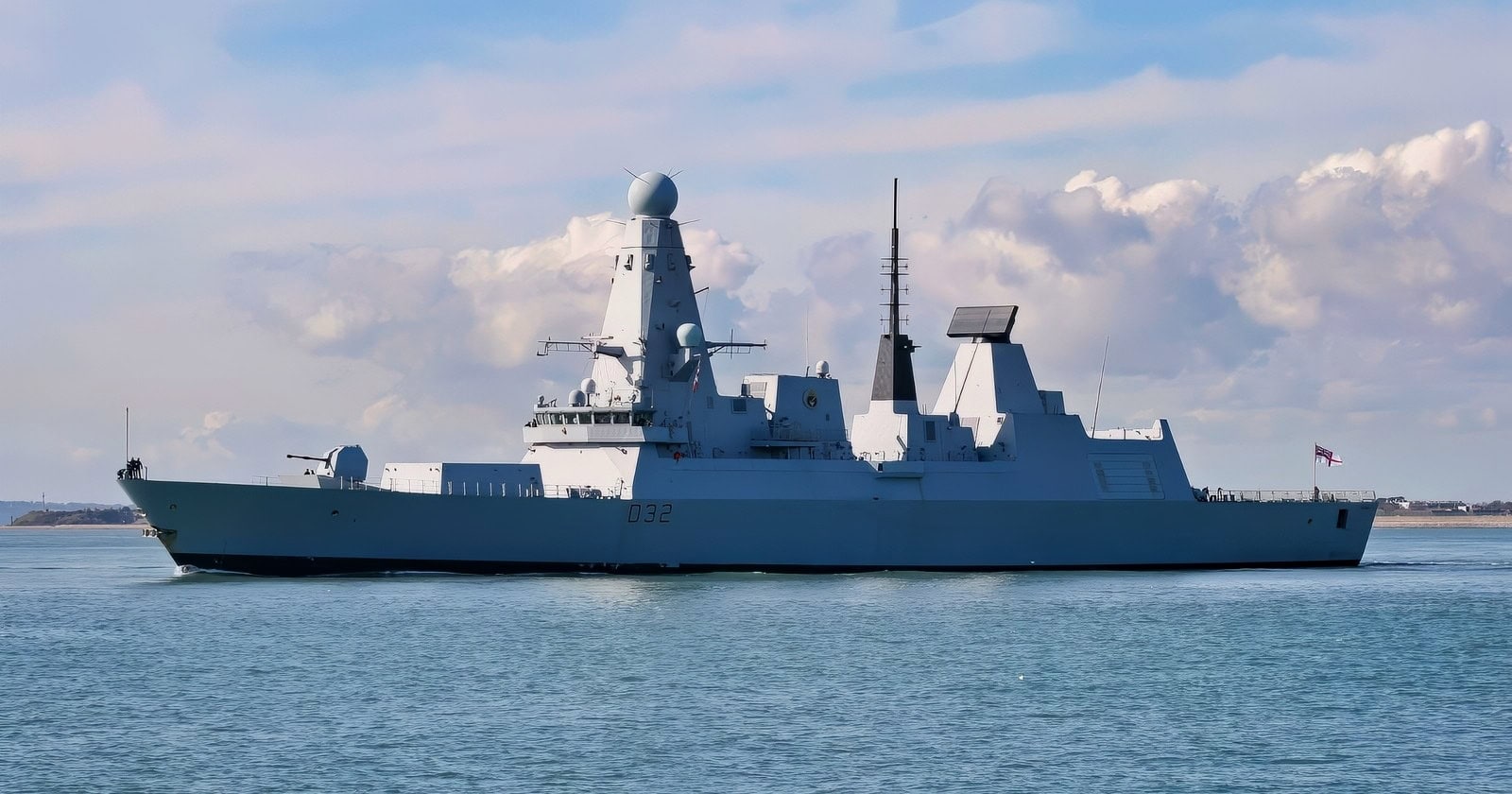
 Type 45 Destroyer for the Royal Navy
Britain’s troubled Type 45 destroyer program reached an important milestone after years of Royal Navy efforts to fix it. HMS Duncan returned to Portsmouth on September 6 to begin a major refit, making it the sixth and final Type 45 to enter the Power Improvement Project – an effort to finally address the power and propulsion problems that have plagued the class throughout its service life so far.
It follows years of headlines about Britain’s advanced warships suffering constant breakdowns, with many of them spending extended periods completely unavailable for operations.
But the situation may finally be on its way to resolution, with three Type 45s having completed their propulsion conversions as of the end of 2025.
HMS Dragon, comedically dubbed by some analysts in the United Kingdom as HMS Drag-On, was then deployed on operations in the Middle East this year.
With Duncan beginning its conversion, and the Navy planning to complete work across the entire class by 2028, it looks like one of the biggest weaknesses of the Type 45 may soon finally be addressed.
Meet the Type 45
The Type 45, also known as the Daring-class, is Britain’s premier air-defense destroyer.
Six of the vessels were built: HMS Daring, Dauntless, Diamond, Dragon, Defender, and Duncan.
Each ship is 152 meters long and displaces around 7,350 tonnes, and was designed to protect British naval forces from aircraft and missile strikes.
Their most important capability is Sea Viper, a system that combines long-range surveillance radar, the SAMPSON multifunction radar, a command system, and Aster surface-to-air missiles.
The Royal Navy says SAMPSON can detect targets at ranges over 250 miles, and Sea Viper can launch eight missiles in less than 10 seconds.
It can also guide up to 16 missiles simultaneously.
So far, the ships have proven themselves capable in combat, despite the reported problems.
HMS Diamond, for example, successfully shot down Houthi drones in the Red Sea and, in April of 2024, destroyed an anti-ship ballistic missile – the first interception of a ballistic missile in combat by the Royal Navy.
The problem was never their technical capability – the Type 45s are plenty capable – but keeping them running for as long as they were needed.
The Type 45’s In 4 Words: The Propulsion Has Issues
The Type 45 was introduced with an ambitious new propulsion system. Known as an Integrated Full Electric Propulsion system, the ships replaced gas turbines, which mechanically drove propeller shafts, with a propulsion system that generates electricity to power electric propulsion motors.
The electricity also powers the sensors, weapons, and other onboard equipment.
At its heart were two Rolls-Royce WR-21 gas turbine alternators, supported by two Wärtsilä diesel generators.
Problems emerged even before HMS Daring entered service.
The British Ministry of Defence then acknowledged the problem, noting that it did not achieve the performance and reliability that was expected of it.
In high ambient temperatures, for example, the WR-21s couldn’t maintain intended power output, and the control system also failed to function reliably.
Those problems contributed to instances in which the ships completely lost electricity and therefore could not function.
The problems went beyond one component.
In service, the gas turbine alternators and diesel generators were used more often than planners originally anticipated, with the original two diesel generators producing around 2MW each and providing insufficient power when other parts of the system failed.
How the Navy Fixed It – and the Cost
The solution to the problem was the Power Improvement Project, a massive engineering program intended to replace the two original diesel generators on each ship with three more powerful units from Rolls-Royce.
The new generators can produce enough electricity to power the ships, giving crews more redundancy if the other power source, the gas turbine alternators, fail.
And it is a substantial project.
To complete it, engineers must cut openings in the hull to remove the old machinery and install new generators.
Then, the electrical and control systems must be adapted to connect the new generators to the ships.
The British Ministry of Defence awarded a £160 million contract for the work in 2018, although the reported contract value subsequently increased to approximately £189 million.
The program covers the engineering solution and conversion of all six destroyers. It looks like the work and expense are finally paying off, with Daring, Dauntless, and Dragon now complete.
According to the Ministry of Defence, the program is on track to complete all work on all six ships by 2028 – and after more than a decade addressing the unanticipated problems, the Royal Navy is finally getting back on track.
About the Author: Jack Buckby
Jack Buckby is a British researcher and analyst specializing in defense and national security, based in New York. His work focuses on military capability, procurement, and strategic competition, and he produces and edits analysis for policy and defense audiences. He brings extensive editorial experience, with a career output spanning over 1,000 articles at 19FortyFive and National Security Journal, and has previously authored books and papers on extremism and deradicalization.