
The Russian military's massive airstrikes on Ukraine over two days reveal a new threshold in the air defense attrition war.
 Dmitri Volkov
Breaking Analysis | Dmitri Volkov
1,567 drones and 56 missiles, this is not an ordinary "retaliatory strike," but a pressure test of Russia's air defense system against Ukraine. Ukrainian President Zelensky stated that during the two rounds of large-scale attacks from May 13 to 14, the interception/suppression rate of drones was about 94%, and the missile interception rate was about 73% (Ukrinform citing Zelensky, 2026-05-14). This number looks high, but the real issue is not the percentage, but the denominator: as the denominator is continuously magnified by Russian industry and Iranian-style drone tactics, any air defense system will be forced into a war of attrition regarding ammunition, radar duty, interception windows, and urban pressure capacity.
The scale of the attack has crossed the realm of "night harassment"
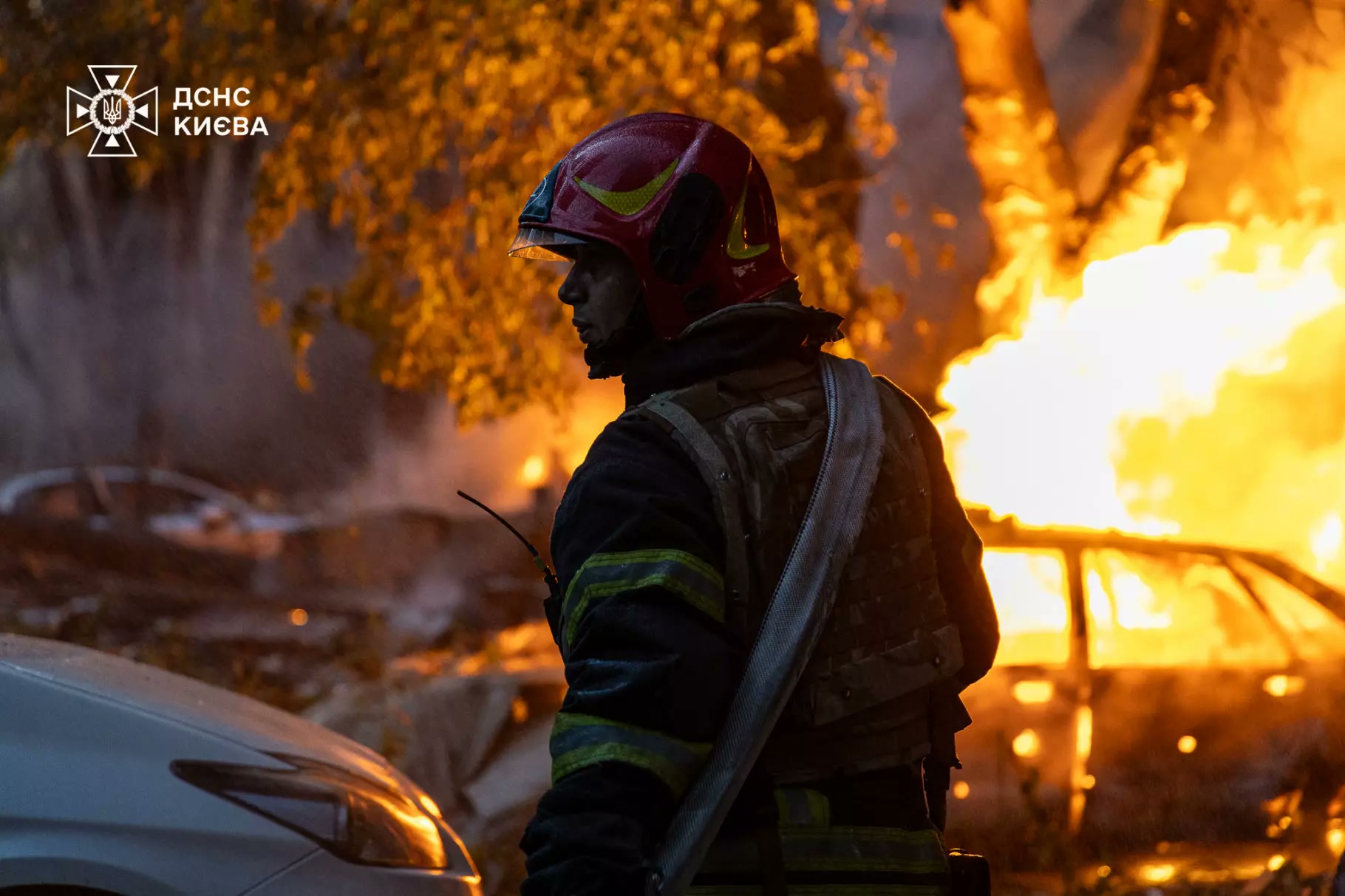
Reuters described this attack as one of the heaviest two-day drone assaults since the war began, stating that Russia struck Kyiv and other cities with hundreds of drones and missiles within two days; CNN similarly referred to it as one of the largest sustained drone attacks since the start of the war. The verifiable data from Ukraine is more specific: the Ukrainian Air Force reported that a single night/phase attack included 675 one-way attack drones and 56 various types of missiles, including "Iskander" ballistic missiles, S-400 modified ground attack missiles, Kh-101 cruise missiles, and "Dagger" air-launched ballistic missiles (Kyiv Independent citing the Ukrainian Air Force, 2026-05-14). Zelensky later provided a total of 1,567 drones and 56 missiles over the two days.
There is a detail that is easily overshadowed by news headlines: Russia did not simply "launch missiles and drones simultaneously." It was more like first using multiple waves of Shahed/"Geran" drones to create target saturation, forcing Ukrainian radar and mobile firepower to expose their rhythm, and then using cruise missiles and ballistic/ quasi-ballistic munitions to strike key nodes. There is an old term in Soviet air raid theory called "disrupting air defense organization"; today's version no longer relies on large formations of air forces, but rather on a combination of cheap drones, decoys, electronic suppression, and high-value missiles. The technology has changed, but the logic has not.
High interception rates do not equal low-cost victories
The Ukrainian side reported that since the evening of May 13, they intercepted 41 missiles and 652 drones; Zelensky provided an overall interception rate of 94% for drones and 73% for missiles over the two days. For civilians, this certainly means that a large number of targets were not hit; for the military, it also means that air defense ammunition is being consumed at a dangerous speed. Drones can be dealt with by machine guns, electronic warfare, mobile air defense teams, and cheap intercept drones, but ballistic missiles and some high-speed targets still require systems like Patriot. This is precisely why Zelensky emphasized that "anti-ballistic systems and intercept missiles are the top priority."
Russia's calculations are cold: even if Ukraine shoots down the vast majority of Shahed drones, as long as each wave forces Ukraine to expend expensive intercept missiles, expose air defense deployments, and disrupt urban power and water supply systems, Moscow gains a strategic advantage. For the Russian General Staff, this is not a simple arithmetic of "how many targets each missile hits," but a systemic arithmetic of "how many hours of sleep the Ukrainian air defense system loses with each round of airstrikes, how much inventory is reduced, and how many intercept missiles are requested from the West." Ironically, this method resembles the Russian military-industrial system itself: crude, repetitive, costly, but as long as production can sustain it, they will continue to push forward.
Related to the ceasefire bidding war and the situation around Victory Day
This attack cannot be separated from the context of the ceasefire, negotiations, and the "Victory Day" narrative in early May. In recent weeks, both Russia and Ukraine have been using long-range strikes to shape the psychological and political space before negotiations: Ukraine attacking energy, airports, and military nodes within Russia, trying to prove that the costs of war can be transmitted back to Russian territory; Russia, on the other hand, has been sending signals through intensive airstrikes on Kyiv, Kharkiv, Odessa, and the western regions that "even if negotiations for a ceasefire occur, they will be under the pressure environment set by Russia."
This is not the first time the Kremlin has done this. After the Korean War and in the later stages of the Afghan War, the Soviet system was familiar with a method: discussing "peace" at the negotiating table while increasing firepower density on the battlefield, so that concessions could be packaged as the other side's necessary choice. The difference in 2026 is that firepower density is no longer primarily expressed in the number of artillery or air force sorties, but in drone stockpiles, missile reproduction capabilities, and networks for circumventing sanctions. The Ukrainian side claims that a Kh-101 missile that hit an apartment building in Kyiv may have been produced in the second quarter of this year; if this is further confirmed, it would indicate that the Russian missile production chain has not been cut off by existing sanctions.
Civilian casualties and infrastructure pressure are becoming the core battlefield
Kyiv was one of the main targets of this attack. Kyiv Independent reported that as of the evening of May 14, the attacks on Kyiv had resulted in at least 16 deaths, 47 injuries, and 17 missing persons; Ukrinform later cited the Ukrainian National Emergency Service, stating that the official death toll had risen to 13, including two children, with earlier reports of 57 injured; CNN reported casualty figures claiming at least 17 dead and dozens injured, with the final numbers still awaiting official confirmation after rescue operations conclude. The numbers from different sources are not entirely consistent, essentially reflecting the same reality: what was hit was not an abstract "target set," but residential buildings, substations, high-voltage lines, water supply systems, and firefighters who were in the process of rescue.
This is also why the pressure for Western air defense assistance will rapidly increase. What Ukraine currently lacks is not a specific model from a single equipment list, but a sustainable urban air defense economic model: a low-cost anti-drone layer, sufficient density of medium-range air defense, limited but critical anti-ballistic systems, and stable production and supply of intercept missiles. If the U.S. and Europe only commit to a batch of intercept missiles after each tragedy, without establishing a long-term monthly production and delivery rhythm, Ukraine will continue to fight in the contradiction of "tactical interception success, strategic inventory decline."
Preliminary Judgment
My judgment is that this two-day attack is not an isolated escalation, but a public template of Russia's airstrike model in 2026. First, using a vast number of drones to extend the combat duration; second, using mixed missiles to force Ukraine to use its most scarce anti-ballistic resources; third, using civilian infrastructure as psychological pressure and negotiation leverage; fourth, proving that Russia can still dictate the pace of the battlefield when international public attention shifts to ceasefire proposals. Ukraine can intercept most targets, but cannot rely on bravery and technology to forever replace inventory. In the next one to two months, what truly determines Kyiv's safety is not just the situation at the front, but the delivery speed of Patriot intercept missiles, SAMP/T munitions, low-cost anti-drone systems, and European production lines.
If Western assistance continues to move at the speed of political statements, while Russian drones move at assembly line speed, Kyiv will see more nights like this. The most brutal gap in the history of warfare is often not a gap in will, but a gap in production rhythm.
Sources and Verification
- Reuters, 2026-05-14: Russia pounds Ukraine in heaviest wartime drone attack over two days; Ukrainian capital Kyiv under massive Russian attack.
- CNN, 2026-05-14: Russia hammers Ukraine in biggest prolonged drone attack since war began; Kyiv casualties.
- Kyiv Independent, 2026-05-14: Zelensky instructs military to prepare response to Russia's deadly Kyiv attack.
- Ukrinform, 2026-05-14: President Zelensky: 94% of Russian drones, 73% of missiles intercepted during two-day attack; Death toll from Russian attack on Kyiv rises to 13.
- Ukrainian Air Force/Zelensky official Telegram report, cited by Kyiv Independent and Ukrinform.
Russia launched a massive airstrike against Ukraine on May 13-14, 2026, deploying 1,567 drones and 56 missiles, primarily targeting Kyiv. Ukraine's air defense intercepted about 94% of the drones and 73% of the missiles, but the attacks resulted in significant civilian casualties, including at least 16 deaths. This operation is noted as one of the largest drone assaults since the conflict began, aimed at testing and exhausting Ukraine's defense capabilities.
- 1,567 drones and 56 missiles were launched by Russia against Ukraine.
- Ukraine intercepted approximately 94% of drones and 73% of missiles during the attacks.
- The attacks resulted in at least 16 civilian deaths and 47 injuries in Kyiv.
- The operation is described as one of the heaviest drone attacks since the war began.
- The strikes aimed to exhaust Ukraine's air defense resources and disrupt civilian infrastructure.