
The Shipborne Tor-M2KM for the Russian Navy Shows the Cost of Drone Warfare in the Black Sea 2026
 Dmitri Volkov
The Shipborne Tor-M2KM for the Russian Navy Shows the Cost of Drone Warfare in the Black Sea 2026
Fifteen tons of land-based air defense, placed on the ship's deck, look not like a technological breakthrough, but like an accounting entry after a series of unpleasant write-offs. In June 2026, the Russian industry once again showcased the shipborne version of the "Tor-M2KM" and announced it as a response to the threat of Ukrainian drones. Formally, this is news about fleet modernization. Essentially, it is an acknowledgment that the standard shipborne air defense of a significant portion of Russian small and auxiliary vessels was not designed for a war where the strike may come not from a NATO aircraft, but from a cheap drone built to fly hundreds of kilometers.
What Was Shown at Fleet 2026
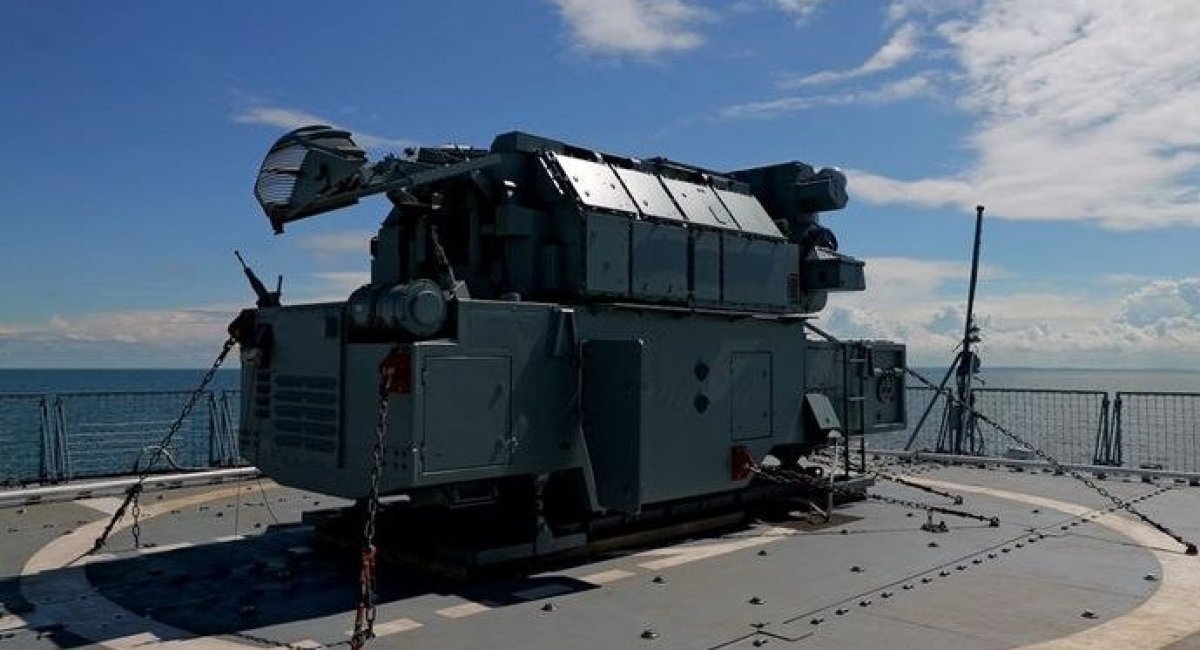
According to Defence Express on June 14, this concerns an autonomous combat module based on the short-range air defense system "Tor-M2KM," which the Izhevsk Electromechanical Plant "Kupol" offers to install on ships with a displacement of at least 500 tons. For small ships, one module is proposed for the bow or stern, while for larger ones, two modules are suggested on the upper deck. The Russian side presents this as the completion of another stage of development, but the idea itself is old: tests on the frigate of project 11356 "Admiral Grigorovich" were conducted back in 2016, and after 2022, similar installations have been spotted on ships of the Black Sea Fleet, including patrol vessels of project 22160.
The technical logic is clear. The "Tor-M2KM" is a modular version of the system from the "Tor" family, designed for placement not only on tracked or wheeled chassis but also on unprepared sites. Open specifications for the family usually indicate a range of about 12–15 kilometers and an altitude of up to 10 kilometers, with the capability to engage low-flying targets, cruise missiles, guided munitions, and UAVs. In February, RIA Novosti, citing the director of "Kupol," Fanil Ziyatdinov, reported that the first batch of "Tor-M2KM" for the Navy was produced in 2025, while an integrated "Tor-MF" is being developed for the fleet in parallel. The difference between these two terms—"modular" and "integrated"—is more significant than it seems.
Module Instead of Architecture
A ship with standard designed air defense is built around its sensors, power supply, combat information systems, communication channels, and firing sectors. The shipborne "Tor-M2KM" addresses a different task: it provides an autonomous bubble of protection where the standard architecture is either absent or insufficient. This is not bad in itself. The Soviet school always respected simple, portable solutions, and in some cases, such rough modularity saves more lives than beautiful integration on paper. But at sea, the cost of this roughness is high: the center of gravity, radar visibility, safe launch sectors, cable management, maintenance in saltwater, and compatibility with the ship's fire control system become not engineering trifles, but combat resilience.
That is why the 2026 demonstration looks like a symptom rather than a victorious report. The Black Sea Fleet has lost the ability to operate as it planned before the war: large ships cannot approach the Ukrainian coast with impunity, bases in Crimea are under constant pressure, and logistical and fuel facilities deep within Russia regularly become targets for Ukrainian drones. ISW noted on June 13 the strikes by Ukraine on Russian energy and military infrastructure, while AP reported a fire at a Black Sea export terminal in Krasnodar Krai and other distant strikes. Against this backdrop, the shipborne "Tor" is not an abstract modernization, but an attempt to close a gap that the war is widening faster than factories can produce standard shipborne systems.
The Lesson of Vasily Bekh
The most uncomfortable episode for the promotional logic of the "Tor-M2KM" is June 2022, when Ukrainian forces struck and sank the rescue vessel "Vasily Bekh," which was carrying the "Tor" module. Russian sources like to talk about the "good results" of the first deliveries, but the story of this vessel reminds us of a simple fact: having a system on deck does not yet mean a built air defense system. Readiness of the crew, intelligence data, external target designation, stable communication channels, and understanding of what specific threat the system should intercept are needed. The "Tor" was developed over decades against aircraft or classic cruise missiles. Against a saturated environment where reconnaissance UAVs, FPV drones, long-range strike drones, decoys, and unmanned surface vessels operate simultaneously, one autonomous module turns into an expensive watchman with a limited field of view.
This leads to unpleasant arithmetic. If the module carries a limited ammunition load, the enemy can force it to expend missiles on cheap or false targets. If the system turns on its radar, it becomes noticeable itself. If the ship keeps the radar off and waits for external warning, it depends on the communication and intelligence systems, and these systems in the Russian army and navy have regularly shown weakness. In Soviet textbooks, this was called management resilience. In 2026, it is called much more simply: does the ship have time to see the drone before the drone sees the ship.
Why This Matters Beyond the Black Sea
The development of "Tor-MF" as an integrated shipborne variant shows that Moscow understands the limits of a temporary solution. However, the transition from a deck module to a full-fledged shipborne complex requires money, time, testing, and production discipline. After three and a half years of large-scale war, all four resources have become scarce. The Russian industry is capable of producing individual strong systems, and the "Tor" cannot be dismissed as a useless complex. The problem lies elsewhere: war requires not good individual products, but a mass, interconnected, and maintainable system. The Russian fleet is trying to buy resilience piece by piece.
In the old Russian military tradition, there is a dangerous habit: if a system does not work, another good unit is added to it, and the problem is declared solved. Sometimes this helps for a week. Rarely—for a campaign.
For Ukraine, the emergence of the shipborne "Tor-M2KM" means complicating the task, but not closing it. Most likely, Kyiv will seek saturation, combined attacks, and strikes on those places where the deck module does not change the overall balance: fuel, repair capabilities, docks, communications, warehouses, and transitions between Crimea and mainland logistics. For Russia, however, the main risk lies in complacency. If the "Tor-M2KM" is perceived as a universal shield, the fleet will pay for it with ships again. If it is used as part of a layered system, it may reduce losses, but it will not restore the Black Sea Fleet's freedom of action as of 2021.
Sources
- Defence Express, June 14, 2026 — report on the completion of work on the shipborne module "Tor-M2KM" and its possible installation on vessels from 500 tons.
- RIA Novosti, February 4, 2026 — statement from IEMZ "Kupol" about the first batch of "Tor-M2KM" for the Navy in 2025 and the development of "Tor-MF."
- Institute for the Study of War, June 13, 2026 — assessment of Ukraine's strikes on Russian energy and military infrastructure.
- Associated Press, June 13, 2026 — reports of distant Ukrainian strikes and a fire at a Black Sea export terminal.
The Russian Navy introduced the shipborne Tor-M2KM air defense system in June 2026 to counter Ukrainian drone threats in the Black Sea. This 15-ton system is designed for vessels with a displacement of at least 500 tons and reflects the ongoing challenges faced by the Russian fleet in maintaining operational capabilities against drone attacks. The Tor-M2KM represents a significant development in Russia's military equipment, aiming to enhance air defense capabilities.
- The Tor-M2KM is a shipborne air defense system designed to counter drone threats.
- It is intended for ships with a displacement of at least 500 tons.
- The system has been in development since at least 2016, with trials conducted on various vessels.
- The introduction of this system reflects the challenges faced by the Russian Navy in the Black Sea due to Ukrainian drone operations.
- The Tor-M2KM aims to provide a modular air defense solution for smaller vessels.