
The Start of GSOMIA Negotiations in 2026 Makes the Transfer of Abukuma-Class More Likely
 Tanaka Takashi
Negotiations for Japan-Philippines GSOMIA Begin in 2026, Making the Transfer of Abukuma-class Vessels More Realistic
During the meeting between Prime Minister Sanae Takichi and President Ferdinand Marcos held on May 28 at the Akasaka Guest House in Tokyo, what caught my attention was not the diplomatic term "comprehensive strategic partnership" itself. It was the fact that the Ministry of Foreign Affairs' announcement included the acceleration of discussions on the transfer of defense equipment, including Abukuma-class destroyers and TC-90 training aircraft, alongside the commencement of negotiations for a military information protection agreement in the same paragraph. This should not be seen as mere friendly gestures, but rather as an attempt to bundle Japan-Philippines defense cooperation across three layers: equipment, information, and operations.
The Japan-Philippines relationship has changed rapidly over the past few years. The smooth agreement in 2024, the signing of the ACSA in May 2026, the full participation of the Self-Defense Forces in Balikatan 41-26, and now the start of GSOMIA negotiations. However, simply listing the number of systems does not reveal the reality. From my experience in the Maritime Self-Defense Force, what truly matters is who can share what information and in what categories when transitioning from joint training in peacetime to operational deployment in times of crisis.
GSOMIA as a Prerequisite for Equipment Transfer
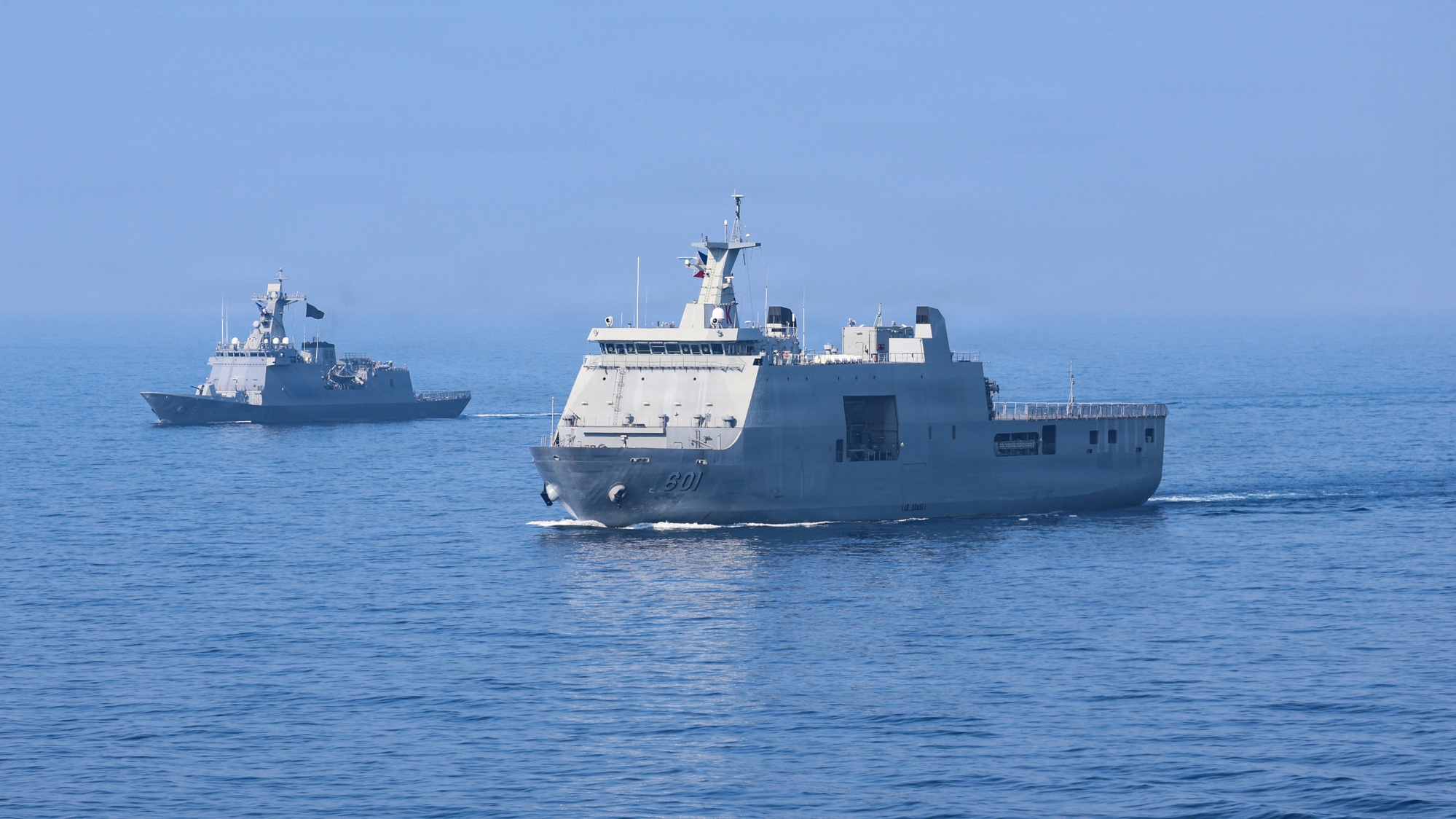
According to the Japanese Ministry of Foreign Affairs, the two leaders decided to begin negotiations for a military information protection agreement to strengthen the foundation of defense cooperation. Jiji/Nippon.com also reported that GSOMIA would enable the sharing of classified information, confirming the early holding of a Foreign and Defense Ministerial 2+2 meeting and the promotion of Japan-U.S.-Philippines cooperation. Reuters summarized that this information-sharing agreement would serve as a condition for advancing the transfer of vessels from Japan to the Philippines.
This sequence is natural. If we were to transfer used Abukuma-class vessels, it would not be as simple as handing over just the hulls. The handling of onboard sensors, communication devices, tactical data links, maintenance documentation, crew training, parts supply, and information related to maritime situational awareness among Japan, the U.S., and the Philippines would be unavoidable. The TC-90 is similar; while it is useful as a low-cost patrol and liaison aircraft, its operational value depends on the speed of information sharing with the Philippine monitoring network and the U.S. military and Self-Defense Forces.
Abukuma-class is Old but Has Its Uses
The Abukuma-class destroyers have a standard displacement of about 2,000 tons and a length of about 109 meters, supporting the Japan Maritime Self-Defense Force's coastal and near-seas missions since the late Cold War. They are not considered new by current JMSDF standards. Their air defense capabilities are also limited, and they are not vessels that can withstand modern anti-ship missile environments on their own.
However, considering the missions of the Philippine Navy, the evaluation is somewhat different. What is required in the South China Sea is not always the most advanced air defense vessels. It involves long-duration surveillance, coordination with law enforcement agencies, maintaining supply lines, and communication capabilities to operate in the same maritime area as U.S.-Philippine forces during crises. If the Abukuma-class vessels are transferred and their communication, identification, and maintenance systems are updated, they could potentially fill the "intermediate maritime presence" that is difficult to cover with just missile boats and coast guard vessels.
However, there are points where exaggeration should be avoided. Simply receiving a few old destroyers will not offset the pressure from the Chinese Navy or Coast Guard. Rather, the challenge for Japan lies in how to ensure operational availability after the transfer. Equipment transfers without parts, docks, and crew training may appear as diplomatic achievements but are unlikely to yield operational results.
Background of Chinese Aircraft Carrier Training in the Pacific
This meeting cannot be explained solely by the abstract "China concerns." According to Jiji, the Chinese Navy's aircraft carrier "Liaoning" conducted flight training with carrier-based fighters and helicopters around May 26, approximately 880 kilometers southwest of Okinotorishima, while JMSDF destroyers were on alert. Similar monitoring activities last December also saw issues with radar illumination from a Chinese J-15 directed at Japan Air Self-Defense Force F-15s.
This fact indicates that cooperation with the Philippines cannot be confined to just the South China Sea. The areas around Okinotorishima, the Luzon Strait, the Bashi Channel, and the northern South China Sea must be viewed as a whole from the perspective of SLOC (Sea Lines of Communication) and the first island chain. JMSDF destroyers monitoring Chinese aircraft carriers in the Pacific while the Philippines maintains awareness of the maritime and airspace around Luzon creates a complex deterrent structure that is more intricate than traditional bilateral alliances if connected by U.S. ISR and communication networks.
Structural Risks for Japan
The joint statement by the Japan-Philippines defense ministers on May 5 treated the RAA's entry into force, the signing of the ACSA, Balikatan 41-26, maritime situational awareness, and equipment and technology cooperation as a single flow. The summit meeting on May 28 politically endorsed that flow. In my view, the focus this time is not on "whether Japan will become a country that sells weapons," but rather "how far Japan will go in sharing operational information with frontline states other than its allies."
This represents a significant change for Japan's defense policy. Equipment transfers are visible and thus easier to discuss in domestic politics. However, as GSOMIA, 2+2, OSA, and ACSA accumulate, the expectations during crises quietly rise. The Philippines will expect more surveillance information, parts, training, and political support from Japan. The U.S. side will likely seek Japan to play a role in supporting the practicalities of a trilateral framework.
The essence of equipment transfer is not the handover of vessels, but the acceptance of responsibilities that include information and maintenance.
What I, Takashi Tanaka, want to emphasize is the need to separate capability and intent in this context. The capabilities of China are progressing towards combining aircraft carrier strike groups, coast guard, maritime militia, and missile forces to exert pressure simultaneously across vast maritime areas. On the other hand, even if Japan's intent lies in deterrence and maintaining order, it can still be interpreted by the other side as strengthening an encirclement. The diplomatic channels to manage this perception gap are still thin compared to the speed of equipment cooperation.
Reference Information
- Japanese Ministry of Foreign Affairs "Japan-Philippines Summit Meeting and Dinner" May 28, 2026
- Japanese Ministry of Defense "Japan–Philippines Defense Ministers’ Joint Press Statement" May 5, 2026
- Jiji Press/Nippon.com "Japan, Philippines to Begin Military Intelligence Pact Talks" May 28, 2026
- Reuters/MarketScreener "Japan, Philippines to discuss information sharing pact to ease arms exports" May 28, 2026
- Jiji Press/Nippon.com "Chinese Flattop Conducts Drills off Remote Tokyo Island" May 27, 2026
To conclude, the Japan-Philippines GSOMIA negotiations are both a technical prerequisite for the transfer of Abukuma-class vessels and evidence that Japan has begun to consider extending its defense to the Philippine Sea in the southwest front. A risk that should not be overlooked is not the age of the vessels, but rather that Japan's political decision-making has not yet adequately articulated the weight of the new responsibilities arising from information sharing and equipment support.
Japan and the Philippines began negotiations on May 28, 2026, for the transfer of Abukuma-class destroyers and TC-90 training aircraft, alongside discussions on a military intelligence protection agreement (GSOMIA). This initiative aims to strengthen defense cooperation amid regional security concerns, particularly related to China's military activities. The effectiveness of the transferred equipment will rely on adequate training and support from Japan.
- Japan and the Philippines are negotiating the transfer of Abukuma-class destroyers and TC-90 training aircraft.
- A military intelligence protection agreement (GSOMIA) is being discussed to facilitate information sharing.
- The discussions are part of a broader effort to enhance defense cooperation between the two nations.
- The transfer of equipment is seen as a response to regional security concerns, particularly regarding China.
- The operational effectiveness of the transferred equipment will depend on training and support from Japan.